
Let’s Be Real About Money, America
And stop pretending we have so much of it
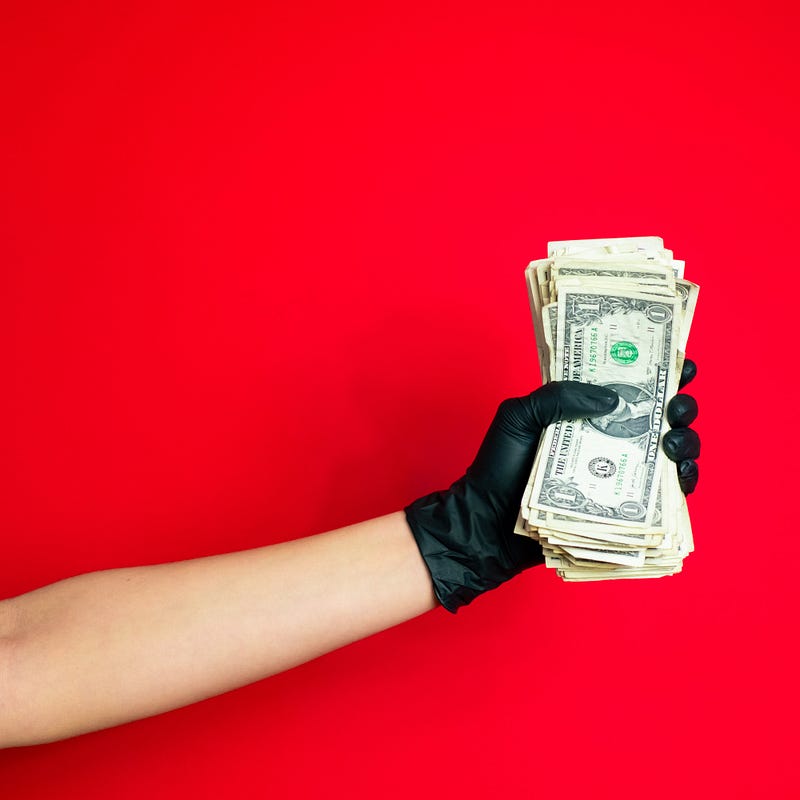
At the bank last week, my Danish husband was told to get a credit card so he could “stop using real money.”
My dear American friend just told me she has forty thousand dollars in credit card debt and she “can’t stop spending.” As is often the case in the U.S., her lifestyle doesn’t fit her income.
It got me thinking that we in the Sates, have a sick relationship with money. Almost a disorder.
But it’s not just the credit card debt.
It’s how we talk or rather don’t talk, about money.
Here are just a few things I noticed. But then, maybe it’s just me who’s bothered.
Hidden school tuition
Every time I look up a graduate program or a preschool for my daughter in the U.S., I have to go digging around for tuition prices. It used to drive me nuts, but I got used to it and didn’t give it another thought.
Until I moved to the UK. There, I noticed that every time I searched for a program of any kind the price was always right there, with the program’s description. Can this be because education is cheaper in the UK? Or because they have a more straightforward relationship with money? Perhaps, both.
Still, literally hiding the enormous costs we’re asked to pay for every kind of education in the U.S., from a child’s music class to a grown-up’s graduate program, is an unhealthy solution.
Let’s put those prices right there at the top of the page, so we can be reminded just how much we’re being ripped off.
Early childhood education prices
Speaking of pre-schools. We reside in Santa Monica, where LA meets the ocean, and a good local pre-school will cost you somewhere between fifteen and twenty-five hundred dollars a month. When my Danish husband found out about the costs of early childhood education in New York and then Los Angeles, he was appalled.
“Doesn’t your government want happy socialized kids and parents who can go back to work easily?” he asked me, as if I knew the answer.
In his home country of Denmark, as in many European countries, early childhood education is not only wonderful but heavily subsidized by the government, so parents pay up to a few hundred dollars a month, depending on their income.
Yet I noticed that no one I ever spoke to about preschools in the U.S. talked about outrageous tuition and how they could afford such an expense on top of their rent or mortgage.
Next time, instead of asking another parent about what preschool their child is going to, I’d like to ask: “How can you afford it?”
Let’s stop acting like anything over five hundred dollars a month is not a lot to pay for a small child’s education and let’s start expecting more from our government.
Doctors’ orders
Let’s forget for a moment that while the rest of the civilized world enjoys free universal healthcare, we’re still paying co-pays on top of monthly payments.
Let’s just think how every time a doctor wants to keep you or your dog overnight “for observation,” the cost of the matter is never mentioned. What about those endless, and some pointless, vaccines and treatments the vets are paddling as if they were free?
Am I the only person who always asks a doctor how much anything is going to cost before I commit to it? They certainly act like I am.
Let’s stop pretending that what a U.S. doctor recommends always serves a purpose. It might just be another rip-off.
Obnoxious Starbucks drinks
The other day, I watched my (American) friend walk into a Starbucks and order an eight-dollar drink as if was completely normal.
I asked her if, perhaps, it was too excessive, and all she could answer was: “But that’s what I want.” What could I say?
How did we get to the point where people think it’s okay to pay eight dollars for a gross sugary drink? It’s not only bad taste but bad money management. Yet I see people happily paying day after day.
Farmers market prices
I go to a local farmer’s market in Santa Monica, because that’s what you do in the U.S. if you don’t want plastic supermarket tomatoes.
I’m not sure what bothers me more there: cheese that costs ten dollars, or the fact that many vendors don’t even list their prices. You would think that at a place where bread costs eight dollars and quail eggs are ten, one might want to know the prices before filling up their bag. But it seems like it’s only me.
When my husband first set foot at the market, he was chuckling.
“I guess if you need to know how much something costs, it means you can’t afford it,” he laughed, referring to the lack of price tags at the farmer’s market and many other places he visited in the U.S.
Yet only once did I hear someone whisper: “Ouch, that’s a lot of money,” referring to “artisan bread.” Thank you!
Unlike my shy husband, I have no problem asking what something costs. And walking away if I can get a better deal. He simply stopped coming.
“It almost seems like bad taste to ask how much anything costs in the U.S.,” my husband noticed.
Am I the only one who’s bothered?
“Trendy” supermarkets & grocery prices
While we’re on the subject of food.
My friend recently told me of a supermarket in our neighborhood called Erewhon.
“It’s for people who don’t want to be shopping with people like us at Trader Joe’s,” she joked.
Yes, supermarkets in the U.S. are a status symbol, too. For regular people, you have your Trader Joe’s. If you’re a bit fancier, you go to Whole Foods. And if you’re very important, you go to a place like Erewhon.
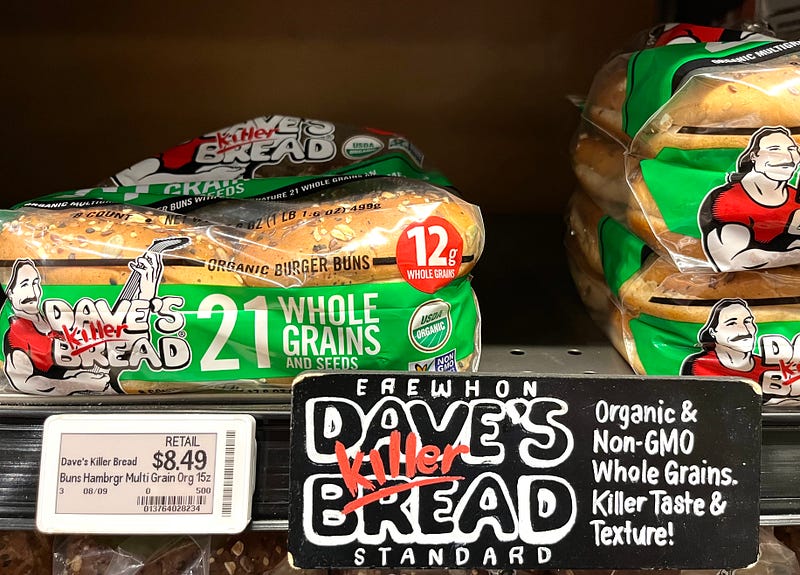
I had to see it for myself, so I went. I wasn’t disappointed. Nine-dollar bread. Thirty-three-dollar-a-pound cheese. Twenty-dollar milk. My husband and I had a laugh at the prices and customers willing to pay, took some photos, and left.
While people in England pay one Pound for a loaf of decent bread, we in the U.S. are happy to shell out nine bucks. We don’t care that the less privileged can’t afford to buy healthy food. As long as the lucky ones can show everyone that they can afford to pay extra. Subsidized food would make them feel too poor, I guess.
My husband often laughs about prices in the U.S.:
“Don’t worry, it’s not too affordable.”
Stay classy (and hungry), America.