
Let me tell you a story
How companies appeal to your emotions

We have always been surrounded by stories: they are our bedtime stories, our favourite books, series and movies and even in our favourite songs. They seem simple at first, but by looking into them, we realise they have masterfully developed techniques that play with our emotions. Brands realised this a long time ago and have been using storytelling techniques in their communication and advertising efforts ever since. By relying on storytelling, brands develop brand personas and brand narratives that allow them to develop long-lasting emotional connections with their costumers, gaining their loyalty and support.
Storytelling is transversal to human life, as we express ourselves through stories, which make it easier for us to recall information while also appealing to our emotions (Kang et al, 2020). The use of stories in order to persuade and to appeal to emotion can be traced back to the Bible and the biblical stories, to Aristotle in Ancient Greece, to the great Roman orators, like Cicero and Quintilian, and even to your favourite candy brand! If one has the patience, it is possible to find immense treatises on how to use speech, stories, and language to persuade people.
Nowadays, this ancient art of telling stories has been adapted to the new media environment and is one of the most essential tools used by advertising and communication professionals. Storytelling is used to increase the emotional power of advertising (Kang, J. A. et al, 2020), promoting identification, empathy and memory (Kent, 2015). It is not very hard to think of an advert which has made us feel like we can do more, or one which felt very familiar or even one that we could not forget about.
Advertisers use many tools to make their messages stick in their consumers’ heads, and storytelling is proven to be one of the most effective ones, is also an effective method to prompt word-of-mouth, which means, making you talk about it with other potential consumers (Kang et al, 2020). Have you never found an advert so interesting or compelling that you felt a need to discuss it with another person? That is one of the goals of advertisers: to make you remember their messages and stories.
Before talking about storytelling in advertising, it is important to understand how it works at its most elemental level, the foundations of this art. In his Poetics, Aristotle (Aristóteles 2008) made one of the first attempts to identify the essential components of a story, he tried to understand what makes a story compelling and interesting. In his book, Aristotle identifies the three main genres as being poetry, narrative and drama, with three main elements, narration, plot and character, these are the basis to theories on storytelling and narrative techniques. One essential aspect of Aristotle’s theory was that all storytelling, comes from mimesis, imitation, recognising that Man finds pleasure in hearing, reading and telling stories that, in a way, reflect his own world and reality, stories He can establish an emotional connection to.
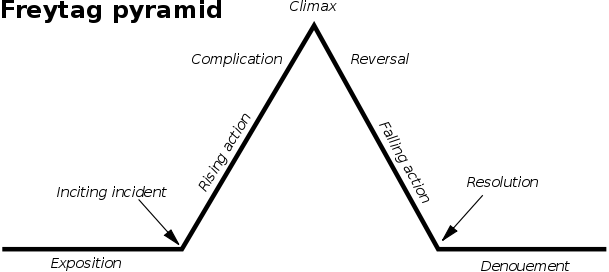
In the 19th century, Freytag, a dramatist, looked at the elements of drama until that point in time and published his Technique of the Drama in which he devised a five-act story structure for dramas, represented by what is now called the Freytag’s Pyramid (Quesenberry, 2019; Monarth, 2014). The five elements of Freytag’s Pyramid are exposition, complication (the rising action), climax (the turning point), reversal (the falling action) and denouement (the outcome) (Quesenberry, 2019; Monarth, 2014).
The characters’ motivations are revealed in the rising action, they interact with each other both through verbal and non-verbal communication, words and body language. The turning point is very self-explanatory, something happens which changes the direction of the action being followed by the falling action, which points towards a resolution, the outcome of the story. (Stern, 1994; Quesenberry, 2019) Besides summing up thousands of years of storytelling tradition, the use of this story structure in advertising has been proven to be effective in advertising (Stern, 1994).
This theory translates, in a simple way, the rising and falling of emotion that we feel when connecting to a story. Do you remember how your heart beats quicker in that point of a movie in which everything condensates and changes, calming down towards the end of the same movie? That is what this theory establishes as a triangle, in which the climax, or turning point, is the high point of the action.
Some authors have argued that logical arguments help in the achievement of best results in advertising (Fishbein and Ajzen, 1975 as in Kang et al, 2020) since they think that humans rely on a rational decision-making process. However, multiple authors have shown that consumer decisions are mostly non-rational, relying on emotions and impulses (Kang et al., 2020). Since we, as humans, have “a narrative understanding of the world” we also think of ourselves as stories (Delgadillo and Escalas, 2004).
Two main elements in the stories we tell each other are chronology and causality (Delgadillo and Escalas, 2004), this means that we organise our stories according to the sequence of events in time and the relations between the several elements of the story. What would happen if you were listening to a story in which the events were all mixed and not organised according to the order in which they happened? Or if suddenly a character appeared that did not have anything to do with the story? You would find the story much less appealing. Due to the way they are organised, narratives make it easier to understand and to memorise information (Delgadillo and Escalas, 2004; Monarth, 2014).
Brands often use storytelling as a way to build their brand image. They make it so that you look at the brand as if you were looking at a person, with its own character and personality. According to Crystal and Herskovitz (2010) “a compelling brand starts with a strong, well-drawn, and quickly recognized persona”. According to these authors, the brand persona establishes the guidelines for the brand message, all branding efforts develop from the persona. The establishment of a brand persona will, in turn, give the company’s narrative a sort of connective tissue in which all stories, actions and communication are in accordance and connected to each other in a logical way.
This consistency makes it easier for people to connect and identify with the brand persona, a crucial process for the development of loyalty, trust and devotion. Crystal and Herskovitz (2010) continue by arguing that this is a process that develops over a long time and that are the result of many well-performed actions that create this prized emotional connection with the customer, built on a level of brand behaviour predictability, which can come to protect the brand from eventual missteps.
Imagine a clothing brand that, for years has established itself as edgy and modern, with good quality products. One day this brand starts selling something completely different: you trusted this brand to provide you with a certain product and they broke your trust by acting in a non-predictable way. However, having a long relationship with the brand, you might be patient and keep supporting the said brand.
In order to make their advertisements and brand stories more compelling towards their consumers, many companies rely on master plots. Kent (2015) identifies twenty master plots that are commonly used to tell stories, these are a quest, adventure, pursuit, rescue, escape, revenge, riddle/mystery, rivalry, underdog, temptation, metamorphosis, transformation, maturation, love, forbidden love, sacrifice, discovery, wretched excess, rise and fall.
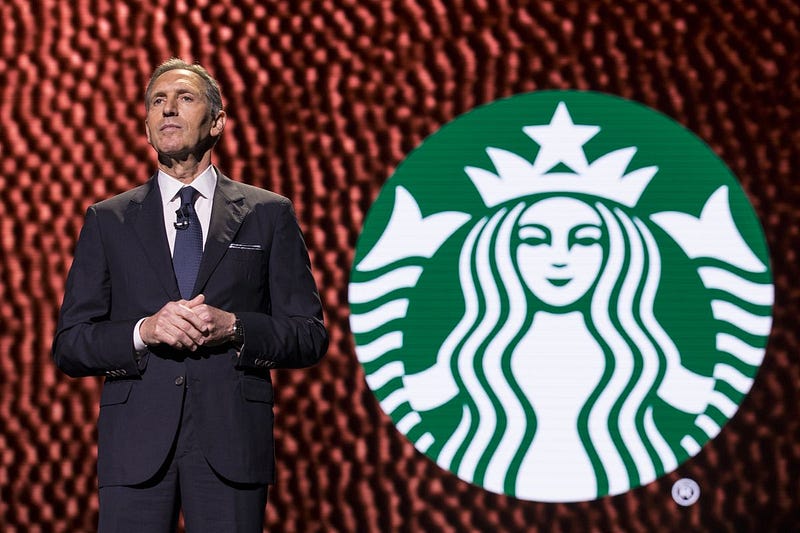
Kent (2015) points to Starbucks’ story about their chairman, president and CEO, Howard Schultz, as a good example of a quest story: Schultz travelled to Italy in 1983 and became enamoured by Italian coffee bars and the barista experience; he wanted to bring this tradition to the United States, so he temporarily left Starbucks to found his own chain of coffeehouses, ending up being able to buy Starbucks in August 1987. You can see the inspirational notes that surround this story about overcoming barriers and making a vision come true. Everyone wants their plans and visions for the future to come true, that’s what makes this master plot so compelling: does not everyone want to be the hero of their own story?
Storytelling has been around for a long time and, also for a long time, it has been used by brands to potentiate their narratives and, in turn, engage with their consumers on a higher level. This art can be seen as an ancient device that has transformed into a modern and sophisticated tool. Authors agree on the fact that the use of storytelling is an essential part of communication and advertising, they also agree that, by telling stories, companies are able to establish long-lasting emotional and loyal connections with their customers. This happens partly due to the fact that humans communicate through stories all throughout their lives, having been conditioned to this form of communication since very early. Another factor that has to do with this is the fact that consumer decisions are often non-rational.
Theories like Freytag’s Pyramid and master plots can help brands to better establish themselves and both their brand personas and brand narratives since they appeal to the consumer’s emotions and potentiate the identification process and loyalty development. Like David Meerman Scott, an author, speaker and marketing and sales strategist once said in an interview “Great communication is about storytelling” (Schulaka, 2015).
References
Aristóteles (2008). Poética (3rd ed.) Ana Maria Valente (trans.). Lisboa: Fundação Calouste Gulbenkian
Chen, K.; Pan, L. (2019) S A Study on the Effect of Storytelling Marketing on Brand Image, Perceived Quality, and Purchase Intention in Ecotourism. Foundation Environmental Protection & Research, 28, pp. 705–712.
Christensen, J. H. (2002). Company branding and company storytelling. Senders and Receivers. New Perspectives on Marketing Communications, Fredriksberg: Samfundslitteratur, 25–58.
Crystal, M.; Herskovitz, S. (2010) The essential brand persona: storytelling and branding. Journal of Business Strategy, 31:3. Pp. 21–28
Delgadillo, Y.; Escalas, J. (2004) Narrative Word-Of-Mouth Communication: Exploring Memory and Attitude Effects of Consumer Storytelling. in NA — Advances in Consumer Research Volume 31, eds. Barbara E. Kahn and Mary Frances Luce, Valdosta, GA: Association for Consumer Research, Pages: 186–192.
du Plessis, C. (2015) Brand Storytelling: the Case of Coca-Cola’s Journey Corporate Website. Communitas, 20, p. 84–103
Freeman, M. (2018). From Sequel to Quasi-Novelization Splinter of the Mind’s Eye and the 1970s Culture of Transmedia Contingency. In Guyness, S.; Hassler-Forest, D. (Eds.), Star Wars and the History of Transmedia Storytelling (pp. 61–72). Retrieved from http://www.jstor.org/stable/j.ctt207g5dd.8
Kang, J. A.; Hong, S.; Hubbard, G.T. (2020) The role of storytelling in advertising: Consumer emotion, narrative engagement level, and word-of-mouth intention. Journal of Consumer Behaviour, 19, pp. 47–56. Source: https://doi.org/10.1002/cb.1793
Kent, M. (2015) The power of storytelling in public relations: Introducing the 20 master plots. Elsevier: Public Relations Review. p. 480–489. Doi: http://dx.doi.org/10.1016/j.pubrev.2015.05.011
Monarth, H. (2014) The Irresistible Power of Storytelling as a Strategic Business Tool. Harvard Business Review. p. 2–5
Papadatos, C. (2006) The art of storytelling: how loyalty marketers can build emotional connections to their brands. Journal of Consumer Marketing, 23:7. Pp. 382–384
Quesenberry, K. (2019) Storytelling, the Bible, and Marketing: An Ancient Framework for Modern Practice. Journal of Biblical Integration in Business, 22:1, pp. 5–17.
Schulaka, C. (2015) David Meerman Scott on Breaking Marketing Rules, Newsjacking, and Authentic Storytelling. Journal of Financial Planning. p. 14–19
Stern, B. (1994) Classical Vignette Television Advertising Dramas: Structural Models, Formal Analysis and Consumer Effects. Journal of Consumer Research, 20:4, pp. 601–615