
Let Fear Win — Writing About Controversial Topics
Be a live ninny or a dead crusader
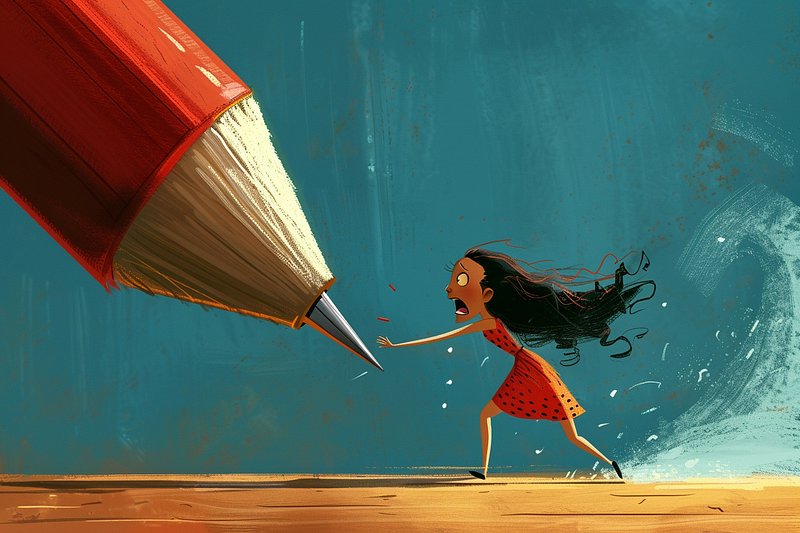
“Write about your passions.” It’s a piece of advice I hear often. But what if your passions will get you into trouble?
One of my passions right now is Christian Nationalism. Specifically, how it’s an intensely lousy thing — for democracy and for, let’s be honest, rational thinking. I’m not a fan.
To be clear, I have no intention of writing about religion in general. I’m not an expert, and my interest is low. I believe that religion is superstition and offers little, beyond certain social benefits. Don’t look to me for deep insight.
My interest is specific. I’m concerned about the danger Christian Nationalism poses to the American way of life—the intersection between religion and public policy. By definition, Christian Nationalists want to impose their thinking onto the rest of us. They want theocratic fascism, and that’s about the least American thing I can think of.
“Okay, great. Get out there and beat the drum,” I hear you saying. But here’s where the trouble enters in: I’m afraid. Which is also about the least American thing I can think of.
I’ve had this impulse before. I’ve set out to write pieces for this platform that I’ve then killed. Why? Again, because I was afraid. I’m not worried about controversy. I’m not concerned about people leaving mean comments. I’m worried about getting shot.
Of course, I know it’s naive and stereotypical but here’s the math I’ve got in my head: “Some people perceive critiques as attacks. Some people react badly to attacks. Many of those people have guns.”
America has plenty of guns. Most of us believe guns are concentrated in certain demographics. There seems to be a high overlap in the Venn diagram of Christian Nationalists and firearm ownership. If Christian Nationalists are a) likely to take offense at criticism and b) have access to guns, the probability of violence increases.
Am I overreacting? Probably. On the other hand, when I told my wife I planned to write about Christian Nationalism, the first words out of her mouth were, “I have safety concerns.” But her worries were more intuitive than concrete. Are there real-world examples of caution being warranted? I can think of one off the top of my head.
In the early 2000s, writer Sam Harris wrote two books about the dangers of religion, The End of Faith and Letter to a Christian Nation. Harris has talked many times about the fallout from those publications. A family man, he had to hire private security to protect himself and his loved ones. He learned Brazilian Jiu-Jitsu. He became a gun owner. Why did he do those things? Because of vigorous and persistent death threats. So much for “turn the other cheek”.

I’ve read The End of Faith and Letter to a Christian Nation. Both are critiques, not attacks — vigorous, well-reasoned critiques, but critiques nonetheless. However, a fear of outsiders and thoughts perceived as undermining are intrinsic to Christianity and religions in general. Protecting the faith is the duty of the faithful.
That’s how you get a small subset of people willing to actualize that protection.
But allow me to put on the brakes and inject some self-knowledge. I’m not Sam Harris. Sam Harris published both of his books traditionally. If I’m not mistaken, they became New York Times bestsellers. Harris’ platform is way, way bigger than mine. Hell, I’ll double down: the likelihood of my anti-Christian Nationalist diatribes getting much traction at all is virtually nil. Look at my stats on this platform. The numbers bear me out. Even considering my limited reach, I can’t help but worry because all it takes is one zealot with a gun to ruin your day — and possibly the day of your family.
What’s my point then? Writing can be scary. You can play it safe or you can take an activist approach and risk pissing off some volatile people. It’s rare but there are examples of writers being killed for their thoughts. Volatile people with limited critical thinking skills (and even more limited senses of humor) are out there.
This article is called “Let Fear Win.” Does that mean I’ve decided not to write about burgeoning theocracies? I don’t know yet. I’ve toyed with not writing about them at all, writing about them anonymously, and diving in with both feet.
The threat of Christian Nationalism needs to be addressed, and I don’t want to offload the responsibility onto someone else. But a looming existential threat is a severe deterrent.


