
Lessons That Need To Be Learned From The Terra’s UST Crash
A Whopping $50 billion meltdown in a matter of 72 hours.
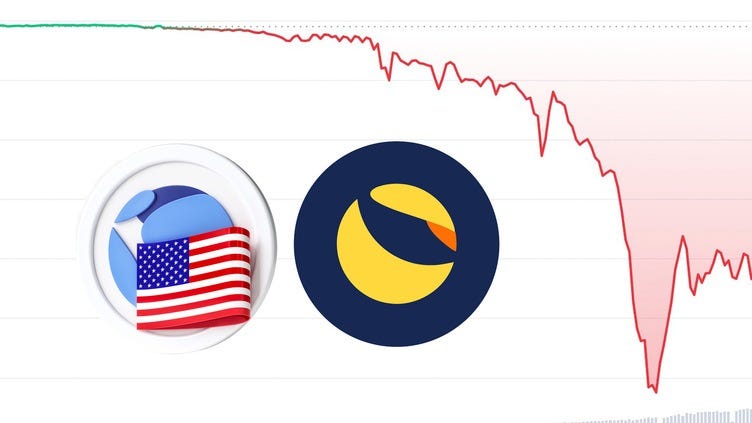
A heartbreaking event that left lots of people broke and massive losses in terms of money and faith. This article is not written to point fingers at anyone but rather to explain what happened and most importantly what can we learn from this event.
Terra explained

Long story short, Terra is a blockchain that focuses on developing stablecoins that are pegged to real-world fiat currencies such as USD, GBP etc… with the UST( USTerra) the most popular one. Instead of using cash to back and maintain the UST’s peg to a dollar, it utilises an algorithmic mint and burns mechanism to help keep 1 UST to 1 USD.
The way it works is this; Terra is built with two coins, Luna which is the token used for staking, governance, and transaction fees on the network and additionally to help the second coin which is UST the stablecoin to keep its peg to a dollar. In order to mint UST, an equivalent amount of Luna needs to be burned and vice versa. For instance, minting 10 UST requires burning $10 worth of Luna. The whole system is based on arbitrageurs burning UST if it is traded below a dollar and minting it if trading above a dollar for profit. This picture describes it better.
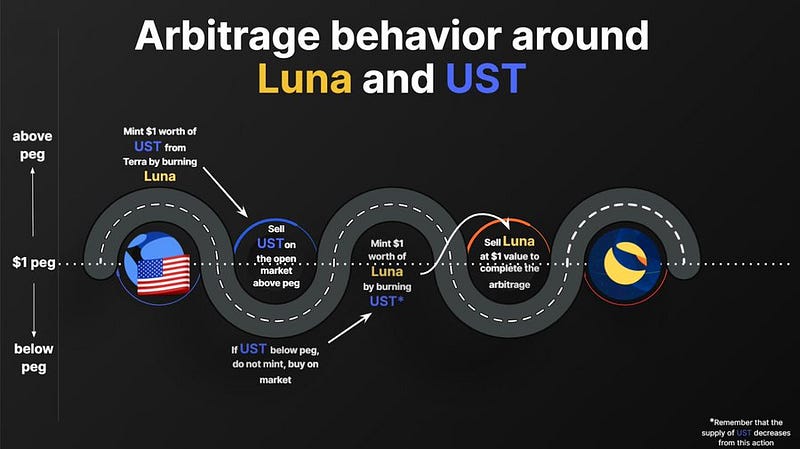
In a nutshell: minting/buying more UST will result burning Luna and Luna will become deflationary. And burning/selling UST will result in minting more Luna and luna will become inflationary.
Learn more about stablecoins
The event of the meltdown

Up to this point, nobody knows the whole story of who caused this meltdown and I do not want to speculate on it here. What we do know however is the way that it is been done because everything can be seen in the blockchain. It all started on the shift from the 3-pool to the 4-pool in Curve. Curve is a decentralised exchange for stable swaps like stablecoins. There is a pool called the UST+3-pool which is made of USDC, USDT, DAI and UST. Recently, a new announcement came to move the UST liquidity from there to the new 4-pool that composes UST, Frax, USDC, and USDT. During this process, a massive whale that happened to have $1 billion UST started to sell off $350m UST into the pool. Since some of the liquidity has been moved to the new 4-pool, the sell-off causes an imbalance in the 3-pool. So UST started to lose the peg due to low liquidity in the pool. This intrigued fear of de-pegging, so people initiated to withdraw UST from Anchor which is a savings protocol in the Terra blockchain to get out of the market.
At first, it wasn’t a massive withdrawal and The Luna Foundation Guard(LFG) who accumulated a large sum of Bitcoin in early march to back UST in case of market volatility, started to sell some of its reserves aka Bitcoin to restore the peg and it was close to doing so. The whale again restarted selling the other $650 m UST this time on Binance. This makes it very hard for the LFG to fully restore the peg. So everyone was panicking to withdraw UST from Anchor and sell on centralised exchanges specifically Binance. This again causes a large de-pegging for UST. Know that this all was happening in a period of market uncertainty. The Fed was raising interest rates and as a result, the stock market and crypto were bleeding. BTC already started to fall combined with the selling pressure coming from LFG to bring UST back to 1 dollar, it fell even more. Luna also on the other side started to fall. Selling pressure is from everywhere. To make matters worse, Binance halted UST withdrawal due to heavy congestion on the Terra network and this is when things started to look pretty ugly.
In a matter of hours, millions of UST have been sold on-chain and that causes more minting for Luna its sister coin. The price of luna started to sink as well and short-sellers came to join the game. Red everywhere. To give an idea of how bad the selling of UST was, the Binance order book was completely emptied
At this point withdrawal from Anchor was skyrocketing and massive selling from everywhere. An absolute death spiral for UST and Luna.
UST had fallen as low as $0.30 and at the time of writing it is trading around $0.09 while luna is pretty dead. A massive wipeout for the terra ecosystem and the crypto space. Luna and UST three days earlier combined had a market cap of over $50 billion. Today, it is less than 10 billion.
The takeaways from it

Big lessons need to be learned from this and the most obvious ones are;
There is “no too big to fail” in crypto.
No matter how big the ecosystem is, a sudden shake can wipe everything out in a matter of days. Luna has more than 100 applications built on top and still going to zero.
Complexity is bad.
Without a doubt, the mechanism of UST and Luna is not that easy to grasp. And the more complex it is, the bigger the vulnerability. That can clearly be seen here. It is been beaten on its own game.
VCs backing can't save you
According to data from Messari, Terra has the biggest VCs in the space, the likes of (Coinbase Ventures, Galaxy Digital, etc…) and even recently secure a massive round of funds to build its reserves. All those VCs today are helpless.
The mechanism just doesn’t work
This algorithmic mint and burn stablecoin has been tried so many times and failed. What makes Terra different is that none of those was actually a layer 1 blockchain designed specifically for Stablecoins and Terra just end up like them. So the takeaway here is that unless something else is added to this mechanism, its success is only on theory. Terra was trying to add an outside reserve BTC but unfortunately, it didn’t come to life.
Don’t go all into anything
This is sadly a lesson we learn all the time. There are lots of people posting on Reddit that they put their life savings into the Terra ecosystem. Some even borrow lots of money to get a higher yield from Anchor. There are also some who put their friends and family’s savings into this which is the last thing you should do. As much as community matters, never go all in, never tell anyone to go in without explaining the risks.
Final words
Billions have been lost here and most of it is from retail investors. It is a devastating experience to witness these horrible events. At this point, blaming won’t help. What is done is done and all we can do now is learn from it and sympathise with those who lost their entire fortune in this meltdown. My thoughts are with you.
Thanks for Reading!