
‘Lessons in Chemistry’ by Bonnie Garmus Is a Lesson in How the Publishing Industry Thinks
Yes, that cover is terrible — that’s on purpose
Lessons in Chemistry has garnered the kinds of controversy common to break-out fiction — from reader backlash against the book’s “preachy” atheism to questions about whether the Apple+ series does the book justice.
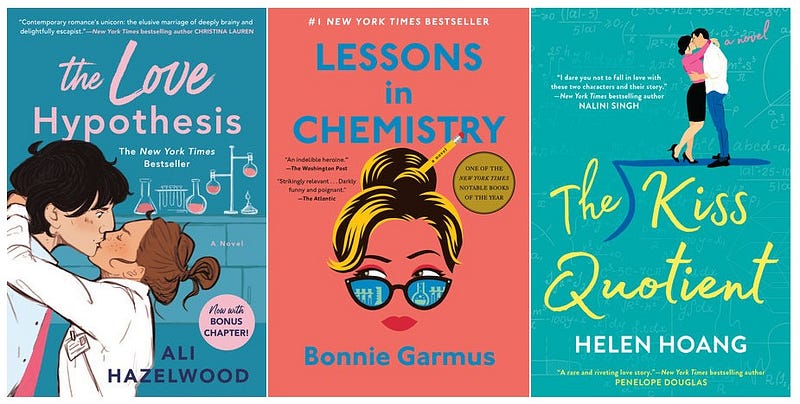
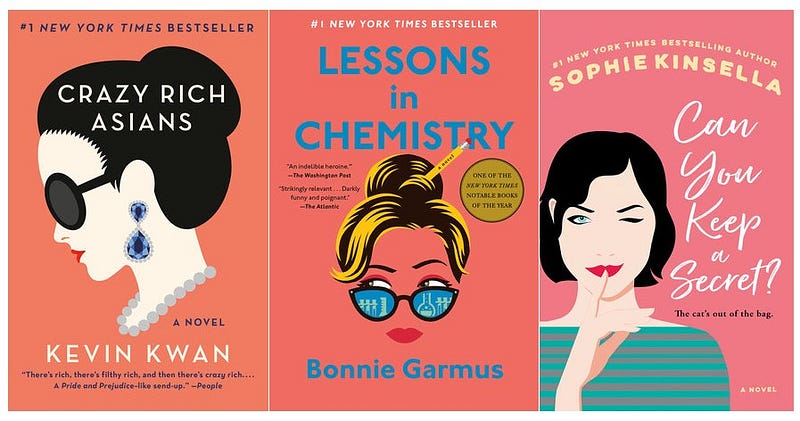
But nothing seems to get readers up in arms quite as much as the book’s original US cover.
“Am I the only one who was furious about the pink chick-lit, rom-com cover on this book? It belittles the book in exactly the same way Elizabeth Zott is belittled!” complained Lisa Wright, a bookseller and active reader, in a Goodreads post.
She’s definitely not the only one.
I’ve heard from both regular readers and book reviewers that they initially thought Lessons in Chemistry was a romance novel, perhaps along the lines of The Love Hypothesis or The Kiss Quotient. There’s chemistry right there in the title after all. And the brightly colored cover has the illustration style currently popular with light-hearted contemporary romances.
But Garmus’s book is not a romance — or even anything that would be typically shelved as “women’s fiction.” It’s a novel about Elizabeth Zott, a woman in 1960s America who is kept from her dream job of being a chemist. So she turns her skills to hosting a cooking show, teaching women all across America lessons in chemistry and empowerment.
The no-nonsense Zott would probably hate the frothy cover as much she hated the chintzy décor of her cooking show’s set.
And the author herself sympathizes with the cover-haters. Responding to the Goodreads comment, Garmus explained, “All I can say is, the publisher did let me have input and I told them I thought it looked like chick-lit (nothing against chick-lit but this book isn’t that). Still, publishers have a lot of experience knowing what an audience will respond to and they thought this was the best way.” She liked the UK and German designs and hoped the US cover would change for the paperback.
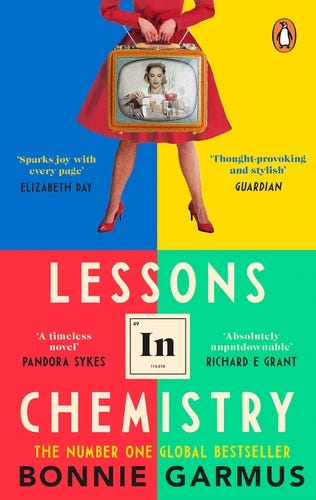
If readers and the author (and probably the fictional main character) so dislike the cover, how could the publisher make such a mistake?
Because it’s not a mistake.
I’ve heard it argued that acquisitions editors at large publishing houses are not looking “for the next big thing” but to repeat “the last big thing.” Books are a risky business. And publishers diminish their risk when they tap into already popular markets.
At the end of last year, I wrote about how the genre of Romantasy is taking over the Goodreads Choice Awards — to the detriment of other genres. I think the Lessons in Chemistry cover further illustrates publishers’ desire to ride the money-making wave of Romance and BookTok. Romance is a larger market than either Historical Fiction or General Fiction — genres readers shelve Lessons in Chemistry under on Goodreads.
But why risk losing a book’s intended readership and alienating the readers who picked up the book by mistake?
I can only speculate. But on my own Goodreads feed, I notice that romance readers tend to be among the most voracious readers and the most likely to leave positive reviews. This is only anecdotal evidence, but I see my theory confirmed when comparing individual books.
Looking at R.F. Kuang’s Yellowface (winner of the 2023 Goodreads Choice Award for Fiction with 200,722 votes) and Emily Henry’s Happy Place (winner of the 2023 Goodreads Choice Award for Romance with 157,687 votes), I notice some stark contrasts. Although the novels were published less than a month apart and Kuang’s novel received more votes, Yellowface garnered 502,766 ratings and 68,401 reviews, while Happy Place got 888,164 ratings and 106,631 reviews.
For Happy Place, that’s a 77% increase in ratings and a 56% increase in reviews over Yellowface. Both books are heavily discussed by readers. Both authors are “winning” in their respective genres. But Henry’s readers seem more likely to share their thoughts online.
This trend of increased reader engagement also appears in Amazon ratings for, and TikTok videos about, the two books. And while engagement doesn’t always equal sales, Yellowface is ranked at #130,787 in Amazon’s book sales while Happy Place is at #88.
Comparing the Goodreads reviews and ratings numbers for the next four books with the highest votes in the 2023 Romance and Fiction categories shows (mostly) similar engagement trends.
I think romance readers read faster and share more than other readers. And if a publisher wants to create early buzz about a book, perhaps they want to catch the collective eye of these vocal readers?
Some reviewers were definitely upset about the bait-and-switch from cover to text. In the early pages of the novel, there is sexual assault scene — which is belied by the bright and quirky cover. Also, blurbs and quoted reviews keep mentioning the “humor” of the book, but it is more wryly bitter than laugh-out-loud funny.
Many, understandably, did not appreciate Penguin Random House springing such dark subject matter on them. But other readers, though startled, were not disappointed by the book they ended up with. And many of the ones who were . . . still left reviews. Not all press is good press. But differing opinions can push curious readers to pick up a title.
Of course, some readers are missing out on a book they would enjoy because they don’t know what genre Lessons in Chemistry falls under.
But here’s the part where I have to admit something: I didn’t like Lessons in Chemistry. I should have been the target demographic: I love female protagonists, historical fiction, smart and slightly insufferable characters, new ways to look at cooking, and really, the whole concept behind Lessons in Chemistry.
But genres have expectations. And so do individual readers. Some of my dissatisfaction is specific to my personal tastes. But some of it based on what I expect from certain genres. As a general and literary fiction lover, I wanted Lessons in Chemistry to have more subtlety. As a historical fiction lover, I felt it was missing a complex understanding of the time it depicted. (As others have noted, Elizabeth Zott comes across as a modern woman who has been transported back to the 1960s.)
So perhaps the perceived demographic is not always the right demographic.
Genre is more nebulous than we like to admit. In a fascinating deep-dive into the market, the authors of “Genre Juggernaut: Measuring Romance” found that what readers classify as “romance” is often several different genres, sometimes combined: historical, fantasy, young adult, LGBTQIA+, paranormal, suspense, etc. — “a veritable genre ecosystem in its own right.”
So while many non-romance readers loved Lessons in Chemistry, I suspect many more romance readers were already primed to enjoy it.
Lessons in Chemistry contains elements that romance readers are already familiar with: female-centered narratives, characters you are clearly expected to root for or against, a fast-paced reading experience, and a tidy happy ending. That last bit is especially important.
Romance Writers of America states that the two elements of their genre are romance at the heart of the story and “an emotionally satisfying and optimistic ending.” This is also referred to a HEA (Happily Ever After), or at least, a HFN (Happily For Now). If a book does not contain this, romance reviewers insist that it should be shelved as something else. (Do not bring up Colleen Hoover books to this crowd. You will be sorry.)
Romances are, at their core, wish-fulfillment. (I write this without judgment as someone who reads superhero comics.) And ultimately, Lessons in Chemistry is more feminist wish-fulfillment fiction than it is historical or even general fiction.
When readers in my book club were asked what they liked about Lessons in Chemistry, one of the most cited elements was the happy ending. They felt angry for Zott, and ultimately, vindicated by her story. They didn’t care about realism. They cared about the way the story made them feel. And that may not be Romance, but it is very Romance-adjacent.
I went into Lessons in Chemistry already knowing that it was more serious than the cover suggested, so I had expectations for how the real-world elements of the story would be handled. I was unsatisfied.
But readers in my book club who thought (or even feared) it would be “chick lit” enjoyed Lessons in Chemistry a lot more. And I suspect that many other readers who were expecting something light were happy to find a novel that acknowledged the darker issues women deal with — while still having an ultimately triumphant heroine.
This might be life imitating art: the viewers who thought they were tuning in to a simple cooking show got something more than a good lasagna recipe. Maybe Zott would begrudgingly approve?
What lessons can be pulled from this strangely successful cover “debacle”? Well, if you are a traditionally published writer, you won’t have much control over your book cover. And even if you did, I would never recommend deliberately misrepresenting your work to readers.
However, it might be wise to consider readers who seem to fall outside of your target demographic — especially if they are part of a highly engaged readership. What’s “the vibe” of your book, not just the genre? What do early readers tell you they feel after reading it? And which other demographic of readers wants to feel this specific way? Understanding other genres is going to get you much further in book marketing than looking down on them.
And if you are a reader, my advice is a little more cynical: Remember that publishers don’t always care if you like a book. They care if you buy it and talk about it. “Don’t judge a book by its cover” goes both ways. You might love something that looks well outside your comfort zone, and you might hate something that publishers are desperate to convince you is perfect for your shelf.
I believe in supporting authors. But I also believe in budgeting my time and money. Reading early reviews from honest reviewers helps me decide whether a book might be my cup of tea.
Of course, that didn’t help me with Lessons in Chemistry. But I feel less regret about disliking a library book than one I spent money on. Libraries are a great way to support authors while being mindful of your wallet. It’s also easier to “test drive” borrowed books and quit them if they don’t fit your reading wants. So go ahead: check out some unlikely candidates. You might surprise yourself.
Despite the less than altruistic nature of publishing, authors and readers are on the same team. Writers want to find their life-long readers. And readers want to find writers who create stories they love. It’s the perfect formula.
And hopefully, a well-designed cover can be the catalyst — not the inhibitor — to this relationship.


