
Lessons I Learnt from “Rich Dad Poor Dad”
Unleashing the wealthy mindset
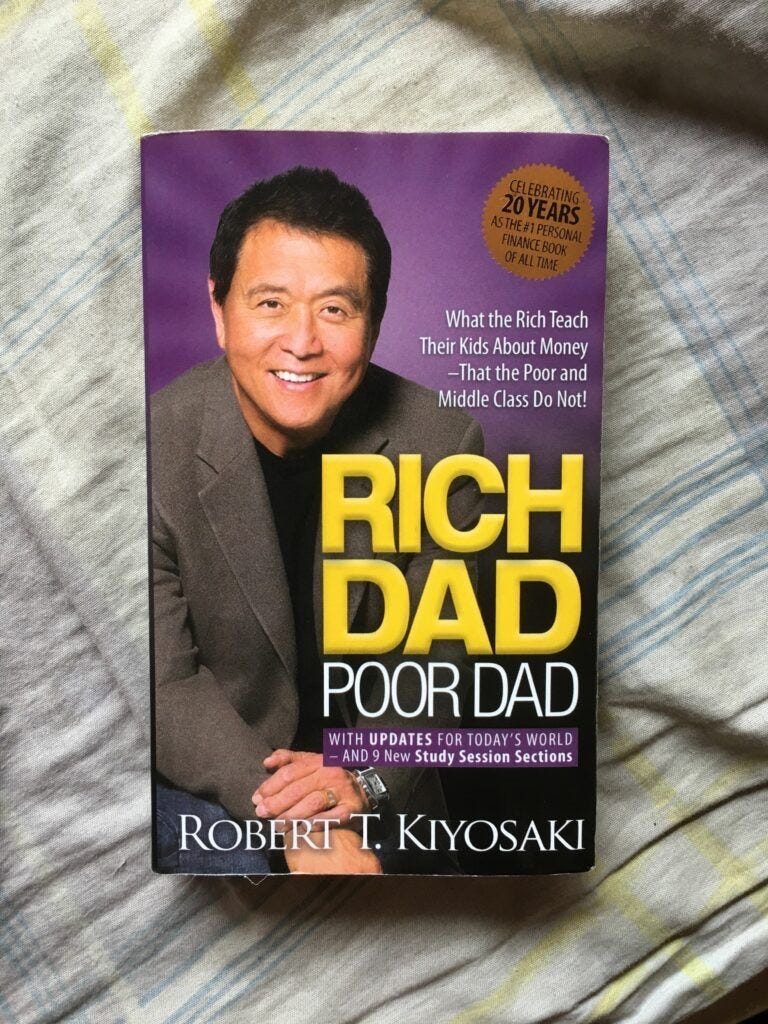
I’ve always considered myself financially savvy — or at least, that’s what I thought until I stumbled upon Robert Kiyosaki’s “Rich Dad Poor Dad.”
Little did I know that this book would be a game-changer, shaking the very foundation of my beliefs about money and success.
Kiyosaki’s unconventional approach to financial education isn’t just about crunching numbers or navigating the stock market; it’s a mindset shift.
As I dove into the pages of his book, I found myself on a rollercoaster of realizations, questioning the very principles I had held dear for so long.

Let’s start with the obvious: the rich don’t work for money.
Seems counterintuitive, right?
We’re taught from a young age that success is directly proportional to the number of hours we put into our jobs.
But Kiyosaki’s “Rich Dad” challenges this notion, asserting that the wealthy focus on making their money work for them.
This revelation hit home as I reflected on my own life.
I had been caught in the rat race, exchanging time for a paycheck.
Kiyosaki’s words echoed in my mind: “The poor and the middle-class work for money. The rich have money work for them.”
It was time to rethink my strategy.
The concept of assets versus liabilities was another eye-opener.
Kiyosaki emphasizes the importance of acquiring income-generating assets rather than liabilities that drain our resources.
As I scrutinized my financial portfolio, I realized I had fallen into the trap of accumulating liabilities masked as assets — a flashy car, a mortgaged house, and other depreciating possessions.
“An asset puts money in your pocket. A liability takes money out of your pocket,” Kiyosaki writes.
Armed with this newfound wisdom, I began to reassess my spending habits, aiming to shift the balance in favor of assets that would contribute to my financial growth.
The dichotomy between the mindsets of my “Rich Dad” and “Poor Dad” became glaringly apparent.
My “Poor Dad” had always advocated for job security, a steady paycheck, and climbing the corporate ladder.
While these principles are not inherently wrong, Kiyosaki argues that they can be limiting if they stifle the pursuit of financial independence.
In contrast, my “Rich Dad” encouraged entrepreneurial thinking, investment, and risk-taking.
He believed in creating opportunities rather than waiting for them.
This clash of perspectives ignited a mental tug-of-war within me.
Should I play it safe, stick to the traditional path, or embrace the uncertainty of entrepreneurship?
Kiyosaki’s emphasis on financial education as the key to success provided clarity.
It wasn’t just about having a fancy degree or a stable job; it was about understanding how money works and using that knowledge to make informed decisions.
Inspired, I started devouring books on investing, attending financial seminars, and soaking up as much knowledge as I could to build a solid financial foundation.

The importance of taking calculated risks was another crucial lesson from “Rich Dad Poor Dad.”
Kiyosaki emphasizes the need to step outside one’s comfort zone to embrace the unknown in pursuing financial freedom.
This resonated with me as I reflected on missed opportunities and the fear that had held me back.
My “Rich Dad” taught me that mistakes are not failures but learning experiences.
Instead of fearing failure, the wealthy embrace it as an inevitable part of the journey.
This mindset shift empowered me to view setbacks as stepping stones toward success, prompting me to take calculated risks that had the potential for substantial rewards.
The concept of working to learn, not to earn, was a mantra that reverberated through the pages of Kiyosaki’s book.
While traditional education often prioritizes grades and degrees, the wealthy focus on acquiring skills and knowledge that can be applied in the real world.
This perspective reshaped my approach to career development.
Instead of fixating on job titles and salaries, I started seeking opportunities that would allow me to acquire valuable skills and knowledge.
This shift not only made me a more versatile and valuable professional but also opened doors to new avenues for income generation.
Kiyosaki’s distinction between assets and income streams struck a chord with me.
While my “Poor Dad” had taught me to save money and rely on a single income stream, my “Rich Dad” advocated for building multiple income streams.
This not only provides financial security but also accelerates wealth accumulation.
I embarked on the journey of diversifying my income streams, exploring investment opportunities, starting a side hustle, and venturing into passive income avenues.
This diversification not only provided a safety net in times of economic uncertainty but also exponentially increased my earning potential.
The importance of financial discipline was a recurring theme in “Rich Dad Poor Dad.” Kiyosaki emphasizes the significance of controlling one’s impulses and delaying gratification for long-term gain.
This lesson prompted me to reassess my spending habits, distinguish between needs and wants, and adopt a more intentional approach to financial management.
As I began implementing these principles into my life, the transformation wasn’t just financial — it permeated every aspect of my existence.
The shift in mindset from a passive consumer to an active wealth builder, was profound.
I found myself questioning societal norms and challenging the status quo.
“Rich Dad Poor Dad” wasn’t just a book; it was a catalyst for change.
It nudged me out of my comfort zone, urging me to explore uncharted territories and challenge my preconceived notions about success.
The wealth of knowledge embedded in its pages became a blueprint for building a life of financial independence and abundance.
The journey inspired by “Rich Dad Poor Dad” is ongoing.
The lessons learned are not mere anecdotes but guiding principles that continue to shape my financial decisions and mindset.
Kiyosaki’s words serve as a constant reminder that wealth is not just about money; it’s a mindset — an approach to life that prioritizes financial education, strategic thinking, and the courage to embrace the unconventional.
So, here I am, navigating the unpredictable waters of entrepreneurship, investment, and financial education, armed with the lessons from my “Rich Dad.” The path ahead is uncertain, but the knowledge gained from “Rich Dad Poor Dad” has become my compass, steering me toward a future of financial prosperity and abundance.
Hey there, amazing readers!
Your support and love for my writing mean the world to me. If you’ve been enjoying my stories and articles, how about taking our connection to the next level?
Join me on Buy Me a Coffee and buy me a coffee (or two). Your support keeps my creativity fueled, and together we’ll continue this incredible adventure! Just click here: https://bmc.link/askaleax8
Thank you for being awesome!