
Lessons From History Most People Are Neglecting
Through literature, studies and physical remnants, we can still see the effects of World War 2. It is crucial we learn from them.
Stop and think for a minute.
How mental has this year been so far? It is only March.
COVID-19 has sent the world mad, with reports of mass confusion and panic as people buy excessive amounts of essential items such as toilet roll. It is frustrating to witness greed on such a mass scale. Amazingly, I even saw a video on Twitter of a lady attempting to rip a pack of toilet roll from an elderly woman, despite having plenty in her trolley anyway.
It makes me wonder, have we learned nothing?
Amongst all the chaos a certain anniversary has slipped under the radar.
2020 marks the 75th year since the end of World War Two.
More specifically, January 27th marked the 75th anniversary of the liberation of Auschwitz. For most of the survivors, this is the last landmark they will be able to commemorate. As a result, it is our responsibility to keep their memory alive.
Conflict
Self-preservation is deep-rooted in all of us. For example, when you fall over, you instinctively put your arms out in front of you to cushion the fall — an albeit small form of self-preservation. In 1950, the concept was put to the test in the ‘Prisoner’s Dilemma’ (Tucker).
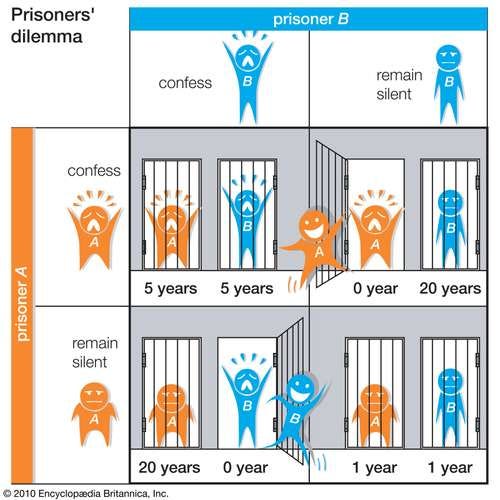
As this diagram shows, the study pitted two thieves against one another. The prosecutor told them that should they both confess, they will get more lenient sentences of five years. Alternatively, if A confesses and B does not, A will be set free while B will serve the longest time possible, and vice versa. The trick comes within the final scenario. If both stay silent, they only get one year.
The results show that even with the opportunity for an early release should they stay loyal to one another, both confess. It is clear then; self-preservation is buried deep within our psyche and exhibited in all walks of life.
This is in part, where global panic is coming from.
As I mentioned earlier, people seem to be at odds with each other. Reports of people hoarding hand sanitizer, some even selling for profit.
The selfish nature of our society doesn’t stop there. The biggest issue is unknowingly passing on the virus to other, more vulnerable people.
As the ‘Prisoner’s Dilemma’ highlights, our self-preservation leads to our self-destruction.
Times such as these should bring humanity together, as it did following the liberation of Auschwitz. We must continually remind ourselves of the worst to ensure it never happens again. The most extreme will destroy others in pursuit of their goals, no matter the cost.
Hitler sought the self-preservation of the Aryan race and attempted to systematically destroy an entire people to do so.
Of course, people fighting over toilet roll pales in comparison to the persecution of the Jews and other ethnic minorities. That would be absurd. Rather, it is important to remember just how far some people are willing to go to get what they want.
The individualistic nature we are seeing in people at the moment is becoming a collective view. Be kind. It may well just go a long way.
Memory
The survivors of the Nazi’s ‘Final Solution’ suffering should not have been in vain.
It is true that for many years after the war, people did not wish to speak of what happened. Many were afraid of speaking out in fear of persecution, with thousands of Jews fleeing to Israel and America.
Trials were quashed by anti-semitism within Allied governments; the prevalence of self-preservation taking center stage.
However, in the decades that followed, people began to discuss the atrocity.
Survivors began writing about it. To put everything into perspective, I recommend books such as Night by Elie Wiesel and This Way For The Gas, Ladies, and Gentlemen by Tadeusz Borowski. Books such as these tend to blur fact and fiction, continually walking the tightrope of believability. It is so hard to fathom, it doesn’t seem real.
Life, at the moment, appears to be heading down that route. Society is heading into largely unknown territory with countries locking down all over the world.
If, as experts predict, the coronavirus hits its second peak later on in the year, we must recognize our mistakes now to combat it better. More on that shortly.
Children must be taught about the atrocity long into the future. It must be a marker for humankind. Not necessarily the Holocaust either. Future generations must be aware of the all too real barbarity inflicted upon people, so we can look back and see how far we have moved forward.
To Move Forward, We Must Look Back
It sounds cliche, but it is true.
Despite having written a dissertation on the subject, the Holocaust remains an enigma to me. It is so incomprehensible it almost hurts my brain trying to figure it out. But that is my privilege.
I don’t need to figure it out. I, like the rest of us, need to learn from it.
As future generations grow up and past generations die, society’s connection to our history grows weaker and weaker. Only through teaching can it remain.
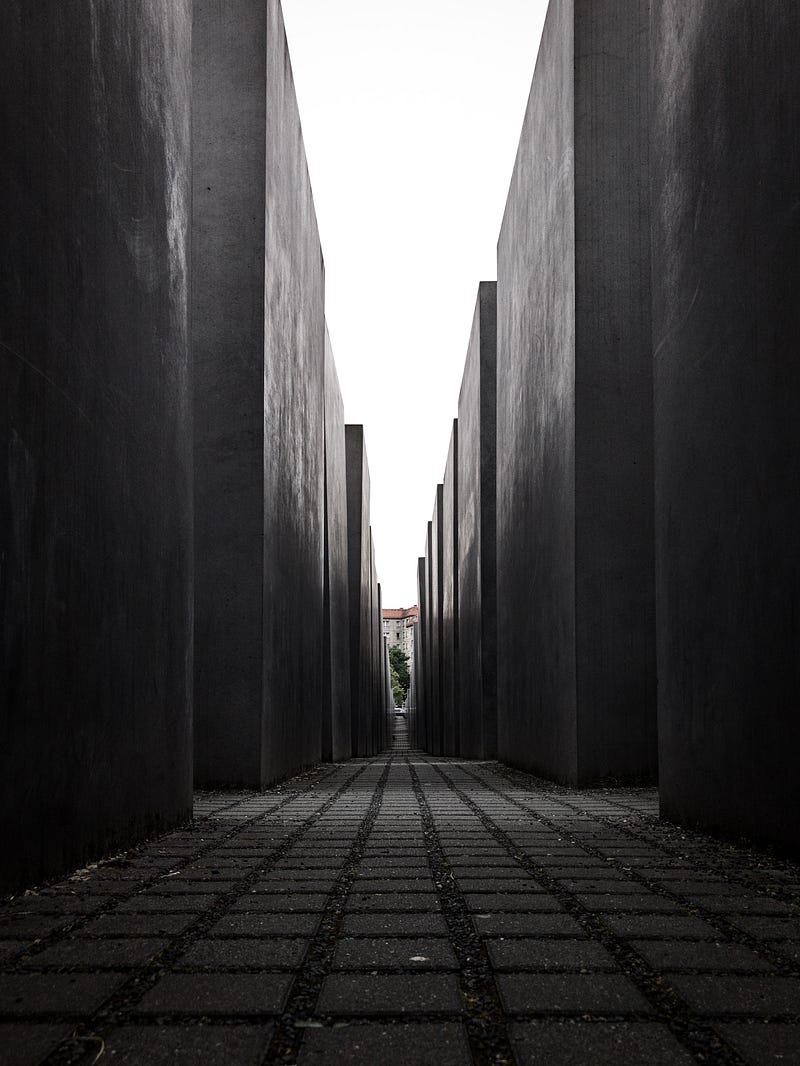
When studying the module at university, I poured over numerous texts from survivors and second-generation authors (more on that later). One that stuck out to me was a documentary named Shoah.
It initially stuck out to me because of its length; a whopping 8 hours. 8 hours of survivor testimony through the form of interviews. No recreations, no waxed lyricism. It is a raw piece of film making, quite unlike anything I have watched. You can check it out here.
How it’s filmed speaks volumes of the Shoah’s (the name the Jewish community gives the Holocaust) incomprehensibility of the Shoah. At times, I felt uncomfortable, watching these men and women struggle to keep their emotions back.
The eyes never lie.
We do not need to understand; we can’t. We need to bear witness, and I can’t think of a better time than the 75th anniversary.
Be Aware
The lockdowns are providing a lot of people with time. As the pandemic has sped up, our lives have slowed down, thus paving the way for a time of reflection.
In the years to come, our memory of this pandemic will serve to evaluate how we function as a society. We must learn, always.
One of the most notable things to come to the fore recently is social distancing. There are a large number of particularly young people who seem to think that because they won’t die from COVID-19, they needn’t worry. I admit, a few weeks ago I was one of those people.
However, it is the more vulnerable we should be looking out for. Working in retail, I come into contact with the elderly every day. It has made me realize just how easy it is to pass on a virus such as this. It is not going away any time soon. For more information on social distancing, click here.
Once again, I would like to take a lesson from history here.
I was certainly not aware of the vast ramifications of the Holocaust. Unlike most, I had the chance to study it. Now, as it is the 75th anniversary, it is time people made themselves aware.
As I mentioned earlier, families fled Europe by the thousands, as the horrors of the war led to them, understandably, fearing for their lives.
Knowing this provides a valuable lesson. Yes, a circumstance may not affect you. Hell, I had this same outlook not so long ago. But, just because it does not, that doesn’t mean it won’t affect other people. The world will change after this experience just as it did following Auschwitz’s liberation.
Hopefully, that will be for the best. At the moment, however, let us focus on being aware. Now more than ever, we must be conscious of our surroundings.
For a second, I would like to contradict myself. Self-preservation can indeed contribute to our demise. However, by making ourselves aware of our surroundings and upkeeping your wellbeing you are acknowledging others around you.
It doesn’t take much but goes a long way.
My Visit to Auschwitz
In April of last year, I visited Krakow.
As my dissertation was based around the Holocaust, I was certain that we would visit. A four-hour tour should do it.
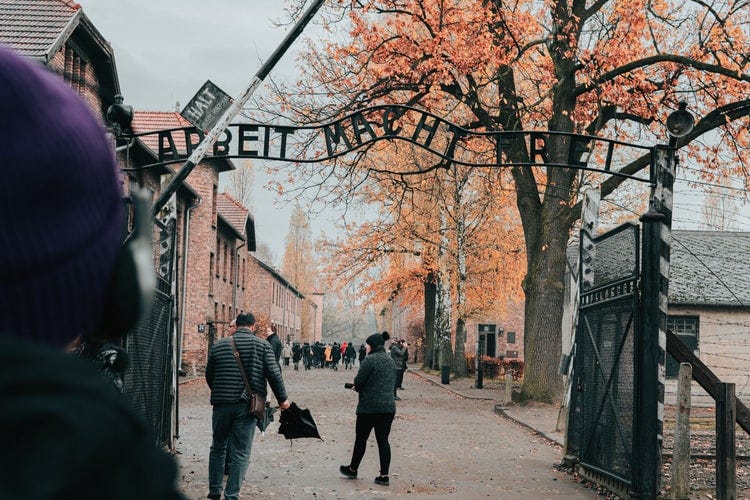
Firstly, we were taken around the barracks of Auschwitz 1. To get into the camp, you walk under the infamous ‘work sets you free’ archway (left). It is an inhumane level of cruelty and feels like something out of a film — designed to make you cry.
Next, some of the old buildings had been converted into museums. They contained large piles of hair, glasses, shoes, and suitcases of the camp’s victims. It wants you to remember what happened to them. As I said earlier, you can’t even begin to fathom it, let alone understand it.
You are forced to reflect on time beyond your imagination. But, why? Well, it is so we can move forward.
Moving forward, we were taken through to the gas chambers. The organizers ask for no talking in here and you can see why. Or rather, hear. The silence is eerie. Standing in the middle of a place full of such death and destruction is a strange feeling. Some are crying, and some refuse to even go in. I, on the other hand, felt myself getting lost within the walls. How many thousands of people lost their lives within these walls? Their spirits seem to linger in the walls — an uncomfortable place to be.
They have kept everything in order so people from around the world can bear witness. Just to be able to do that is a privilege in itself.
You may ask, what is the point in writing all of this?
This is the base of hundreds of thousands of memoirs, poems, books, and journals. It is a rare physical remnant of the atrocity that gives these texts the ability to live on decades after our connection to them dissipates.
Even though most survivors are dead now, they live on. It is a timely reminder that life is finite.
It’s Not All Doom and Gloom
2020 is a year of reflection. The start of a new decade, yet we are looking back.
In doing so, there are positives. Seeing the last remaining survivors of the Holocaust celebrate its memorial allows the world to see the very best of humanity. In times such as these, that is just what we need.
Such a momentous year also enables the world to uncover the countless stories from this period, outrageous in their humanity. It indirectly mirrors the inhumanity; incomprehensible and unfathomable.
Stories as simple as a Sonderkommando recording critical documentation of Nazi crimes upon threat of death, or a Polish man infiltrating Auschwitz to bring prisoners news and keeping them going.
Note to self: rewatch Schindler’s list.
Uplifting stories are blossoming in Europe as well. In our super-connected society, videos are popping up all over social media of rooftop gym classes, Italian communities singing as one and shopping hours for front-line health workers and the elderly.
Dolphins have been seen swimming in Venice. Who would have thought that a global pandemic would bring dolphins to a now clear-water Venician canal?
To Conclude
2020 is certainly going to be a year for the history books. In the years to come, perhaps we will reflect on what is happening now. Even better, we learn from it. Society must continually analyze its mistakes to move forward.
And it doesn’t get worse than the Holocaust.
There are always lessons we can take from the past. For me, we are better off together than not.
Be aware, be kind.
In the rush of panic buying, lockdowns and fright, it would pay dividends for us to slow down. To take a look at the humanity seen throughout the world and find some solace that we are in this together. Of course, you must take care of your own health. Doing so will be that much easier if we make ourselves aware of the collective struggle ahead.