Lessons A White Woman is Learning
How color has entered my white, white world.
I’m Emily. A 40 year old Australian, single mother, student and freelancer. But let’s dive deeper.
My great, great, great grandparents and every succeeding generation of my family has come from England, Ireland, Scotland or Wales. I’m a third generation Australian white woman.
I was brought up in a British school system throughout my elementary school years, where we learned about Guy Fawkes, the Ancient Romans and the Kings and Queens of England. I lived in Brunei at the time (Negara Brunei Darussalam, a tiny, oil-rich nation in South East Asia). I attended the Brunei International School. Each Thursday after morning tea break, we had our language lesson. The brown-skinned kids went to Malay. The white and Asian kids went to French.
I didn’t question it.
I lived in a housing compound surrounded by other expat families, mostly British, Australian, Chinese or Indian. All my closest friends were as white as me.
I didn’t question that, either.
When I was eleven, I moved back to Australia and joined the secondary school system. That was the year I was introduced to the subject of Aboriginal Australians.
Aboriginal Australians, I was told by my textbook and my teacher, were primitive, near-Neanderthals who wore nothing at all, couldn’t make fire, ate what they could glean from the bushes and hunted with primitive wooden sticks. There were very few of them, and most if not all died out after the white men came.
There was no mention of why this was so.
I learned nothing more about the 60,000-plus years-long history of Australia before 1788 (the year the British came to invade) in the rest of my formal schooling. At some point in the next ten years, I absorbed the lesson that the Tasmanian Aborigines (I lived in Tasmania) had become extinct. Like the dinosaurs. And that it was very sad. And we shouldn’t talk about it.
I traveled to Austria when I was 20, to study German as part of my degree. Whilst there, I was asked about the Aborigines. Were they badly treated? Were they in the same boat as the American Indians (the term Native American had yet to reach full traction), with reserves they had to live on and betrayals of trust, etc.? What was the situation like for Australians?
‘I don’t know,’ I replied. ‘It’s tricky’.
Those are the exact words I used. It’s tricky.
This is how I described the nameless gloom, almost-guilt, confusion and ignorance that was my legacy as a young Australian white woman on the cusp of the new millennium. I had no other words to use. I felt the weight of my white compatriots pressing on my vocal chords. We don’t talk about that. It’s sad, but it’s in the past. Aborigines today? Who knows? Who cares? They live outback, they’re not really here. It’s their land, but they’re ghosts upon it. It’s tricky.
I spent the next 15 years building my career, planning and then starting my family, traveling the world. I was open to everything, or so I thought. I got on well with everyone everywhere. I made best friends of Japanese people, English people, American people. I heard and saw and noted things in the world I had never learned about at school. But I was still me, with all the possibility and limitation that entailed.
In 2000, Australia hosted the Olympic Games. It was thrilling. We all felt so patriotic. We cheered our swim team as gods. Then, Cathy Freeman won the gold medal in the women’s 400m running race. She was a favorite, she even lit the torch in the Opening Ceremony. And she was Aboriginal. The first Aboriginal I remember ever seeing on TV. When she rounded the field on her victory lap, she draped both the Aboriginal and official Australian flags over her shoulders. In fact, she did the same thing when she won the same race in the Commonwealth Games six years earlier. And boy, she was criticized for it.
How dare she sully our glorious sports with her politics?
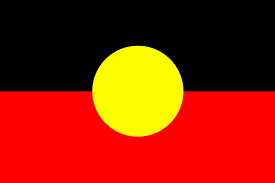
It was the first time I had ever properly noticed the Aboriginal flag. It’s a brilliant flag.
Throughout the early years of the new millennium, the Aboriginals and Torres Strait Islanders began to swim into my view. I was living in Australia again. I heard about famous Aboriginal Australian sportsmen and women. The people below are first identified as belonging to the People or tribes they belong to within the Aboriginal Australian family.
- Nova Peris-Kneebone (now Nova Peris), a Kiga, Yawuru and Muran woman and member of the gold medal winning hockey team in the 1996 Olympics. Then, in 2013, she became the first Aboriginal woman to be elected to federal parliament as a Senator.
- Anthony Mundine, a Bundjalung man and professional boxer. He has twice held the WBA super-middleweight title, once the WBA interim super-welterweight title, as well as the IBO middleweight title once. Before he became a boxer, he enjoyed a great career as a gifted rugby league player.
- Lionel Rose, a Gunditjmara man and professional boxer. He was the first Aboriginal boxer to ever win a professional world title: the world bantamweight tile of 1968. Lionel was Australian of the Year in 1968, and appointed a Member of the Order of the British Empire (MBE) in the same year. He was also a successful singer. This at a time when some of White Australia’s cruelest policies were causing untold harm to Aboriginal families and individuals.
- Evonne Goolangong (later Goolagong-Cawley), a Wiradjuri woman and professional tennis player. She won 86 singles titles including multiple grand slam titles, also during a time of shocking abuse towards her people by their government. She was was inducted into the Sport Australia Hall of Fame in 1985 and the International Tennis Hall of Fame in 1988.
There are so, so many more. The Australian Rules Football League, or AFL, has welcomed Aboriginal players for decades, one of few options for young Aboriginal men to find serious success in mainstream Australia.
Perhaps I shouldn’t have used the word ‘welcomed’. Sydney Swans player and former Australian of the Year Adam Goodes may have something to say about that. But he was just the most visible and outspoken of many players who have experienced systematic, institution-condoned, crowd-powered racism in the game of games.
During the years to 2008 I became aware of other Aboriginal and Torres Straight people — a whole segment of society I had previously been blind to were suddenly popping out of the woodwork. Or were they? Perhaps I was just no longer as oblivious to their presence. Because, despite Australian government policy designed to ensure it and media efforts to make it true by words alone, our First Australians were not a ‘dying race’. They had never gone and were not about to be forgotten. From the moment the first white invaders arrived to colonize owned land in 1788 until today, Aboriginal Australians have fought, died, negotiated, protested, petitioned and stood up for their rights.
And I knew nothing about it.
But that’s not entirely true, is it? Why would I feel that deep, nameless guilt if there wasn’t something to be guilty about — even secondhand? I had never knowingly oppressed an Aboriginal Australian.
But acknowledgement of my privilege and my place in the fight to bring equality to the First Australians was many years into my future.
I traveled to Alice Springs and went to see Uluru, known then still as Ayers Rock, after a white governor, the Chief Secretary of South Australia in 1873. In Alice Springs I saw the most Aboriginal people in the flesh that I had ever seen. They seemed at a loose end, waiting around on the streets, doing little. I wondered and felt sad. I listened to an Aboriginal tour guide talking about how the Aboriginal people you saw in towns were usually ones who had been forcibly removed from their tribal communities for crimes such as murder or rape. Interesting, I thought. But what about the ones in major cities like Sydney and Melbourne? Are they criminals too? Do they truly want to be back in their tribal communities? Are there even communities for them to go back to?
I had still not yet heard of the Stolen Generations, the massacres, the slavery, the systematic removal or refusal of rights, almost the whole of modern Aboriginal history. As for ancient Aboriginal history — what was that? Surely there wasn’t anything to know.
I still did not truly understand that there were many, many nations, or tribes, of Aboriginal people, with different customs, ways of living and livelihoods, all of whom had been drummed off their ancestral lands, torn from their rightful pursuits, all of whom were living lives their ancestors had never dreamed of for them. It was impossible to put them all in a single box and say you knew, you understood. No more could you claim to understand the nuances of European nations without years of study.
But I was finally ready to learn and listen. Around this time I began to seek out Aboriginal stories on TV and in films. Later, I began to seek written stories. I discovered the Aboriginal presenters and shows on SBS, Australia’s Special Broadcasting Service designed to give a voice and representation in the media to non-white, non-British-derived Australians. Funny that all the other TV stations didn’t feel it was in their remit to do this. But there you are. Not funny, actually.
There was a brilliant movie based on a classic book with a true story at its heart, Rabbit-Proof Fence. I began to learn about the Stolen Generations when ‘white enough’ Aboriginal children were forcibly removed from their families and raised in missions to be domestic servants for the whites. Many were told that their families were dead or didn’t want them. They were punished for speaking their own languages and few found peace either in the white or the black worlds. Many victims remain alive and in pain today.
I began to listen to Christine Anu, a Torres Strait woman and brilliant singer, singing about her life with optimism and joy. There was more to Aboriginals than despair. There was hope. I heard again the powerful words of Aboriginal musicians like Yothu Yindi and Archie Roach and really listened. There was grief and anger and determination. I began to learn about Aboriginal history, and found out what Mabo was (or rather who), and why the town my grandmother was born in was called Mathinna, and that the ancient Aboriginal carvings in the rocks at my local beach were not relics of a forgotten people but treasured souvenirs of a living, vibrant community. There was more to history in my own place than I had ever imagined.
Briefly, Eddie Mabo was a Torres Strait Islander man who campaigned for Aboriginal land rights and was instrumental in the successful fight for the High Court to overturn the concept of ‘terra nullius’ (empty land) which the white Australian government had used as their excuse to steal the land and deny it to its rightful owners. Thanks to Mabo and other campaigners, some Aboriginal traditional owners have had some of their lands returned. And Mathinna was the daughter of a Tasmanian Aboriginal chief who was taken in by Lady Jane Franklin, wife of the then governor of Tasmania, Sir John Franklin, after she was stolen from her Port Davey or Lowreenne people. Dressed in shoes and European clothes, they treated her by turns as a pet and a daughter before returning to England and abandoning her in an orphanage with a notorious reputation. Her short life deteriorated rapidly and ended in tragedy when she was only 17 years old.
I was discovering and growing — growing in knowledge, yes, but also in shock, disappointment, frustration and worry — what was my place in all this?
In 2008, I got a job at Rio Tinto — the very same mining company who just weeks ago blew up a 46,000 year old Aboriginal site, containing artifacts shown only recently to be utterly unique and extraordinarily significant in the jigsaw puzzle of archaeological record. It was in the way of a new iron ore mine, and the Western Australian government signed off on its destruction despite efforts by archaeologists and native Australian groups to stop it. The destruction was legal. And it cannot be taken back, no matter how the executive apologizes.
The company has always made a big show of their close relationship with local Aboriginal groups and leaders, and their support of employing local Aboriginals.
All they had to do was not blow it up. They knew about the findings. But they did. And another piece of Aboriginal Australia’s precious past died as the explosives did their job.
While I worked at Rio Tinto, I traveled all around the remote West of Australia. I met many people from many cultures, and I found myself asking more and more questions.
But here is where I ran into my first personal hurdle — cultural misunderstandings.
I don’t know where to place blame, or if there is any to place. I must take some responsibility simply for being myself, a white ignorant white collar woman. But I think I was not entirely at fault. Our department offered Aboriginal Cultural Awareness courses, to help us oblivious white folk get to know some of the cultural contexts that might affect our work with our Aboriginal colleagues. I jumped at the chance. I wanted to know everything. I wrote copious notes. And when the presenter asked for questions, I had my hand up.
He had told us that young Aboriginal women (remember this was Western Australian outback tribes. Nothing I say here may be at all relevant to other Aboriginal tribes) felt pressured by their peers to have children as early as possible — it was a cultural expectation. And so I wanted to know, if there are young Aboriginal women working on the mine sites, are they likely to experience this kind of subtle peer pressure if they focus on their career before having children.
The presenter glared at me. ‘It’s a cultural thing,’ he said.
Yes, I replied. But are you saying that it might be more difficult for them to develop their career because of this? Would we need to watch out for subtle bullying?
He was almost apoplectic. ‘Don’t question our culture,’ he said. I subsided, none the wiser.
I asked another question later on and received the same shut-down response. I couldn’t seem to make the presenter understand that I wanted to be the best supervisor I could be, the best mentor. I wanted to understand, not to judge. I wouldn’t have minded whatever the answers were, but I felt slammed for simply asking. Perhaps he was answering and I wasn’t hearing. I just don’t know. I can’t identify what I did wrong to bring about such a profound failure of communication in a forum that was all about educating me. Me, me, me. Maybe that was my problem?
It was a setback. I felt snubbed. I felt hurt. My white privilege wanted to be salved. How dare they tell us they need to be understood and then refuse to communicate in a way that worked for us?
I’m still working my way through the tangles of these feelings, over ten years later.
But I’m a linguist and communicator by trade. I am determined that if such an opportunity arises again, I will do better. But I confess, that experience has also made me wary to ask my questions. I have them, but I keep them to myself. I try to glean answers through others’ interactions. It’s not a great way to learn.
In the last five years, Aboriginal Australia has suffered setbacks and welcomed new voices to the fight. I follow many of them on Twitter and am often challenged to think anew about things I had never considered before. I have discovered that the Tasmanian Aboriginal people, or Palawa, still exist. Their descendants have gone to amazing efforts to keep alive old traditions, rediscover lost lore, including lost language, and preserve and protect important sites and locations. Still, few Tasmanians would know much about our first peoples. There is a great deal more to do in this space, to make people aware of the wonderful heritage we have stomped all over.
I love history. And until two years ago, I still bought into the myth, perpetuated by the last 200 years of history, willfully promoted by all levels of government, commentators, historians and media, and widely believed still by modern Australians, that the Australian Aboriginal people as a whole were totally primitive, near-Neanderthals.
The movie, Manganinnie, about a Tasmanian Aboriginal woman who loses her family and takes in a little white girl, was hailed at the time of its release as a carefully researched, historically-accurate story about Tasmanian Aboriginal culture and lifestyle. I watched it in the 1980s and it contributed to my belief in Aboriginal primitiveness. The main character carried a lit torch with her wherever she went, from which to start the evening’s fire. When the little girl accidentally drops the torch into the water, the poor woman spends the entire night awake, staring into the evil dark, screaming out protective words to ward off the spirits that would come and engulf them both without the light of the fire.
The fact that anyone believed for a minute that this inability to make fire was likely, in a place where snow fell and people skinned animals for clothing, is embarrassing. It shows the utter contempt of the native by the invader.
That textbook I mentioned at the beginning of this article, with naked tribespeople eating berries and relying on lightning strikes and bush fires for their fires? It was still the prevailing image in my mind, and in the mind of white Australia.
And then I read Dark Emu.
If you want to read a true history of Australia, this is the book to read. Quoting from numerous, open source documents from the earliest days of white invasion, Bruce Pascoe shows us who the Aboriginal Australians really were, and how the myth spread by institutional Australia was so easily taken up and perpetuated by its late arrivals.
The earliest white explorers encountered civilization in the most remote interiors and from coast to coast. Large tribes or nations, divided into settlements and cultivating the land — agriculture! Sacrilege. Fields and fields of grain, harvested, ground into flour and baked — millennia before bread was first thought to have been invented in the Middle East. Large, permanent fish traps, still in place today, thought by some to be the oldest permanent structure made by humans. Terraced fields of grains, hand-plowed fields of yams. Storage sheds overflowing with food, a land protected, husbanded, and fertile enough to feed everyone on it with more to spare. No fences, but farmlands nonetheless. No destructive bush fires — fires were controlled and used with deliberate precision for fertilizing and reseeding. Shrubs and trees were carefully tended to, to ensure good feeding and shelter for the wild kangaroos and wallabies who were kept as food stocks. No drought. No floods.
Hardly sounds Australian at all!
When the settlers arrived in the lands these explorers documented, all of this bounty had disappeared. Why?
Because the settlers did not follow on the heels of the explorers. They sent their cattle and sheep ahead of them. And that’s where everything went wrong. Cattle have hard hooves that are completely unsuited to Australia’s old, dry and brittle earth. Where they went, destruction followed. The land compacted, rain couldn’t penetrate, so it ran off and away, causing drought in one place and flooding in others. The cattle got into the fields without fences. The settlers cut down trees that served multiple purposes and ignored the delicate balance that kept the land cooler, more fertile and protected from out-of-control fires. There are accounts of Aboriginal people trying to hold white settlers to account for this destruction and being utterly destroyed for it.
The emptiness of Australia’s outback is a construct — we did that. The lost, placeless, purposeless native people we still so despise — we did that, too. We purposely destroyed the oldest continuous culture on earth, denied doing it as we held the weapons, and then derided them for their despair.
That destruction continues today.
Aboriginal Australian deaths in custody are rife. Police patrol streets with large Aboriginal populations to find people with unregistered cars or unpaid fines, and the ‘culprits’ are thrown into prison. Parents are dragged off to prison with no provision made for the dependent children left at home, sometimes leading to tragic consequences. The linked news item happened yesterday. People like me say, ‘It’s simple. Don’t break the law and you won’t be in trouble.’ But people like me don’t see patrol cars on our streets, just looking for the chance to find us guilty of something. Don’t tell me you’ve never been late to pay a fine or fix a brake light. If you’re white, you can shout cheeky or downright rude words at police and they will tell you to calm down and de-escalate. If you’re Aboriginal Australian, this happens. That one was last week.
When George Floyd couldn’t breathe, Aboriginal Australians remembered when David Dungay Jr said those exact words back in 2015, as he was killed — murdered? — in prison by people who should have been taking care of him. Of course, there were no convictions, not even any disciplinary action. There was video. But no one in white Australia even noticed. The media were oblivious, even when one of their own reported on it, in passing.
Why has it taken a US situation to make Australia sit up and take notice? We’ve been influenced by US culture forever. Our children play make believe games in American accents, reflecting the TV shows they watch. This I know from watching my own children and my friends’ children play.
Frankly, I don’t care why it has worked. But I do care that it has worked. Suddenly, we are aware. My people are being forced to acknowledge our people, the harm of whites and the hurt of blacks, in a way we have never bothered to do before, at least to such an extent. In the last two or three years, books like Jess Hill’s See What You Made Me Do with its chapter on domestic violence in Aboriginal Australia, books by Aboriginal commentator Stan Grant, TV shows like ABC’s Total Control and outspoken victims and warriors like Adam Goodes have built the fuel into a bonfire which #BLM has now ignited. Well before the events of the last month, in Total Control, a short series about an Aboriginal woman who is invited into the Australian Senate only to be betrayed and controlled by the politicians-so-white she encounters, the Prime Minister tells her to pull her head in and not speak out about yet another betrayal of Aboriginal rights, saying, ‘the last thing we need right now is a Black Lives Matter moment.’
I would beg to differ. The only thing we need right now is a Black Lives Matter moment. We have it. Now let’s see if we can extend it from a moment to an era. Let’s see if my kids can grow up in knowledge not ignorance, in alliance not opposition, in equality not superiority with their kids. Let’s see if we can learn to say our kids and mean it.
That would be the point when we were truly one as a nation.
Thanks for reading. You might also like these:


