
Lesson #1 from cracking the 2nd toughest exam in the world- “Learn to fall in love with the process”
We talk a lot about loving the process but never about how to love the process
On March 15th this year, I shared my story of cracking the 2nd toughest exam in the world — IIT-JEE.
I shared 10 lessons that I learned through my journey of preparing and finally clearing the exam. Here is the link to the original post in case you also want to read that story:
My story of cracking the 2nd toughest exam in the world
In this post, I will be expanding on lesson 1: “Learn to fall in love with the process”
You would have read, heard, and watched a gazillion times about the significance of focusing on the process, but how many of us have consciously taken steps to teach ourselves to love the process?
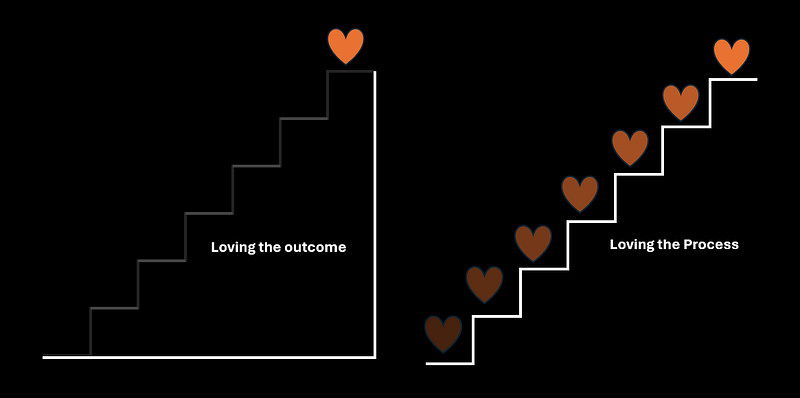
What is falling in love with the process?
Loving the process is about enjoying the day-to-day activities involved in the journey of achieving your goal. It’s about not running out of motivation en route to your mission because you love the process itself and not just the goal.
Why is it important to learn to love the process
1. Because loving the process is not always natural
Just saying “love the process” isn’t going to automatically motivate you to enjoy your day-to-day work.
It is true that sometimes, love for the process comes naturally.
For example, when I was preparing for my engineering entrance exam, I loved solving physics problems. I could sit with a problem for 6 hrs straight to find a solution. Eventually, I got very good at physics, and it didn’t feel like any effort to me despite spending hours with it. I had not put any conscious effort to love physics. It came naturally.
However, for most goals, the process almost always has at least some elements that might not pique your interest naturally. And in that case, you would be better off learning to love the process.
I wish someone could teach me this 15 years back. I could have done better in chemistry in the entrance exam. I hated chemistry.
And yes, I totally believe that if someone taught me how I could love the process, I could have fooled myself into at least hating chemistry lesser if not loving it.
2. Statistically, it would be stupid to be just focused on the goal
For any goal in life, the time spent in the process is disproportionately high compared to the time spent on the outcome. The outcome would just be a moment, or a short duration of time and it will pass quickly, and soon you will be on another journey to achieve your next goal,
so…
When you are going to spend the majority of your life’s time in the process, doesn’t it make sense to teach yourself to love the process?
Read the above line again. The fun must be in “the now”.
3. Happier more often
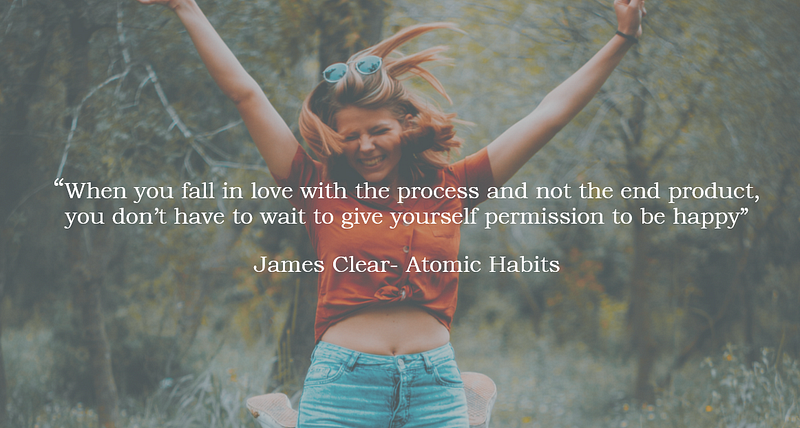
When you are enjoying ‘the now’ every day, you make yourself quite free of the expectations of achieving the target. This takes away a lot of burden off your shoulders and allows you to be in the moment which further leads to providing you more chances to be happy every day.
4. Lesser regrets
When you have already fallen in love with the journey of putting in that effort, regardless of the outcome, you will not lose any moment of life worrying about the end goal. You would consciously live every day in the journey. And that means, no regrets.
How to fall in love with the process
I use these 2 ways to fool my mind into loving the process:
1. Create and acknowledge short-term rewards
There needs to be short-term rewards in the process itself for you to love it. These are short-term happy moments that you get from the small progressive steps toward the goal.
Example:
I am in my early thirties with a demanding day job, a side hustle, and a family to manage. Last year, I gave myself a target to revive my badminton game and become the best badminton player in my city in 1 year and for that, I knew I would have to beat players aged around 20.
So, I allocated some extra hours beyond my regular responsibilities for training to cut down some extra weight and increase my strength & agility to stand a chance against the younger players.
It’s been 6 months now.
I am still mostly losing to the top player, and it demotivates me at that moment, but what keeps me going is the small side rewards and the incremental improvements in my game.
Some short-term rewards on the side: My stamina has improved. I have become fitter. I am more active. I have more self-belief that I can beat that top player. I am happier.
Incremental improvement: 6 months back, in a set of 3 games, I used to lose all 3 with a high margin in score (21–15). Now, I win 1 out of 3 and the score difference is also getting thinner when I lose (21–19).
2. Seeing the day-to-day grind as the development of fungible skills
Companies, all over the world, hire people with as little as 10% match of candidates’ previous work profile to the ones the company is offering.
Why? Fungible skills
Viewing your daily activities for a goal as a tool for the development of fungible skills and not just as a means to an end helps you see the larger impact of your grind and creates deeper and long-lasting motivation.
My preparation for the toughest engineering entrance exam has developed my problem-solving skills, analytical ability, resilience, and much more. And these skills have helped me succeed in fields beyond Engineering.
Call-to-Action
If you are free for the next 10–15 minutes, you can get started on this small routine that I try to follow:
Let’s say you want to become a popular writer on Medium, become a successful YouTuber, get fitter, clear a competitive exam, or start a business/startup. Whatever your goal is: Do the following:
- Think about the potential reasons to love the process of achieving your goal.
- The reasons should be detached from the goal. For example, my goal for writing on Medium is to create an audience, however, my reasons for loving the process of writing on Medium are improving my writing skills, becoming a clearer thinker, understanding SEO, etc.
- Create short-term targets. It could be writing 10 articles in a month or even smaller, 3 articles a week, or going to the gym for the next 3 days.
- Write down your reasons and short-term targets on a piece of paper or your computer. You should have it somewhere you can see and monitor regularly.
- Internalize the reasons by reiterating them in your mind. Monitor the progress against short-term targets. You can choose the frequency of monitoring.
- If you feel lost or fail in your short-term targets, revisit your reasons and the targets and modify accordingly.
- If you succeed, first pat yourself on the back. Then analyze what’s working and what can you modify/add to make it better.
- Immerse yourself in the present with periodic monitoring against the end goal.
Note: Falling in love with the process doesn’t mean forgetting the end goal. Many times when you are in a tough phase of your process and you are thinking of giving up, the end goal can provide you the motivation for that extra push. However, the end goal can be in the background, the focus must be on the process.