
Leno
A weave and a talk show host who didn’t need one
Today’s New York Times Spelling Bee letters:
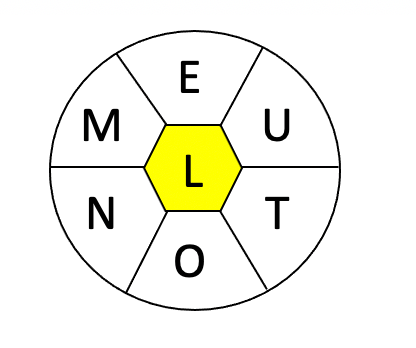
E, M, N, O, T, U, and center L (all words must include L).
Merriam-Webster says…
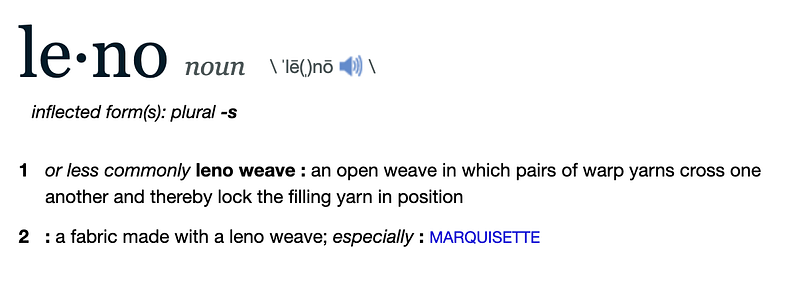
Silly little dictionary! Don’t you know leno can’t possibly be a word if the New York Times says it ain’t?
For further fascinating facts, check out the Spelling Bee Master.
What’s your favorite dord* from today’s puzzle?
My Two Cents
According to my calculations, I will probably start making thousands of dollars a month on Medium in June… of 2187. Until then, I’ll continue working my regular job as a translator and editor.
Every translator has their area of expertise, as well as some subject matters they’d rather not touch with a three-meter pole. (That’s ten feet; we use meters here in Spain.) My strong suits are science and math, language arts, and history. I’m not that great with tech, and I avoid financial and legal translations whenever possible.
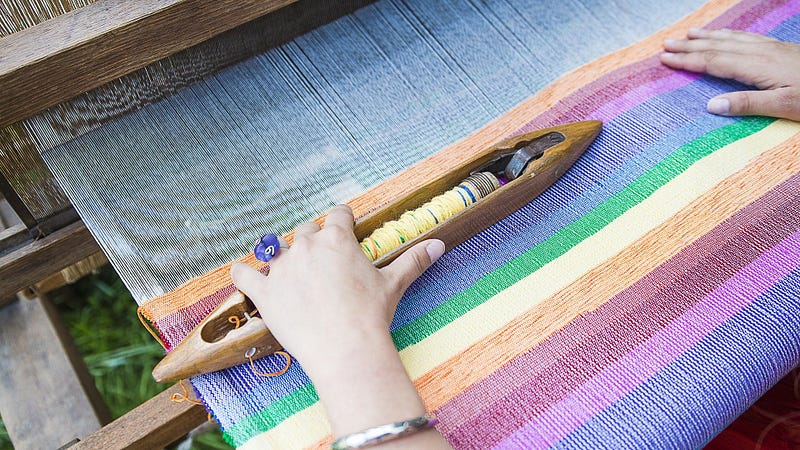
A few years ago I had to translate material related to the clothing industry from Spanish. It was both painful and interesting, as I learned a bunch of terms (in both languages) that I wasn’t even aware existed. A lot of them had to do with weaving.
Warp speed ahead
In order to talk about leno the weave, we should first clarify some industry terms:
▹ Warp: a series of yarns extended lengthwise in a loom, under tension. One warp thread is called an end.
▹ Weft: a lateral filling thread or yarn. One weft thread is called a pick.
▹ Loom: device used to interlace two sets of threads
▹ Reed: a part of the loom that resembles a comb. It separates the warp to guide the shuttle across the loom and push the weft threads into place.
▹ Shuttle: tool that carries the weft yarn
Weaving can be done by the hand with no additional tools, but larger projects typically use a shuttle or other device. Industrial weaving has automated practically every step, but mechanical hand weaving is still a traditional practice in many cultures.
When you weave, you entwine the moving weft through the stationary warp at right angles. This is done by repeating three steps, known as the “primary motions of the loom”.
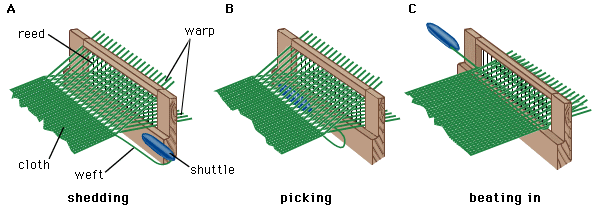
- Shedding: separation is created amongst the warp threads to create room for the pick (the weft thread to be woven). This is done with the reed.
- Picking: the pick is thrust across the loom with the shuttle.
- Beating-up (or in, or battening): the weft is pushed up against the rest of the material that is being woven. This is also done with the reed.
That’s it. Now you know how to weave! All you need to do is buy some threads, set up your loom, and repeat those three steps about a million times to create your very first pocket handkerchief.
Why all this preamble?
Well, if I had simply stated at the beginning that a leno consists of two warp yarns twisted around a weft, you probably would have thought I was pulling your leg or, worse, talking about canceled Dr. Seuss characters.
But now, I actually sound like I know what I’m talking about, and you seem to believe that I do. Or so I hope.
Here is what a leno weave looks like, schematically:
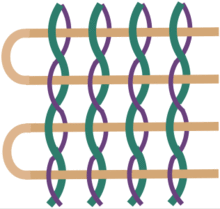
The leno weave is used to make fabrics that allow light and air to pass through, yet stay sturdy. For example, produce and shellfish bags, firewood mesh bags, curtains, and mosquito netting. Clothing is also made from fabrics with a leno weave.
For a leno weave, you thread the loom with the warp yarn and add a doup yarn. The doup yarn can be of similar or lesser weight and strength, and even a different color. The weft is woven in and for each pass the warp and doup yarns are twisted to create the figure eight pattern shown above.
In weaving, they call this “rope a doup”. (Cue rim shot.)
The Tonight Show, with Conan O… ooops!
Leno.
I meant Leno.
I know Jay gets a bad rap, but I never disliked him as much as everyone wanted me to. Yes, he was no Johnny Carson, but when I moved to the United States, watching The Tonight Show before going to bed felt very “American” to me. My favorite segment was Headlines (on Mondays, if I remember correctly), in which he read newspaper or magazine clippings with text errors. Some of them were truly laugh-out-loud hilarious.
Thanks to Leno I found out about Conan O’Brien, who hosted the later show. I started staying up for Conan and became huge fan. I connected at a stronger funny-bone level with the offbeat, self-deprecating humor he espoused on his program.
Then came 2010, and the battle of the hosts. Team Leno, Team Coco, all that weird and crazy and embarrassing fighting that, in retrospect, looks even more absurd and petty now. Especially considering all the important issues we’ve had to deal with in the last few years.
Today, neither of them is hosting Tonight. In 2014, Leno started hosting Jay Leno’s Garage, a show about cars on CNBC, while Conan moved to TBS the same year of the fracas, where he continued his antics. Recent news claims he will be leaving the basic cable station and heading to HBO Max this year or next. Which is fine by me, since it’s easier for me to get the latter channel here in Spain.
In any case, it’s clear that, although leno weaves are used on a daily basis, there’s no doubt Leno never used a weave. I mean, look at the head of hair:

Okay, okay, calm down! Here’s a picture for those of you on Team Coco:

In any case, when it comes to today’s word, we’ll have to stick to the one spelled with a capital L. Because the editors of the Spelling Bee puzzle took one look at leno, and decided it was a dord.*
Please check out my previous entry on another dord*:
*What the heck is a dord, anyway? Here you go: