
Legal Fictions and Israel’s Status at the United Nations
War’s strange legality, and the UN’s call for a truce in Israel’s war with Hamas
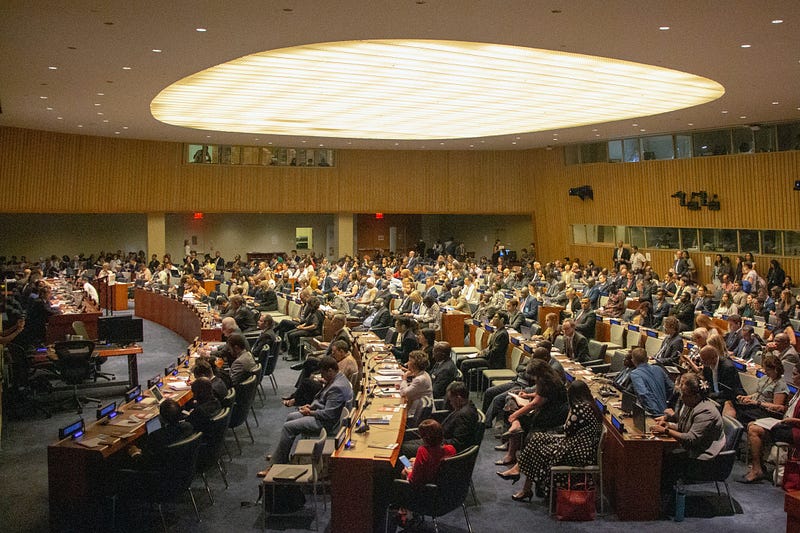
According to a press release, on Oct 27 the United Nations issued its first formal response “to the escalation of violence in Israel and Palestine since the Hamas terror attacks of 7 October, after the Security Council failed on four occasions to reach consensus on any action.”
The response, backed by over 45 member states, was to adopt “a non-binding Jordanian resolution” that calls for an “immediate, durable and sustained humanitarian truce leading to a cessation of hostilities.”
Notably, “An amendment, proposed by Canada and backed by over 35 Member States, including the US, seeking an explicit condemnation of Hamas, did not pass, failing to get two-thirds support.”
The Ambassador for Saudi Arabia, for example, stressed that “the current crisis was due to the failure on the part of the international community to end the Israeli occupation and implement a two-state solution,” and that “Silence in the face of illegitimate Israeli practices, whether over the past 70 years or even recently is what led the region to the current crisis.”
But how should the UN’s General Assembly resolutions be understood? What’s the true purpose or value of the United Nations itself?

Schoolyard politics at the UN
Here’s how we should think of it. Imagine there’s a classroom full of teenage students, but there are no teachers, principals, custodians, or even parents. So, it’s a Lord of the Flies situation. And the teens fall into the groupings you’d expect to emerge at that age level. You have your popular and unpopular teens, and your jocks, bullies, rich kids, nerds, delinquents, and so on.
Some of the bullies pick on a smaller student, called Jacob, harassing him daily and even trying several times to drive him out of the classroom and into the wilderness beyond the school. Jacob builds a wall around his desk, but the bullies go under and over it to pick on their prey.
Yet behind those walls, Jacob lifts weights to build his muscles, trains in martial arts, and acquires more power, so he manages to extend his wall to cover the desk of one of the bullies who had attacked him in the past. Outraged by this defensive maneuver that inconveniences the bully, the latter plots a devastating attack on Jacob, and after launching it and trashing Jacob’s school supplies, Jacob vows to drive that bully out of the classroom.
But while Jacob is in the process of doing so, the rest of the students gather to issue a one-sided assessment of the conflict. Even the bullies get to have their say and vote on a resolution that ends up condemning Jacob for the “aggression” and “genocide” of his self-defensive measures, a resolution that ignores the devastating attack that prompted Jacob’s most decisive attempt to rid himself of the nearest bully.
That’s a rough analogy for thinking about how the UN has handled Israel’s war with Hamas. The “bully” countries that have never recognized Israel’s right to exist lay all the emphasis on the brutality of Israel’s military actions in Gaza, actions that are intended to destroy Hamas in response to the latter’s egregious pogrom that brutalized and killed 1,400 Israelis, the equivalent of around 50,000 Americans (relative to the two countries’ respective populations). Thus, in a sense, Hamas’ Oct 7 pogrom was over 16 times as injurious as 9/11.
“As of 2022, 28 of the 193 UN member states do not recognize Israeli sovereignty; the Muslim world accounts for 25 of the 28 non-recognizing countries…Most of the governments opposed to Israel have cited the ongoing Israeli–Palestinian conflict as the basis for their stance.”
Those anti-Israel countries implicitly agree with Hamas’s goal of ending Israel as a home for Jews, if not perhaps with its terroristic means of achieving it, although Iran is one of those countries and it supplies funding and weapons to Hamas. And Iran, too, got to vote for the resolution against Israel in the UN. Hamas might as well have voted too.
But here’s how Iran would want to reword the above analogy for Israel’s relations with its neighbours:
- ‘Jacob has always been a nuisance and the worst bully in the whole classroom. Those who “bully” Jacob are only defending themselves against Jacob’s infamies. How, for instance, did Jacob come to be in the classroom in the first place? By taking hold of a desk that was meant for someone else! Never mind that Jacob was nearly eaten by a pack of hyenas before he managed to crawl his way into this school; that was his problem and not our concern. When his neighbouring classmate stretched her leg into Jacob’s space, Jacob rudely and shamelessly slapped it away. Granted, she’d been kicking him with it at the time, but who would dare strike a girl in that fashion? And that was just one of many infamies and genocides and callings upon demonic assistance that prove Jacob has no business in our classroom.’
And so on and so forth. You could almost hear such an absurd speech being read at the UN.
The power behind the law
Again, what’s the function of these General Assembly “resolutions”? Their value lies solely in how they clarify the members’ preoccupations. The jocks will think and talk like jocks, the rich kids like rich kids, the bullies like bullies, and the nerds like nerds. The diplomatic language at the UN is much more advanced than what we could expect from children or teens, but the absurdity of the conflicts and rationalizations is just as palpable.
Of course, at least for some weeks, Israel ignored the UN resolution that it should pause its pursuit of Hamas to allow supplies to aid the Palestinians. Some countries that voted for that resolution don’t have Israel’s best interests at heart, nor even that of the Palestinians. By supporting Hamas, for example, Iran’s supporting a terrorist organization that uses Palestinians as human shields, and that hides its weapons in tunnels beneath civilian infrastructure.
Now, UN resolutions become legally binding only when they’re passed by the Security Council, the permanent members of which were determined by the outcome of WWII, which is why Russia is on that council but the Axis powers aren’t permanent members. What this means is that international law at the UN is largely a matter of how global power is distributed. Yet we assume that might doesn’t make right.
Are national laws any more respectable than international ones just because the former are easier to enforce due to the government’s monopoly on power within each country? Many laws seem reasonable enough, and some countries may have more respectable legislative and judicial processes than others. But even within a society, the legal process can be corrupted, as when powerful corporations in a democracy have undue influence over legislators due to the corporations’ campaign contributions so that their lobbyists are able to neutralize regulations with loopholes.
My point, though, isn’t that we should feel free to break the law whenever we want, or that Israel is justified in prosecuting all its wars just because the concept of law is suspect. It’s just that our moral intuitions are more relevant to what we think about certain wars than treaties or UN resolutions. Even when a country violates a treaty, what matters isn’t the treaty as much as that country’s hypocrisy — which is an ethical failing on the part of its leaders.
The oxymoron of “laws of war”
Legal technicalities are especially irrelevant to considerations of the brutal violence that goes on in terrorism or wars. Indeed, the very existence of war gives the lie to the concept of social laws. We like to think we’re bound by laws, and that because laws are things that ought to be followed, we’re good people for obeying them. This is how the social order sustains itself.
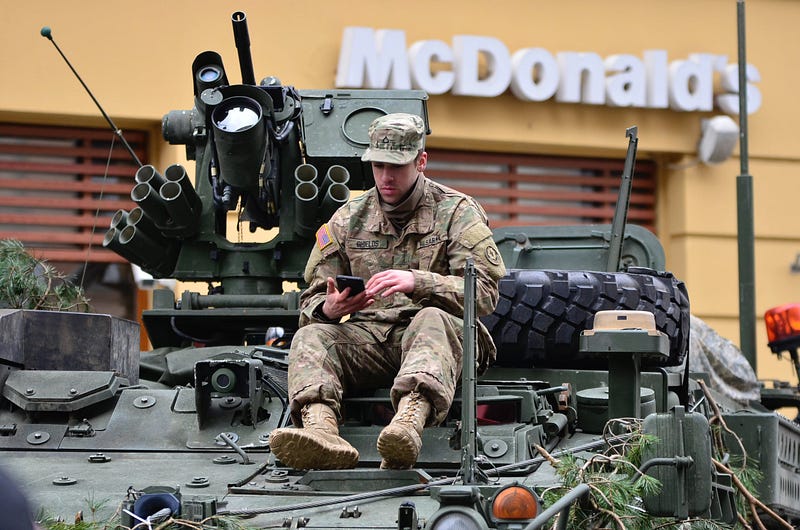
But then wars come along, conflicts which are obviously organized acts of extreme antisociality. And bureaucrats think wars should be regulated too, that wars should fall under legal umbrellas, or that some conduct should be banned for being especially uncivil. Thus, killing soldiers by bombing or shooting them is legal in wartime, but killing civilians is beyond the pale, as is the use of indiscriminate weapons such as poison gas.
Of course, societies are free to enter treaties to express their values, and if certain conduct is deemed monstrous, it will be outlawed. But we’re dangerously deluded if we think that war ought to be legal whereas certain wartime atrocities should be banned. From a civilized standpoint, all wars are atrocious, regardless of the weapons used or the intentions declared. All soldiers are people, too, regardless of their uniforms that superficially dehumanize them, turning them into state functionaries.
Why is war legal? Murder is illegal because the killing of people is bad (because personhood is a precious anomaly in the universe). But war is the mass killing of people. The difference is that soldiers wear uniforms that indicate their country’s intention to achieve some political purpose by resorting to military force.
In other words, murder is fine if it’s political (collectively and officially decided on), but not if it’s personal. If you kill someone because you want his or her stuff, that’s murder. But if a country wages war to steal another country’s land or resources, that collective act of murder is legally protected, assuming some crafty diplomats can obfuscate the theft with cheap rhetoric or bogus pretexts, treating the theft as an act of self-defense.
Yet those international regulations are as artificial and morally arbitrary as the legal fictions that protect Wall Street’s cloaking of its frauds, as in its conjuration of “collateralized debt obligations,” which nearly sank the US economy in 2008.
Returning to Israel’s conflict with Hamas, what matters isn’t the diplomatic compromise that will fall out of the UN. No, our judgment of the conflict should be based on the morality of what Israel and Gaza/Iran are doing.
Is Israel acting morally by laying waste to Gaza as a means of eliminating Hamas? Is that even a rational, feasible goal? Thanks to Israel’s bombing and blockade of Gaza which will supply another generation of aggrieved anti-Israel fanatics, won’t Iran be able to reconstitute a comparable terrorist organization in the region? Are Palestinians collectively complicit in Hamas’s Oct 7 pogrom against Israel? Who’s David and who’s Goliath in the broader conflict between Israel and the Muslim world?
These questions aren’t likely to be settled well by diplomatic compromises. You’re as likely to see a morally sound resolution from the UN, as you are to see a great movie written by a committee of corporate hacks.
I collect my Medium writings in paperback and eBook forms, and I put them up on Amazon. Check them out if you’d like to have them handy and to support my writing in that way. The newest one is Questing for Epiphanies in a Haunted House, and its 600 pages include 99 recent, wide-ranging articles of mine.