Legal Analysis: Swiss Mining and Commodities Trader Glencore’s Fuel Oil Market Manipulation and Foreign Corruption Cases
Legal research and analysis has taken on a much more important role in today’s society due to the international nature of many of the world’s biggest corporations and businesses. Along with the development of a interconnected global economy, there are more and more legal cases to be identified and analyzed in many areas of law. The outcomes of these cases, such as Glencore’s fuel oil market manipulation and foreign corruption cases, have produced effects across borders and legal jurisdictions, which is why legal cases are significant to civic societies, the global economy and international politics.
Background on DOJ and CFTC Investigations
According to JD Supra, an online legal publishing service platform, the Glencore case is about massive bribery and foreign corruption, involving multiple Glencore subsidaries operating in different countries, with the executives and traders at the highest levels of those companies directly responsible for the actions committed.
Several incidents involving Glencore’s bribery and corruption schemes took place in South America and West Africa — Nigeria, Cameroon, Ivory Coast, Equatorial Guinea, Brazil, Venezuela, and the Democratic Republic of the Congo (DRC) — for which all of the areas where Glencore conducted business were related to either foreign bribery and illicit payments or commodity price manipulation schemes (i.e. oil price manipulation).
On 24 May 2022, both Glencore International A.G. and Glencore Ltd. (herein referred to as “Glencore”) pled guilty to the United States Department of Justice’s (DOJ) claims that the Swiss mining and commodites trading company violated the Foreign Corrupt Practices Act (FCPA) and engaged in a commodity price manipulation scheme. This was part of a multi-government effort from the United States, United Kingdom and Brazil.
In the plea agreement, Glencore was forced to pay more than $428 million in criminal fines and more than $272 million of criminal forfeiture and disgorgement. By accepting a independent compliance monitor for three years, the DOJ has agreed to credit around $256 million of the payments made by Glencore to assist the DOJ in related investigations of other domestic and foreign perpetrators.
According to U.S. Attorney General Merrick Garland: “This represents the Justice Department’s largest criminal enforcement action to date for a commodity price manipulation conspiracy in oil markets. ”
In a separate case initiated by the Commodity Future Trading Commission (CFTC) there were charges of manipulative and deceptive conduct brought against three entities: Glencore International A.G. (Switzerland), Glencore Ltd. (New York), and Chemoil Corporation (New York).
This case was investigated for actions committed by Glencore and its subsidiaries due to oil price manipulation and foreign corruption in the United States and global oil markets from 2007–2018. These actions included manipulation or attempted manipulation of four S&P Globl Platts physical oil benchmarks and related futures and swaps in the United States for the purpose of profiting from market trades that exclusively benefitted Glencore executives and traders.
The CFTC’s order forces Glencore to pay $1.186 billion as a settlement for its manipulative and fradulent conduct in the global oil markets. According to CFTC Chairman Rostin Behnam, Glencore’s actions to manipulate and decieve traders and markets has caused a direct impact on consumers, alluding to how Glencore’s oil market manipulation scheme “can drive up the cost Americans pay at the pump or to heat their homes.”
“When individuals and entities seek to disrupt the reliability of benchmarks, they interfere with the proper functioning of the markets that directly impact consumers.”
It was noted in the CFTC’s order that there was direct intent by Glencore personnel to manipulate the price of fuel oil products in interstate commerce as well as create artifical prices so that Glencore’s trading positions could profit further from volatile oil markets.
In connection to the DOJ’s foreign bribery and corruption case, the CFTC also launched an investigation into Glencore’s fraud and corrupt payments to employees and agents of state-owned entities (SOEs) in Brazil, Cameroon, Nigeria and Venezuela. In addition, there were charges of misappropriation of confidential information from certain SOEs in Mexico.
In conclusion, it was asserted in the CFTC order that by conducting business with those countries’ SOEs, through bribery and corrupt payments, that Glencore had in fact secured unlawful competitive advantages in trading physical oil products — and they did so intentionally — with the result of several Glencore executives and oil traders receiving hundreds of millions of dollars in improper gains from such illicit activity.
Glencore’s Foreign Bribes and Oil Trading Schemes
- Emilio Jose Heredia Collado — $341 million fine and $144 million forfeiture of profits after Collado admitted to conspiracy of fuel oil price manipulation at the ports of Los Angeles and Houston.
- Anthony Stimler — Pled guilty to bribery and money laundering schemes while overseeing trading activities in the West Africa markets, specifically Nigeria.
- Nigeria’s Pipelines Products Marketing Co. (PPMC) — $90,000 request from trader in order to secure an “amount they needed to cover PPMC in ‘newspapers’ reading material.” (“Newspapers in this context were code for bribery payments made to Nigerian officials).
- Re-election of Nigerian Official — $300,000 was sought to “advance” the official’s re-election in Nigerian elections in 2014. Then in 2015 Glencore was required to pay $50,000 per cargo as an “advance payment” for access to oil cargoes from Nigeria. This all amounted to $124 million in illicit profits for Glencore.
- “Operation Carwash” — $147,000 in payments were made to three Brazilian officials at Petrobras which were referred to as a “service fee” of 50 cents per barrel of Brazilian oil. This led to Glencore paying $40 million in illicit payments to Brazilian officials.
- Petrobras — $29.6 million must be paid to Brazil’s state-owned oil company Petrobras due to Brazilian prosecutors finding Glencore guilty of defrauding the company.
- Venezuela — $1.3 million was paid by Glencore to Venezuelan government intermediaries to speed up $12 million payments owed to Glencore by Petroleos de Venezuela for outstanding oil contracts.
- Democratic Republic of Congo (DRC) — $500,000 in bribes were paid to judges in the DRC over Glencore’s alleged breach of contract, with damages amounting to $16 million. Glencore admitted to paying $27.5 million in bribes in the DRC.
UK’s Serious Fraud Office and Operation Azoth
On 21 June 2022, Glencore Energy Ltd., a UK subsidiary of Glencore, pleaded guilty to seven counts of foreign bribery in conjunction with oil operations in Cameroon, Equatorial Guinea, Ivory Coast, Nigeria and South Sudan. At a Southwark Crown Court hearing in London, Glencore Energy Ltd. admitted to paying over $28 million in bribes in exchange for preferential oil access from those countries.
The UK Serious Fraud Office (SFO) opened an investigation against Glencore in 2019, called Operation Azoth, for the purpose of exposing the company’s “profit-driven bribery and corruption” for oil operations in Cameroon, Equatorial Guinea, Ivory Coast, Nigeria, and South Sudan.
Glencore’s foreign bribes were exposed by the SFO investigation, including increased cargoes, valuable grades of oil and preferable dates of delivery.
SFO Director Lisa Osofsky said: “This significant investigation, which the Serious Fraud Office has brought to court in less than three years, is the result of our expertise, our tenacity and the strength of our partnership with the US and other jurisdictions.”
“We won’t stop fighting serious fraud, bribery and corruption, and we look forward to the next steps in this major prosecution.”
Per The Guardian, Glencore is a member of the FTSE 100 index of Britain’s largest public companies. That’s why the SFO’s investigation into a Glencore UK subsidiary is crucial. For instance, the success of the UK’s Bribery Act could be at stake in determining whether or not Glencore’s foreign corruption violated Section 1(1) and (2) of the Bribery Act. If so, Glencore’s public contracts could potentially be affected.
It’s important to know that the SFO is carrying out its investigations to find out who is to be held accountable for the foreign bribes and corruption — not only the Glencore agents and employees of the UK subsidiary, but also Glencore’s top executives from the parent company in Switzerland. This is one of the key issues of the case.
The results have so far proved that the top executives should be held accountable for the actions committed by its subsidiaries.
According to the SFO’s website: “Glencore has been convicted of seven counts of bribery under the Bribery Act 2010, five substantive charges under Section 1 and two under the corporate failure to prevent bribery offence, section 7.”
The “corporate failure to prevent bribery offence” held under Section 7 of the Bribery Act 2010 is the likely target of Glencore’s top brass in Switzerland. Any chance of getting those individuals charged in the case would have to fall under the guidelines and criteria of Section 7.
Concluding Thoughts
It’s been reported by many news agencies and media outlets that Glencore is having an amazing year in terms of its profits from the Global Commodity Supercyle. As one of the world’s largest miners and commodities traders, the company’s exposure to thermal coal, crude oil and critical metals such as cobalt and zinc, has brought Glencore’s profit margins to exceedingly new highs.
Reuters reported that Glencore’s profits would exceed $3.2 billion [£2.6billion] in just the first half of this year (H1 2022). This is nearly the amount of profits the company made in the whole year of 2021, when the company held record profits of $3.7 billion. Therefore, Glencore is on its way to have another historical year in profits from the mining and trading of global commodities, which have been exacerbated by the ongoing Russia-Ukraine Conflict, ushering in a new Global Commodity Supercycle.
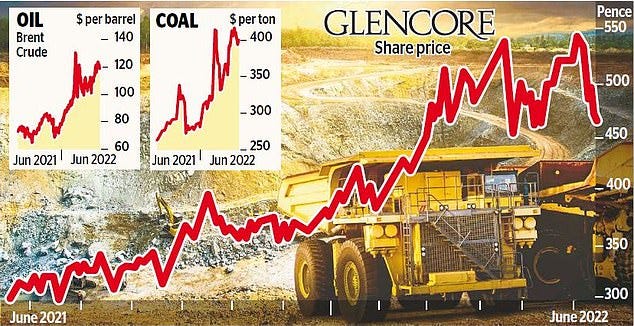
Since Glencore is one of the only countries that still has a full-fledged coal business, it has given the company extreme flexibility to give investors more returns through corporate buybacks and dividends.
It’s no wonder that organizations and public interest groups, like the UK-based Spotlight On Corruption, is pointing to Glencore’s top executives in the foreign corruption and bribery cases. According to a statement by Executive Director of Spotlight On Corruption Susan Hawley, she says that it is “essential that those responsible for the wrongdoing, including senior executives and the parent company, are held to account.”
Spotlight On Corruption has been following the SFO’s investigation proceedings against Glencore Energy Ltd. in the UK; they added that“compensation for the victims of their alleged corruption in West Africa” must be acknowledged and enforced.
After the announcement of Glencore Energy’s conviction of foreign bribery in UK courts, Spotlight On Corruption put out a statement on Twitter:
“We also need to see @UKSFO move swiftly to ensure that senior executives who approved or encouraged this bribery scheme are in the dock, to ensure real accountability and effective deterrence.”
Spotlight On Corruption believes in the mission to stop bribery worldwide. It can effectively build trust in public institutions, while strenghtening democratic governments and sustainable development initiatives. According to their official website:
To end corruption it is essential to look at all bribery conducted and enabled by UK individuals and companies, including banks, lawyers and accountants, both at home and abroad.
In doing so, the organization researches how the UK’s 2010 Bribery Act is implemented and how changes to relationships with foreign governments are affecting successful anti-corruption outcomes in UK courts. For example, since the UK’s exit from the European Union — Brexit — the Bribery Act has come under fire from the public in regards to its effectiveness in alleviating foreign corruption and economic crimes.
Organizations such as Spotlight On Corruption are working endlessly toward the mission of stamping out foreign corruption all over the world, by means of monitoring governments and their relationships with one another in both domestic and international economic, legal and political frameworks.