
Lefty Dizz dun walked out on me one time…
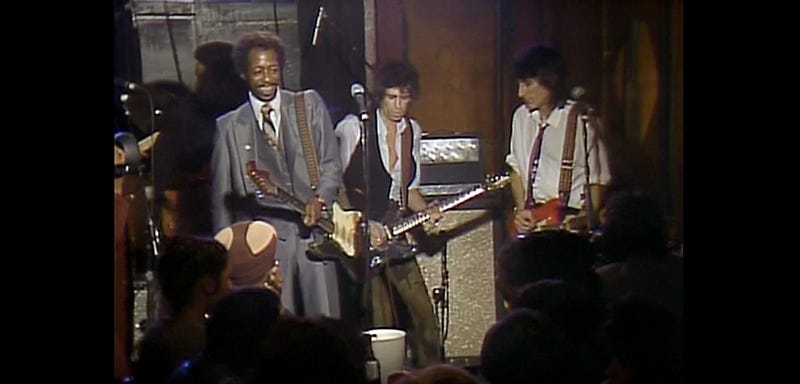
No slouch: Lefty played with Mick Jagger, Keith Richards, and Ronnie Wood
Spring Street Theatre used to resemble a big shed, hidden away down dingy side streets off Hull’s main drag. Basic. A bar, no stage, just the floor where the band played, smack bang in front of an audience on raked seating, and hardly any ambient lighting.
One freezing February evening in 1992, walking those icy streets, hoping not to get mugged, I was relieved to see the welcoming light at the entrance of the club-cum-theatre, and a billboard pronouncing ‘Tonight — Lefty Dizz — all the way from Chicago!’
With the city morgue opposite, you’d always get some guy at the bar joking, “there are more stiffs across the road than in here tonight”. The night Lefty Dizz played, the place was packed.
It was cheap, unlike the main theatres in town with their plush seating and respectability. Punters could stack pints of beer under their seats, watch the show, and hope the guy behind didn’t kick them over when he stretched out his legs.
It was rare to get a real Chicago Blues player in a place like Hull. They played the big cities of England — Liverpool, Manchester, Leeds — not an out on a limb town like Hull.
The intimacy of the theatre meant we were so close to the action we could see every move the pick-up band made tuning up: a local trio of drummer, lead/rhythm guitarist, and electric bass (he’d have a night he’d never forget).
The lights dimmed leaving them in the spotlight as they played Blues in the style of Fleetwood Mac’s Peter Green, Freddie King, and Jimi Hendrix.
Then Lefty Dizz was announced and the spotlights shone behind the band. We heard him before we saw him. Classic Chicago licks. Loud!
Wearing a sharp tan suit, matching Fedora, and snakeskin boots, he mooched behind the band carrying a battered Fender Strat. Left-handed, skeleton-thin, his face heavily lined, his guitar riffs were clean and bright. As his right hand worked that fretboard to death with a myriad of pull-offs and hammer-ons, he confidently strode out onto the floor.
Never still, he stalked the place, checking out his audience. Slowly pacing down the side and behind the seating racks, belting out licks, his coiled guitar lead stretched to the max. He reached the exit, turned, and made his way back to the microphone to sing. His gaze was intense. Never smiling, no chit-chat between numbers, he just did his thing, occasionally returning to the mic to mutter a few incomprehensible words. Mostly, he just riffed. It was electrifying.
After about forty-five minutes, and deeming us worthy, he engaged with his audience for the first time. Moving to the front row, motioning to the girls, taking their hands if reluctant, to rake the strings of his guitar, while he fingered the fretboard, never missing a note.
Lifting the guitar to his mouth, he played it with his teeth. Walking back to the mic, he slung the Stratocaster over the back of his head, Hendrix style, playing for all he was worth.
Something happened on the next number, a slow Blues shuffle in the style of Little Willie John. A false start after just a couple of bars, he motioned the band to stop. He wasn’t happy, and turning to the bass player told him he’d got it wrong. The other musicians looked bemused. They tried it a second time. After a long solo introduction, just as he was about to sing, he shut it down again.
This time he was really mad. He went up to the bass player, shouting, “You can’t play, man. What you doing? You’re messing it up.” Turning and walking up to the mic, he said, “You better get it right this time”, counted them in, and started to play.
It sounded great, didn’t break down, and Lefty sang the verses of a song I’d not heard, which had a repetitive phrase about leaving home. He stood before the girls on the front row playing awesome slow Blues riffs, occasionally shouting out, “I’m leaving honey, I’m leaving town”.
Moving to the end of the row, he walked beside the seats, playing soulful Blues and shouting about leaving town. On reaching the exit sign, he unplugged his guitar, opened the door, and walked out.
As the ear-splitting crackling and buzzing from the disconnected amplifier filled the space, the band looked at one another in shock, the audience in disbelief. Then, the lead guitarist jumped to switch off the amp, ran to the exit door, opened it and we heard the sound of a car door slam and a vehicle drive away.
The guitarist came back inside, walked up to the mic, and looked at us. “Well, he said he was leaving and it appears he’s gone. What do we do now?” Play, came the response, and for the final hour, that’s what they did, doing it well.
I later discovered that Lefty Dizz went on to do a gig in a nightclub in Sheffield, seventy miles away, and for better money. Even though he only fulfilled half his gig in Hull, none of us felt short-changed. He was the real deal and he gave us a night to remember. And the guy playing bass a night he’d never forget.
18 months later, on September 7 1993, Lefty Dizz died of the effects of oesophageal cancer. He was only 56. A talent truly lost.
If you enjoyed this story, you may like this:


