
LeetCode 257(Golang): Binary Tree Paths(Easy): Recursion vs BFS vs DFS
You understand concepts like DFS(Depth First Search), BFS(Breadth-First Search), etc., but do you know how they relate to pre-order, post-order, and level-order traversals? Let’s delve deeper into their interconnections through a simple LeetCode problem.
1. Problem 2. Solution && Analysis 4. Conclusion 5. Refefence
So let’s start :)
Problem
Given the root of a binary tree, return all root-to-leaf paths in any order.
A leaf is a node with no children.
Example 1:
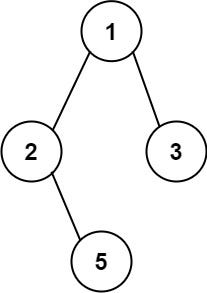
Input: root = [1,2,3,null,5]
Output: ["1->2->5","1->3"]
Example 2:
Input: root = [1]
Output: ["1"]
Constraints:
- The number of nodes in the tree is in the range
[1, 100]. -100 <= Node.val <= 100
Solution && Analysis
DFS(Depth First Search)
- Recursion && bottom-up && post-order traversal
From the first example, you can draw the following diagram:
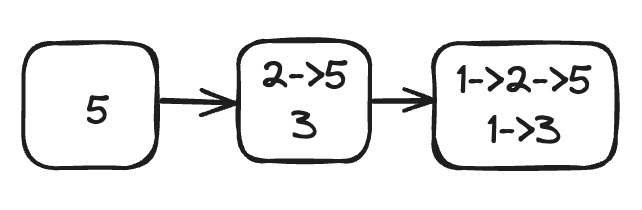
> Why DFS? > Recursion is the ”stack“, it involves a stack pushing process, conforming to the stack’s Last-In-First-Out (LIFO) principle. > > Why post-order traversal and bottom-up? > because we are the last to deal with the root node.
Time Complexity: O(n * h) Each node in the tree is visited once (n is the number of nodes). For each node, a string concatenation is performed, which can take up to h operations in the worst case, where h is the height of the tree.
Space Complexity: O(n * h) The space complexity is mainly due to the recursive call stack and the storage of path strings. In the worst case, the call stack can go as deep as the height of the tree, h, and for each call, a path string of length up to h is created. This leads to O(n * h) space usage, considering the worst-case scenario for a skewed tree.
2. Stack && up-bottom && preorder traversal
diagram:
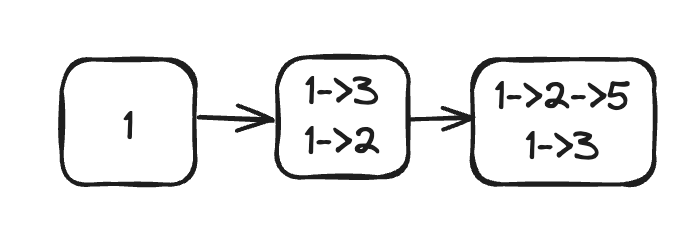
> Why up-bottom && preorder traversal? > Handle the root node first.
Time Complexity: O(n * h) The time complexity is O(n * h) where n is the number of nodes in the tree, and h is the height of the tree. This is because each node is visited once, and for each node, path strings are concatenated and copied, which can take up to h operations in the worst case. Space Complexity: O(n) The space complexity is primarily affected by the storage of the stack and the path strings within each `StackNode`. 1. The stack itself, in the worst case, can have as many as `n` `StackNode` entries (especially in a skewed tree where the traversal resembles a linear list). 2. Each `StackNode` contains a path string, which can grow up to the height of the tree, `h`, in length.
BFS(Breadth-First Search)
- level order traversal
diagram:
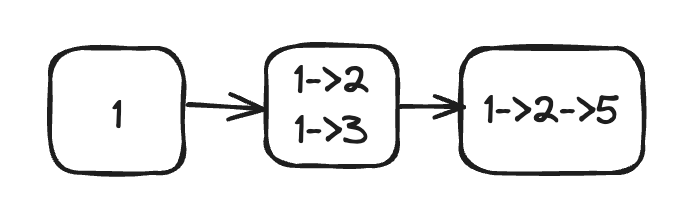
> Why BFS? > Use of Queue: BFS is characterized by the use of a queue data structure to keep track of the nodes to be visited.
Time Complexity: O(n * h) Each node in the tree is visited once, where n is the number of nodes. The major cost comes from constructing the path strings for each node. Since paths are being concatenated at each level, the time to construct paths can be up to the height of the tree (h) for each node, leading to a worst-case time complexity of O(n * h). Space Complexity: O(n * h) 1. The space complexity is primarily due to the queue and the storage of path strings within each `nodePath` struct. 2. The queue may contain multiple `nodePath` structs, each with a path string. In the worst case, the length of these path strings can grow up to the height of the tree, h, especially for nodes deeper in the tree.
Conclusion
1. Depth-First Search (DFS) can generally be implemented in two ways: recursively or iteratively. It primarily leverages the characteristics of a stack, and can be combined with the concepts of pre-order and post-order traversals for top-down and bottom-up approaches, respectively. 2. Breadth-First Search (BFS) typically requires the integration of a queue for implementation and can be aligned with the ideas of level-order traversal 3. Commonly, when tackling a DFS or BFS problem, these features can be your starting points, enabling a systematic approach towards problem-solving. 4. In Go, the string type is immutable. Utilizing strings.Builder can be more efficient. If there’s interest in this area, I am also planning to write an article on this topic. Your comments and engagement are welcome.
Outstanding Question: Are there solutions as follows?
1. Recursion && up-bottom && Preorder traversal && DFS 2. Stack && bottom-up && Preorder traversal && DFS
Feel free to reply in the comments section. :)


