
Lee Kuan Yew’s Hard Truths to US Congress
Voices for The Future
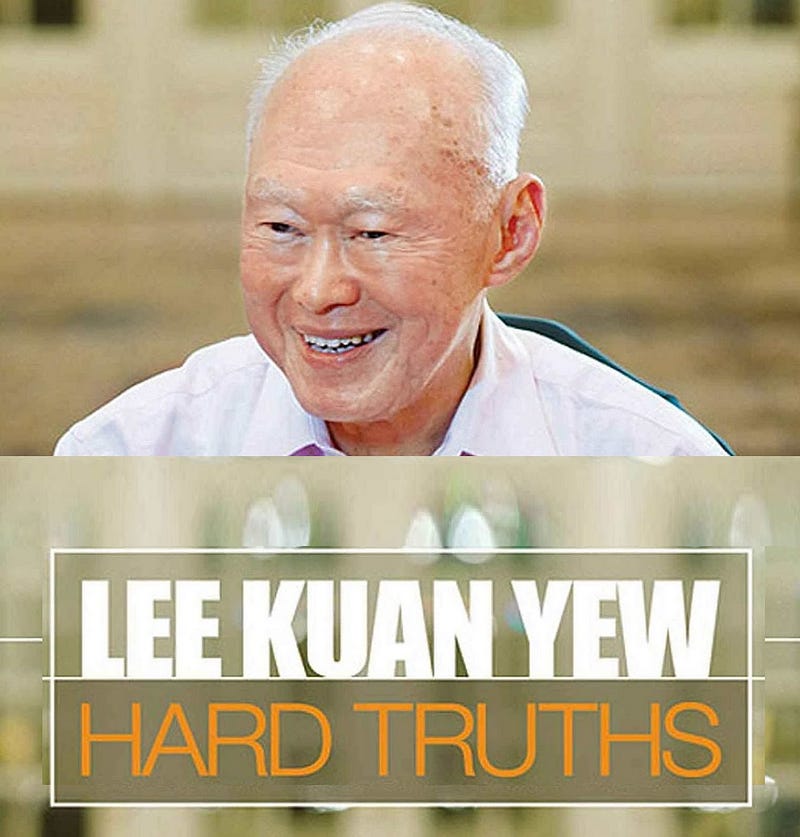
On 9 October 1985, then-Senator Joseph Biden watched and heard Lee Kuan Yew’s speech in the US Congress Chamber. As US President today, he should re-visit Lee’s speech for its timeless relevance. It is believed that the impact of the 1985 speech helped to mitigate the tide of protectionism brewing in the US Congress, and empowered the prosperity in East and South-East Asia, and the world, through the 1990’s and into the 21st Century.
In 1985, Lee Kuan Yew, then Prime Minister and Founding Father of Modern Singapore, was invited by the 40th US President Ronald Reagan to address a Joint Session of the United States (US) Congress. He spoke passionately and strongly advocating continuous US trade engagement in East and South East Asia, even as the protectionist tide was running strong in the US body politic. He argued why it was in the strategic interest of the US to continue to support free trade and open economies. He pointed out that if the US, as the bastion of capitalism and free trade, turned her back on the very principles it had preached for decades, then the repercussions could be catastrophic for those very countries that followed its example.
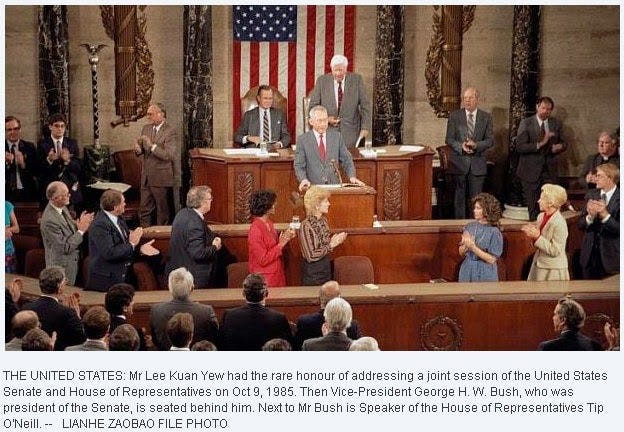
LEE KUAN YEW’S HARD TRUTHS TO THE UNITED STATES (US) CONGRESS — Selected Excerpts
ON US LEADERSHIP
“I am greatly honoured by your invitation to address this Joint Meeting of the United States Congress. It cannot be often that someone representing two and a half million people from a small country in the Third World is offered the opportunity to address the representatives of 240 million people who form the World’s most wealthy, and most advanced nation. America is a great nation not just because of its power and wealth, but mainly because it is a nation moved by high ideals. Only the elevating power of her idealism can explain the benign manner in which America has exercised its enormous power since the end of World War II and the magnanimity and generosity with which it has shared its wealth to rebuild a more prosperous world. This idealism which inspired the Founding Fathers of this nation has, down the ages, also affected and inspired free men and free women throughout the world.”
“Decisions made in this august chamber especially in the decades since 8 December 1941, have determined the course of human history and settled the shape of the contemporary world. If the era after the war has seen a world relatively at peace and accompanied by an unprecedented degree of human progress, much of the credit must go to American leadership.”
ON CHINA
“After nearly three decades of Maoist seclusion and self-sufficiency, Deng Xiaoping decided that closing China’s doors on the world was the cause of her stagnation. China needs to modernise. China has opened its doors to trade, investments, technology, and tourism. She wants to get the same economic uplift that Japan, South Korea, Taiwan, Hongkong, and ASEAN have had from the free market economies of the West by plugging into their trading and investments power grid. In a few years after this decision, China’s trade with US and Japan has gone up many times, 13 times from US$0.5 billion in 1975 to a respectable US$6.4 billion to US$13.2 billion with Japan for the same period. China is seeking growth through trade, not territorial aggrandisement. Her quest for a better life for her people is through peaceful cooperation in trade, investments, and transfer of technology and know-how, not the use of force for territorial conquests and the carving out of a sphere of influence or a trading bloc.”
“China’s decision is a most significant factor for peace, stability, and growth in Asia. For nearly 30 years, from 1949 until Mao died in 1976, a poor but ideologically fervent China was a ceaseless spoiler of other countries’ economic plans as she undermined their stability. She was an exporter of revolution. She provided arms ideology and radio support to guerilla insurgencies in Southeast Asia. China has, for the present, discontinued such support.”
“China was a founder member of GATT. The present government of the PRC abandoned its membership in 1950. Recently, it has sent out feelers for re-admission as a developing country member of GATT. If the US cuts down China’s growing trade with her, then China has to rethink its economic strategy. Shutting out China’s products, especially textiles, from America’s markets, will have far-reaching implications. China must then look for other ways of getting foreign exchange to pay for modernisation. If, as is likely, she cannot get enough alternative markets to make up for the loss of America, her modernisation will slow down. She will become restive.
“There are two scenarios for the 21st century. The first is bleak: if, because of domestic problems, the US loses the will to maintain free trade. There are over 300 bills in Congress dedicated to the protection of the US market. Protectionism and retaliation will shrink trade and so reduce jobs. Is America willing to write off the peaceful and constructive developments of the last 40 years that she had made possible? Does America wish to abandon the contest between democracy and the free market on the one hand versus Communism and the controlled economy on the other, when she has nearly won this contest for the hearts and minds of the Third World? Never in its history has the peoples of the world enjoyed such high standards of living. For 40 years, the maintenance of political boundaries was made possible because trusting, and usually aggressive, people have been able to fulfill their drive to better their lot through trade. If this method for adjustment and accommodation between societies moving at different speeds is no longer possible, then a return to the traditional ways of conquest or influence is likely.
ON PROTECTIONISM IN GLOBAL TRADE
“Putting up barriers to America’s markets would halt the economic advancement of the free-market-oriented developing countries. It would send a signal that the model provided by the countries of East and Southeast Asia is no longer an available option. It could set off a chain reaction that would result in a downward spiral of the world economy.
“Therefore, America will find that the putting up of tariff barriers is not enough. She will have to go one step further: she will have to be the policeman, to enforce order over her sphere of influence, of the world outside the Soviet bloc.
“Let us not forget that protectionism and less trade mean less growth for the developing countries. This means debt burdens cannot be discharged. Defaults may be unavoidable, with incalculable consequences for the international banking system. Even if the banks survive the upheavals, these developing countries will have to abandon all thoughts of liberalisation towards plurality and more democratic freedoms. Severe or repressive government is the other side of austere or negative economic growth.
“America can upgrade her declining low value-added industries or they will continue to decline whether America goes protectionist or not, just as the ancient agricultural societies of pre-industrial China and Japan, with their self-sufficient, subsistence economies based on buffalo power and manpower, had to change with the advent of the industrial age. Rapid and profound change is the kind of world Americans have created by their inventiveness. American legislators have the awesome responsibility of deciding under what rules the peoples of so many different countries should undergo rapid changes in their ways of making a living, and yet avoid violent conflicts.
“It is inherent in America’s position as the pre-eminent economic, political and military power to have to settle and uphold the rules for orderly change and progress.”
“Americans are leaders in a marathon for technological change and product innovation. American enterprise is blazing the trail into the microchip and computerised world of tomorrow. In the interests of peace and security, America must uphold the rules of international conduct which rewards peaceful cooperative behaviour and punishes transgressions of the peace. A replay of the depression of the 1930s, which led to World War II, will be ruinous for all. All the major powers in the West share the responsibility of not repeating this mistake. But America’s is the primary responsibility, for she is the anchor economy of the free market economies of the world. In your hands therefore lies the future of the world.”
Read — Full Lee Kuan Yew’s Speech Transcript
Watch — 10-Minute Video
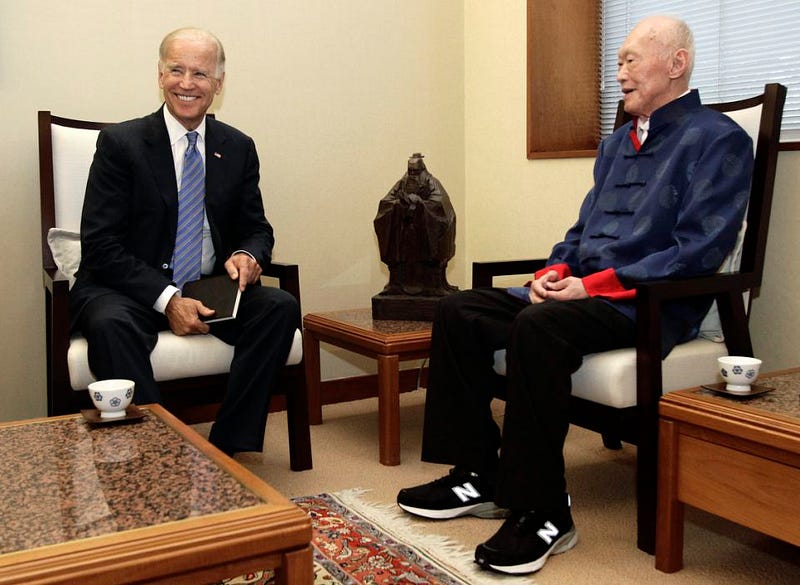
For nearly 60 years, Lee Kuan Yew influenced, shaped, and molded my life through the social, political, and economic transformation of a Third World Singapore into the “First World” nation par none; characterized by economic prosperity, law and order, national security, housing for all, world-class education and full employment with social justice. He was my Prime Minister from 1959 to 1990, stayed in the government as Minister Mentor till 2011, and was thereafter appointed Senior Advisor to the Government of Singapore Investment Corporation. He died on 23 March 2015 at 91 years old.
Please enjoy my recent Articles.
You can also subscribe to my stories and social media posts via your email. Enjoy more interesting Articles by signing up to Medium here: https://thefuturistoracle.medium.com/membership