
Learnings and Observations From My First 1,000-Views & $25 Story
Separating the replicable factors from the chance ones

The most exciting part about writing on Medium is that you’re almost running a mini-business, except that you don’t have a team — you’re a one-person show. You’re responsible for your own content, marketing, data analysis, strategy, planning, and execution.
And to be able to stay motivated and continue to strive for excellence, it is very important to learn from your successes and failures, so you can replicate the former, and avoid the latter.
Having begun this journey of writing on Medium on July 15, 2020, today marked exactly four months of this eventful ride.
And, while I may not have shot up to a star writer just yet, I’ve felt fairly good about what I have accomplished. One of these accomplishments is my first ever story to get 1,000 views and in the process earn $25, and counting.
Here is what I have learned from a thorough analysis of why this particular story clicked, and how I can replicate part of the success factors to try and do this more often.
The Story & Statistics
The story happens to be a True Crime story, published in the publication Crimebeat, which is a relatively new publication but has found a good and loyal following.
The story was published on October 10 and so it has been a little over a month. Here are what the stats look like currently:
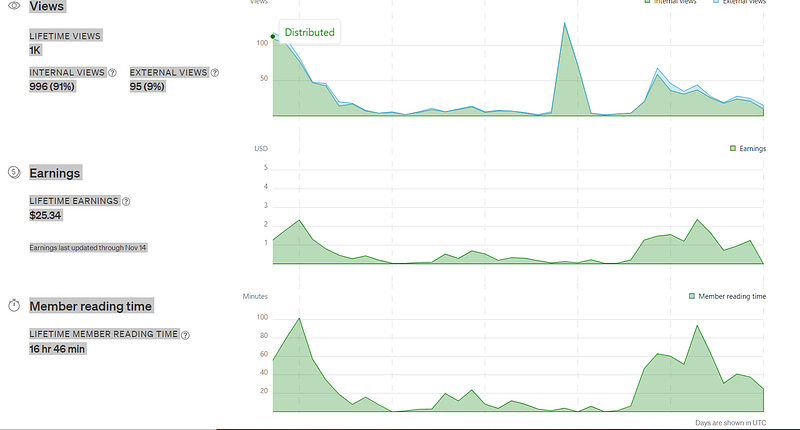
As you can see it now has close to 1,100 views, and earnings of over $25 with a lifetime member read time of 16 hr 46 mins. I’ll get to the details in subsequent sections.
Know Your Followers Well
So my tryst with True Crime began with my first story in the genre, written back in September. This was a story that got curated in True Crime, was published with CrimeBeat as well as got close to $10 in earnings, meaning it reached a fair bit of audience.
What this also meant is for that week/month, a majority of my new “followers” had found me via this story.
This told me that I had a significant amount of followers who are interested in True Crime owing to this first semi-successful story.
And so, I used this knowledge to write occasional (one or two a month) stories on True Crime, in addition to my usual stories — which are anyway very diverse in terms of topics.
Killer/Engaging Titles Work Wonders
When you’re writing in any genre, a catchy headline always attracts the readers. But when you’re writing fiction / true crime / story-like genres, you need to surely engage the audience with a punchy title.
This story did well at that — who wouldn’t want to read about a guy who was a bestselling author, a serial killer, and happened to kill his victims using their own underwear? These are all facts that I used in the title of the story without needing to “lie” or be clickbaity, yet create a powerful title.
Factual Images Provide Authenticity
This one isn’t easy to do in all stories — but where you can try to use pictures that are authentic and relate to the story — whether it is your own clicks, illustration, or a picture directly related to the topic.
It is hard to find such images that are copyright-free, but Wikimedia Commons can often be a good source when writing real-life stories.
I did just that for this story — I had an actual catchy picture of the serial killer used — so people didn’t see a random image, but the actual killer, and wanted to read more about a guy who looked like a showman rather than a criminal.
Write Content that Holds Your Audience to the End
Once you’ve got a “view” the important bit is to convert it into a “read” and a proper read, not just a skim through.
My story is about a 5–6 minute read and the average read time I got is 3 min 31 secs, and a read ratio of over 60%.
Those are solid numbers for a story that also managed to get 1,000 views. I broke down the story into an introduction about the character (the serial killer), his life, his crime journey, his pseudo-redemption, and his final conviction and punishment.
The audience naturally wanted to get till the very end to know what happened with the guy eventually, and so was hooked on to reading the whole thing rather than just jumping to the end.
No matter what genre you pick for yourself, create your content in such a way that the reader HAS TO go through the finer details to get to the end, rather than just being able to skip to it.
Curation Still Helps — I Got a Second Wind
I’d given up on the story after the initial success it got, as I do with all my stories.
However, this story was curated in True Crime, which meant it had a chance of getting noticed at some point again. That is exactly what happened a few days ago.
Probably, Medium chose to re-distribute my story in some form either to readers of True Crime on their daily mails, or some other way, shape, or form.
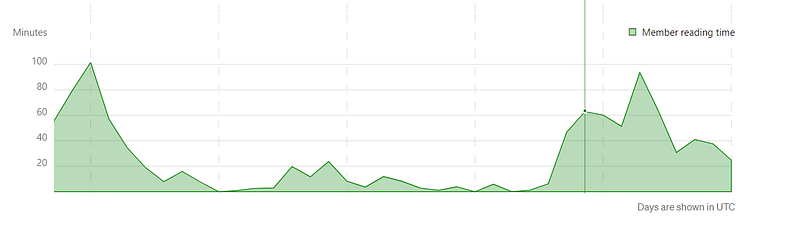
What resulted was that about a week ago I had a series of days with solid read-times every day and that took my story from dying at a ~500 views, $10 story to a 1,000+views, $25 story.
Curation may have been “deemphasized” by Medium, but it still gives you a shot at infusing a second wind into your stories like no other feature of Medium does. This was the first time I saw a real “2nd wind” to my stories, but I know of many others who see this on a much more significant level.
Summarizing Some of the Learnings
- Follow the basics — a solid title, image, beginning to engage the reader into viewing your story
- Know your followers — With all the talk about a “relational” Medium, it matters how you are able to curate your content to suit your audience. And your main audience is your followers, who will see your content on their homepage, irrespective of other factors. So make sure if they see a story, they want to read it.
- Write in a way that forces thorough reading — The holy grail is reading time, so try and write in a way that makes it hard for the reader to skip parts and requires them to read the whole thing to really get to the end. This isn’t always easy but some writers are masterful at this. Britni Pepper does this amazingly well in one of her most successful stories, and in general in most of her stories. Without knowing her actual stats, I can guess she’s one that gets longer read-times than others.
- Curation still matters — Well, I don’t chase curation or care for it as much as I used to before, but it still helps provide your story a shot at being rediscovered at a later stage out of nowhere.
- Keep Writing — This is a game of persistence — I’ve been on Medium for about 4 months now and I still average around a story a day with some variability owing to my work schedule. You can’t predict which story will take off, but if you keep writing and writing well — some day, some story sure will.