
Learning to Play the Piano Taught Me How the Brain Works
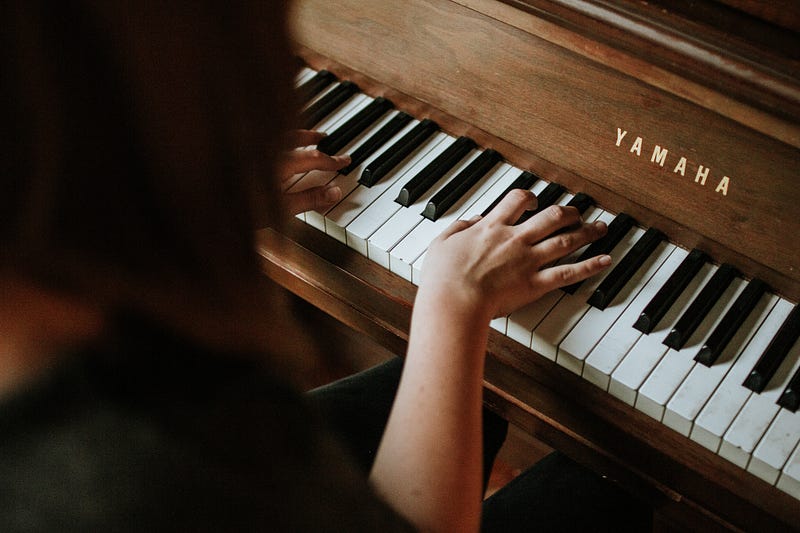
I learned to play the recorder when I was 10 years. In hindsight, it seems like the most effortless skill I have ever acquired. In just a few days, I could place my fingers firmly on the finger-holes and produce well-sounding tones. In a few weeks, I could play some basic gospel songs, and in about 2 to 3 months, I was comfortable with the instrument.
Knowing intervals intuitively was mind-blowing (still is). I could practically play all songs in all the major keys without prior preparation. I would play all the hymns in my mother’s hymn book and try the songs playing on the television. I fell in love with music and instruments, and I wanted to transition into other instruments. As most of our childhood dreams, life happened, and I forget about my wish to learn another instrument.
Two years ago, I made the firm decision to learn to play the piano. While most of my learning was self-thought and classical (lots of music theory and score sheet), I was thrilled by the “hear and play” method of learning because of the intuitive play I already had and liked recorder.
Learning to play the piano was tough. I could hardly move my fingers on the keys. After just a few minutes of playing the scale, my fingers go numb. And sometimes it felt like they were not in my control. Months in, I observed a pattern whenever I am learning a new piece.
When I get stuck, I would usually try the line repeatedly before proceeding. Then if I play the piece from the beginning, it was a hell of a disaster. I made mistakes upon mistakes. After a couple of tries without success, I will leave my piano, go to the living room and watch some television. Like magic, when I get back to the piano, I would be able to play the piece that I couldn’t play just a few minutes ago.
This is a piece I have been trying for over 30 minutes, stuck in a Sisyphean loop with no progress but a few minutes break from the piano. To do what has no relationship to a piano, I could play the piece perfectly. It was a thrilling observation for me. The few minutes break felt like a time out to take papaya’s spinach.
But what exactly was going on?
Combinatory Play
In his letter to mathematician Jacques Hadamard, Albert Einstein explained his thought process when the latter asked how he thought. Einstein coined the word combinatory play to explain the interaction of the mind with two or more unrelated activities. When Einstein was stuck with an idea, he would go to play the violin. He reported that playing the violin affected how he thought about science and mathematics.
Come on, Einstein, what has the violin got to do with the general theory of relativity or photoelectric effect?
Not just for Einstein. Archimedes, after struggling with understanding the principle of buoyancy, got the idea while taking his bath. “Eureka!”
No doubt, children learn faster than adults. The prefrontal cortex, which stores working memory, is more developed in adults than in children. While a child’s brain is flexible and creative, an adult brain is more static and more inclined to perform tasks fixedly. What if we can become like little children?
Combinatory play is simply going into another activity to free the brain into creating other neural pathways.
Using combinatory play to turbocharge your creativity when stuck in an idea or task
- Do any other unrelated activity: Go take a walk. Have a drink, see a movie, and so on—anything to take your mind off the present task before you for a time. I can assure you that you’d come back to the task with a reinvigorated mind and a new perspective on the task. For example, I never publish a piece the moment I am done writing and editing. The next time I come to the piece, I have a clearer mind and can better find errors and better ways to express an idea. Take a break.
- Sleep on it: Sleeping on an idea is a great way to move that idea from short memory to long memory. As you may know already, sleep allows the brain to process all the day’s activities. After sleeping on a particular piece of music I was trying to play on the piano, the muscle memory on my fingers fascinated me.
- Try in unfamiliar terrain: You’d agree with me it will be foolish for a sprint athlete to sprint only for his training and fitness repertoire or for a swimmer to only swim in preparation for a swimming competition. We need a wide range of activities to prepare a sprinter for a sprinting match. Learn to switch up. As a writer, just changing my environment gives me a new zeal to write.
Combinatory play might be the missing piece to your creativity. Play with it.


