
Learning To Lower My Mountain of Expectations
A pandemic journey on the Bhutanese way of happiness
Although summer is gone, it will be months before rains come to California.
About three weeks ago, over 10,000 lightning strikes ignited hundreds of wildfires across California. This unfortunate event is likely due to climate change. Smoke from the fires made it difficult for us to go outside for at least a week. Tireless and brave firefighters as well as cooler weather helped to contain some of the major fires, which made the air more breathable the past week.
The real fire season hasn’t yet begun, and it seems that more unwelcome surprises are in the store for California. But for now I live one day at a time. I will worry about tomorrow tomorrow.
Just around this time, with wildfires forcing us to hole up further at home, a travel bug has bit me. Sadly, I can’t travel anywhere. Not yet, anyway. Besides, my son’s school has just started. So I am having trouble seeing any end to this homebound life. I’ve learned to love spending most of my time at home. But just not all of my time.
Out of desperation, I began scouring our home library for travel books — we can at least travel vicariously, can’t we? — and found The Geography of Bliss by Eric Weiner (2008). This book is about “one grump’s search for the happiest places in the world.”
I enjoyed reading it years ago, especially the chapter “Happiness Is a Policy,” which is about Bhutan. Each of the ten chapters of the book covers the author’s exploration of happiness in a different country. The irony of this to me is that the last chapter, about the USA, is titled “Happiness Is Home.”
Now that most of us are stuck at home indefinitely, happiness has gotta be at home or else we are in real trouble.
More or less, my whole world has been reduced to a two-bedroom apartment with a backyard and a little garden. I am desperate for an escape into the wide world, even if in my imagination. Good travel stories can transport me somewhere else. They always do.
Reading this chapter, I was humbled by the Bhutanese approach to happiness.
Bhutan is a country known for its focus on the what Bhutanese call Gross National Happiness. Eric Weiner went there to explore this idea.
He writes,
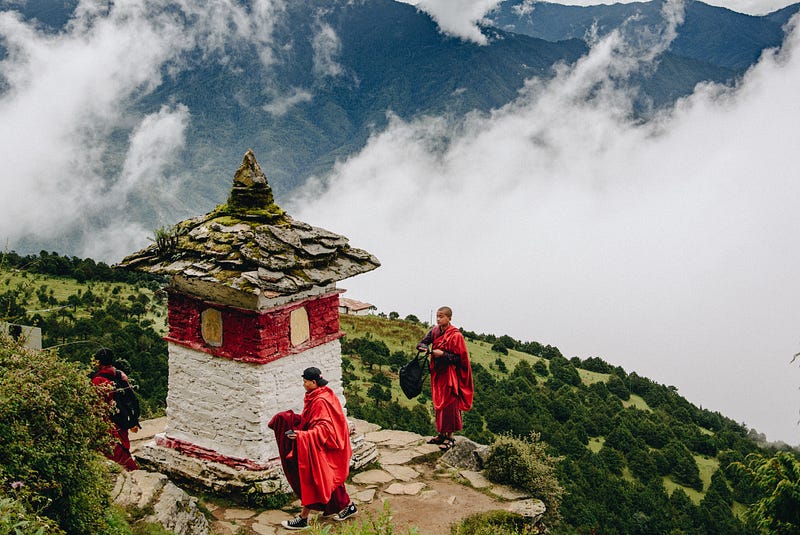
“In most countries, your arrival is staggered, your transition into a new environment eased by the familiarity and hermetic sameness of Airport World. But in Bhutan there is no Airport World. There is, truth be told, barely an airport. Just a tiny hut of a terminal, which, with its carved woodwork and swirls of deep reds and blues, looks more like a Buddhist temple than an airport.”
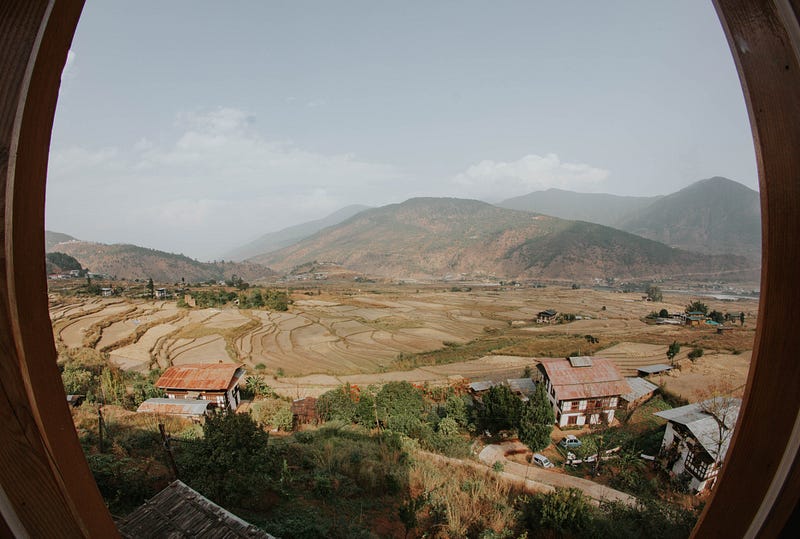
“I quickly discover that driving in Bhutan is not for the meek. Hairpin turns, precipitous drop-offs (no guardrails), and a driver who firmly believes in reincarnation make for a nerve-racking experience.”
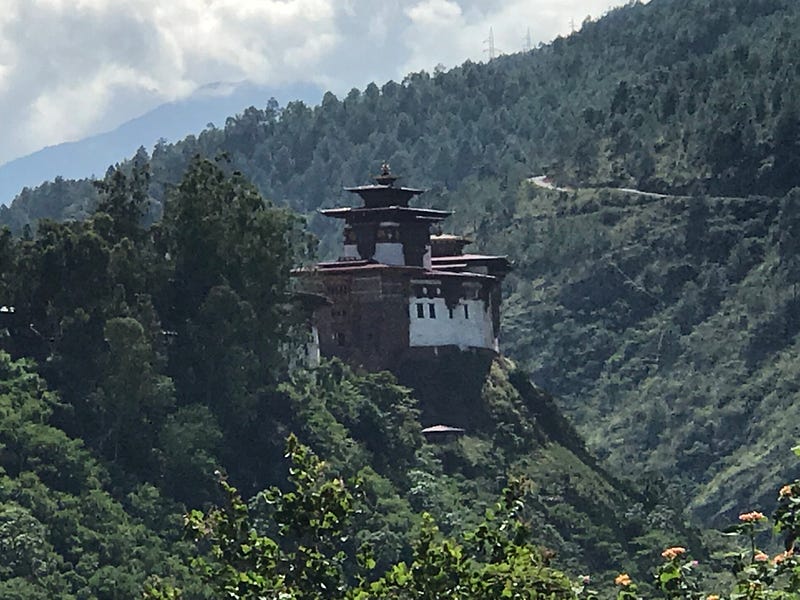
“No billboards or neon signs; there is hardly any advertising in Bhutan, and neon signs were banned until a few years ago. However, I do spot this hand-painted sign, propped up by two pieces of wood on the side of the road.
When the last tree is cut, When the last river is emptied When the last fish is caught, Only then will Man realize that he can not eat money.”
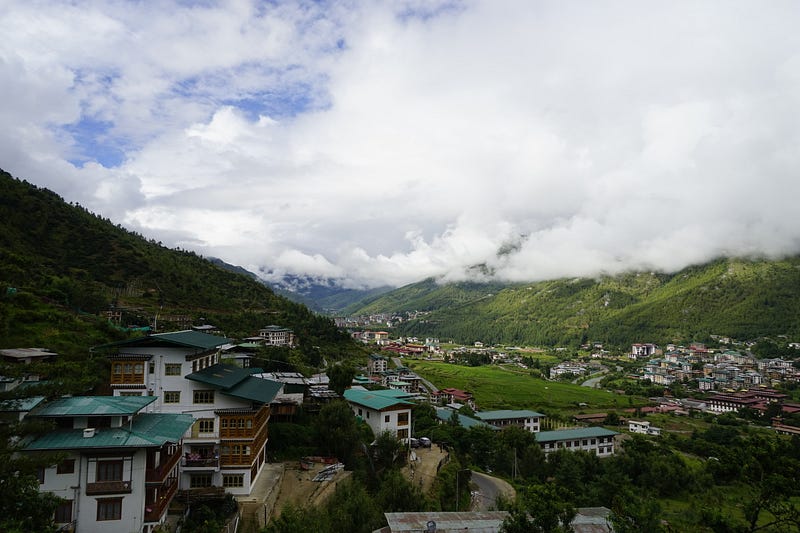
Happiness is appreciating more from less
In the capital Thimphu, Eric meets Karma Ura, a wise man who runs Bhutan’s only think tank.
Eric asks, “Karma, are you happy?”
Karma says,
“Looking back at my life, I find that the answer is yes. I have achieved happiness because I don’t have unrealistic expectations.”
This answer throws Eric’s idea of happiness upside down. He says “In America, high expectations are the engines that drive us, the gas in our tanks, the force behind our dreams and, by extension, our pursuit of happiness.”
In response, Karma says, “My way of thinking is completely different…. I have no such mountains to scale; basically, I find that living itself is a struggle, and if I’m satisfied, if I have just done that, lived well, in the evening I sigh and say, ‘It was okay.’”
This exchange made me think. It seems true that Americans are culturally conditioned to prioritize doing and achieving over being and experiencing. It is easy to miss life when we excessively focus on doing, being productive, and climbing our own mountain of expectations.
To me, lowering our expectations means appreciating what we already have. The pandemic has forced us to simplify. I realized I had been anesthetized from feeling happy about many things simply because I’d taken them for granted. Though I had more, I appreciated it less.
My happiness set point is definitely lower than it used to be for lots of things. These days, for example, I feel happy when I step outside and breathe in fresh air and feel a cool breeze. I believe the ability to appreciate more from less makes us kinder and humbler.
Bhutanese also see happiness to be relational.
Eric asks, “Can money buy happiness?,” and Karma answers, “Money sometimes buys happiness. You have to break it down, though. Money is a means to an end. The problem is when you think it is an end in itself. Happiness is relationships, and people in the west think money is needed for relationships. But it’s not. It comes down to trustworthiness.”
Towards the end of his book, Eric reflects,
“Money matters, but less than we think and not in the way that we think. Family is important. So are friends. Envy is toxic. So is excessive thinking. Beaches are optional. Trust is not. Neither is gratitude.”
I’ve learned, too, during this time of the pandemic, that beaches are optional, but gratitude is not. Reading this chapter again was enough for me to feel as if I’d gone somewhere, even if just for an hour or so, which in turn helped me feel okay being at home.


