
TRAVEL TALES | NEW ZEALAND
Learning That Giving up on Your Destination is Not a Failure
A hike in New Zealand taught me a life lesson or two
Holding onto the straps of David’s backpack, I waded through the ice-cold river water. He stepped ahead telling me the water was at knee height. Two steps later, I told him the water was now at my thighs and the current was getting stronger but we were already more than halfway across.
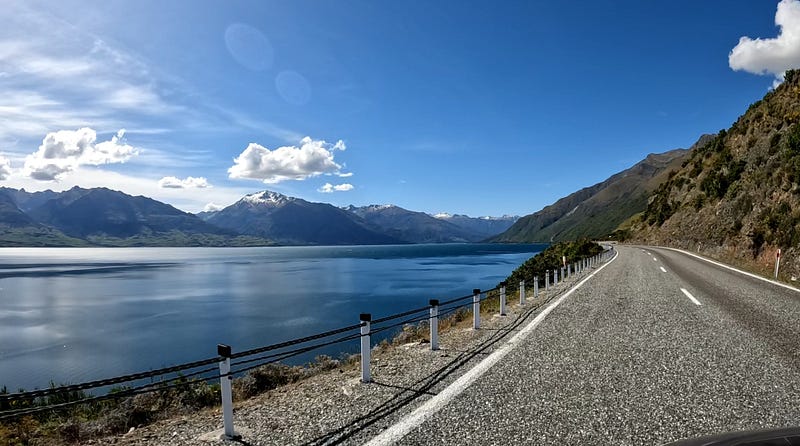
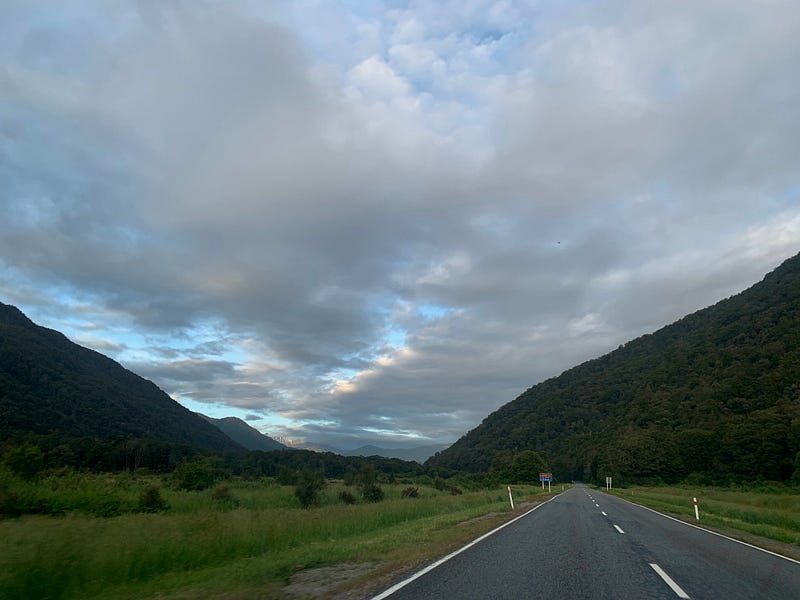
The day didn’t start as planned as our working day dragged out and we hit the road a lot later than we had hoped. The drive was stunning starting on a scenic road hugging the side of the mountain next to Lake Hāwea. Not a breath of wind was blowing as the lake was flat reflecting the surrounding mountains like a mirror.
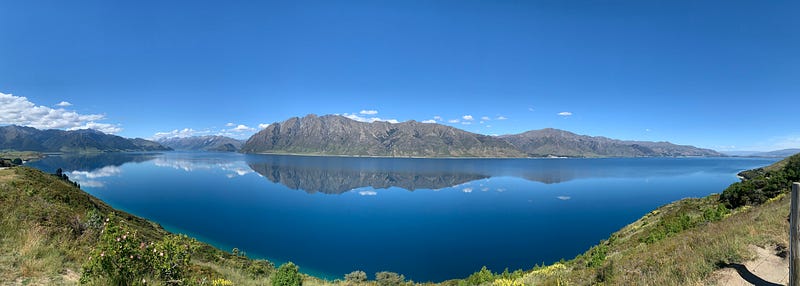
Once we reached the end of the water to our right, the road quickly swirled across from Lake Hāwea to Lake Wānaka passing the end of the mountain range building up between the two massive bodies of water.
The highway we were driving on is the main road cutting through the mountain ranges of the Southern Alps bringing locals and tourists to the wilds of the West Coast.
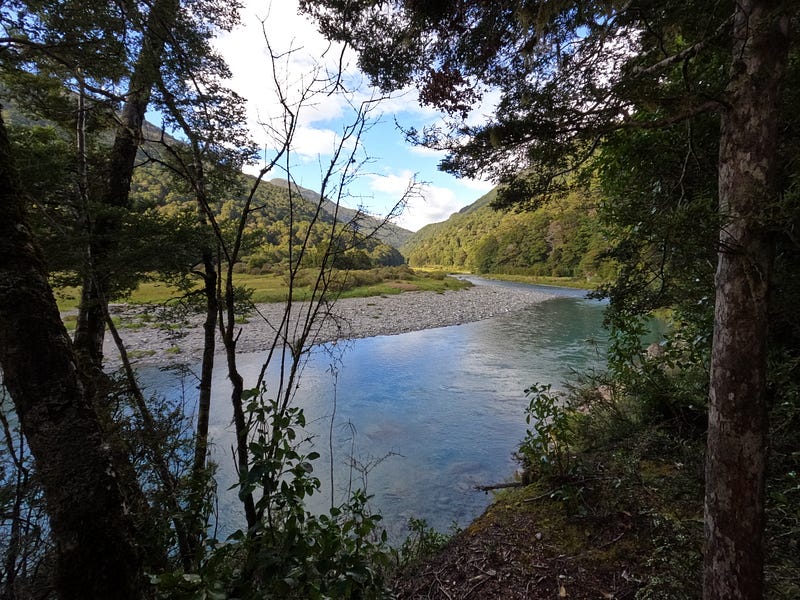
While we didn’t plan on getting to the coastline, we stopped our car just off the road on a gravel patch next to the Makarora River. Covering our bodies in insect repellent, we tied our hiking boots and swung the loaded packs onto our backs.
A new adventure was about to begin.
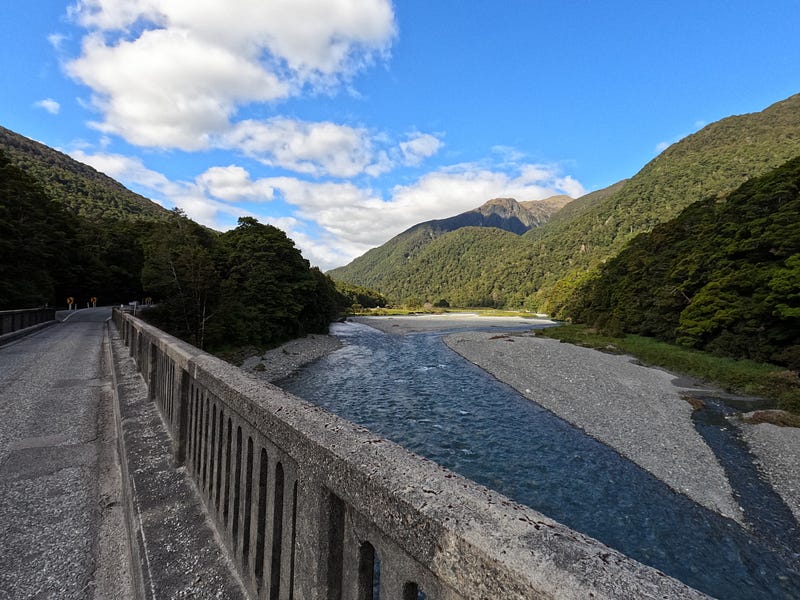
Walking over the bridge across the Makarora River, we entered the bush where a sign was indicating a hut far in the mountains. It was 6 pm by now, still light as the sun sets late in the summer in New Zealand. We had no intentions of reaching that hut but setting up camp somewhere along the riverbanks once we got out of the thick forest.
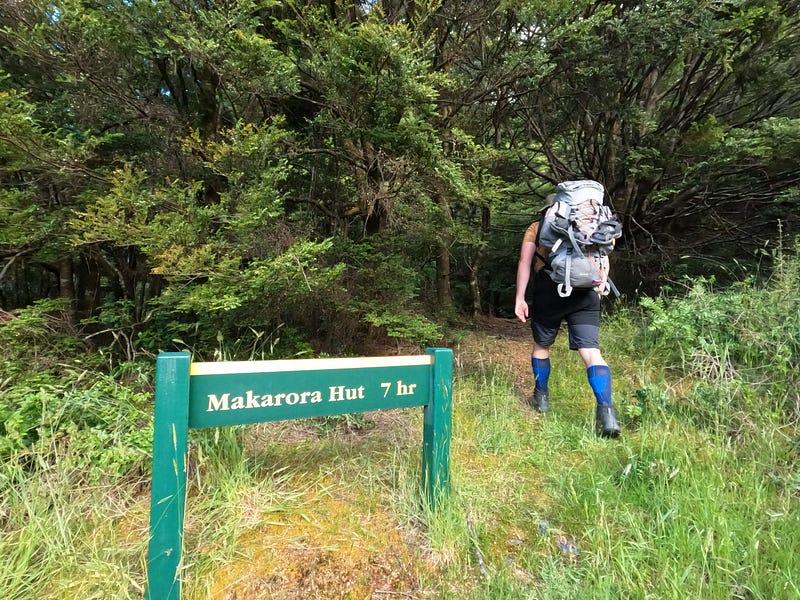
Anyway, just five meters past the start of the track we had our first river crossing ahead. No, there are no bridges or fixed walkways across bodies of water in the country once you leave the well-trodden tourist trails.
This stream was fast-flowing but not a challenge for us. Using our hiking sticks as a support we were across the water with two steps and began our journey in the forest.
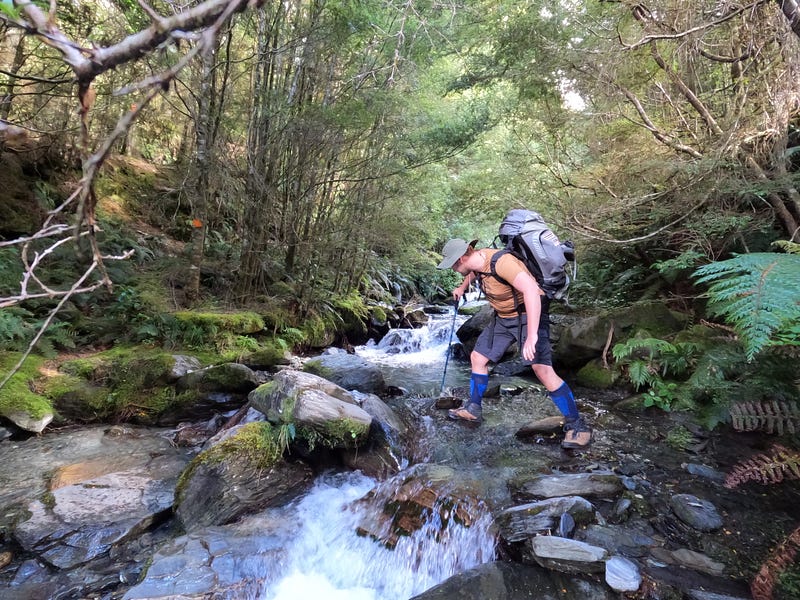
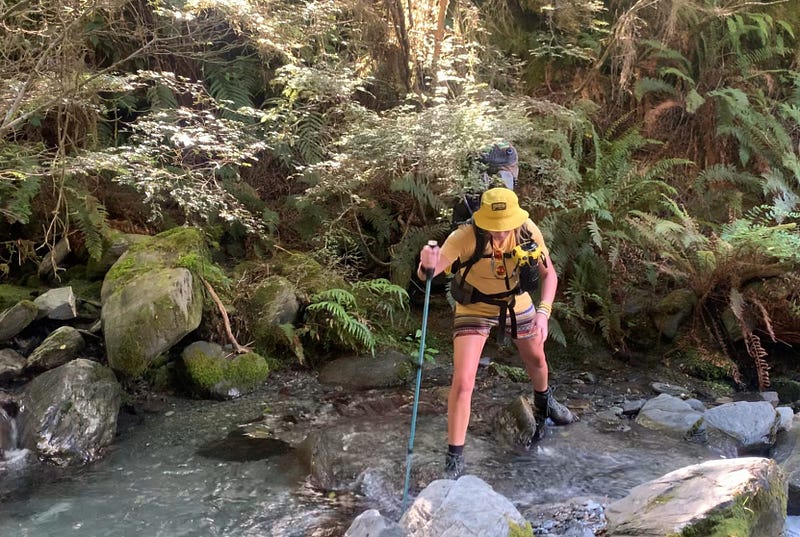
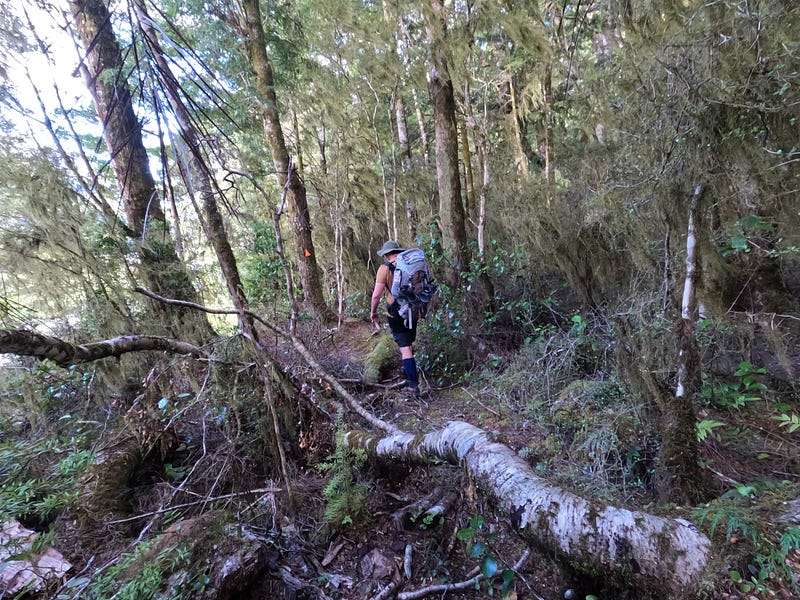
While the hiking trail was narrow, I wouldn’t call it overgrown as it was well-marked with small orange tags mounted on trees along the way. Some parts of the trail were very swampy and we took it slow not to disappear in the mud. Having wet feet and soaked shoes right now would have forced us to turn around.
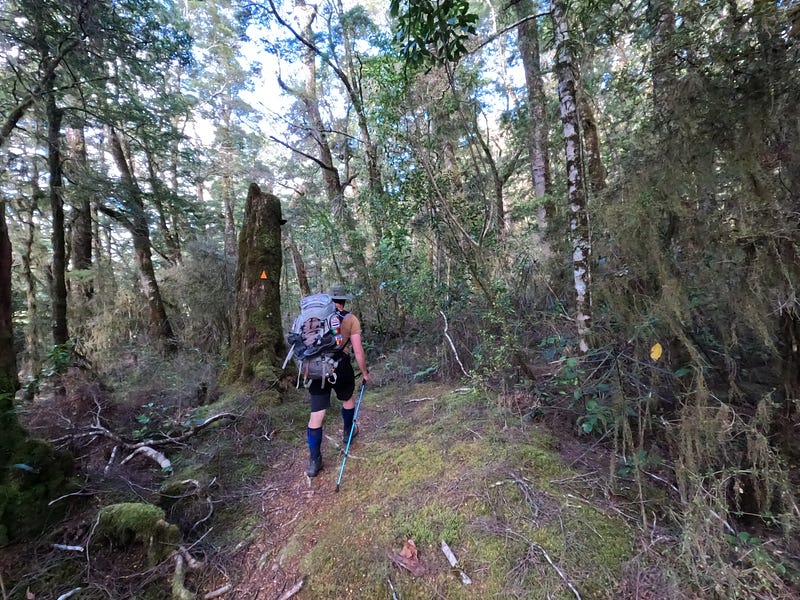
While the forest was thick and we sometimes got stuck with our backpacks in the bushes around us, the trail wasn’t rising in elevation much and meandered along the shores of the Makarora River.
We had to cross a few fallen logs while most of them had been cleared off the trail. We did try not to stop too often to cover some ground as we knew camping in this thick forest was not an option and it would take us a while to get out of it.
As David was leading the trail, I heard him exclaiming “Wow, that’s a big waterfall” upon spotting the sight between the trees in the thick forest.
Trying to research this waterfall, the trail leading up to it and any information on people hiking it failed as the web would navigate me to similar named and a lot more popular falls in Utah, the US.
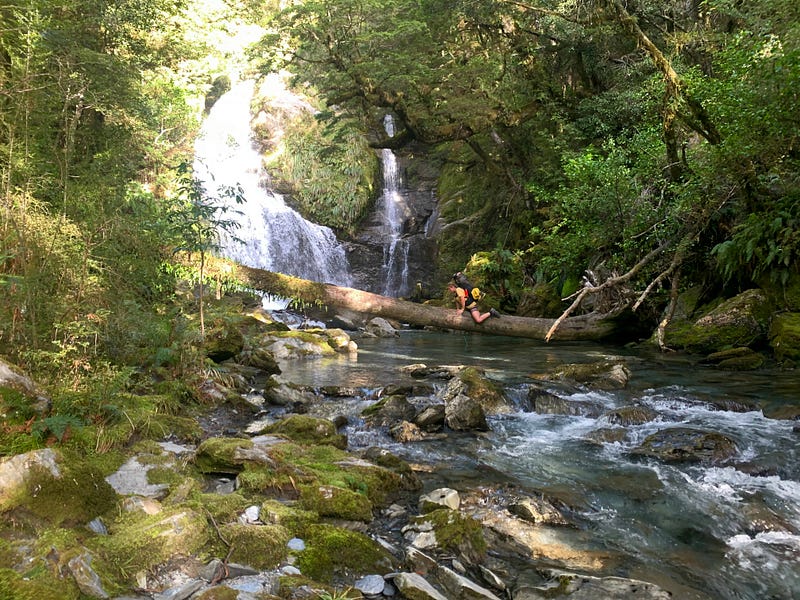
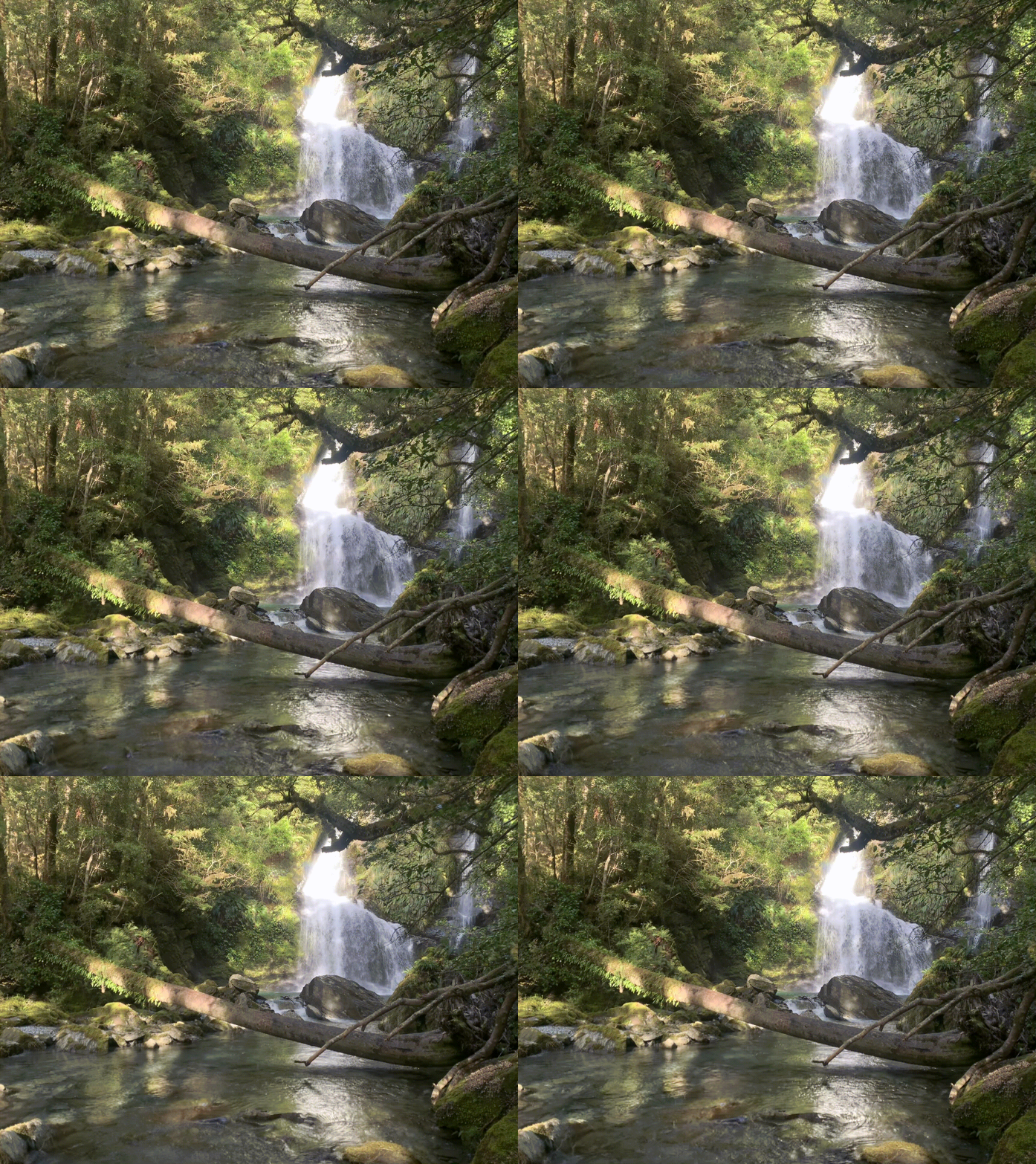
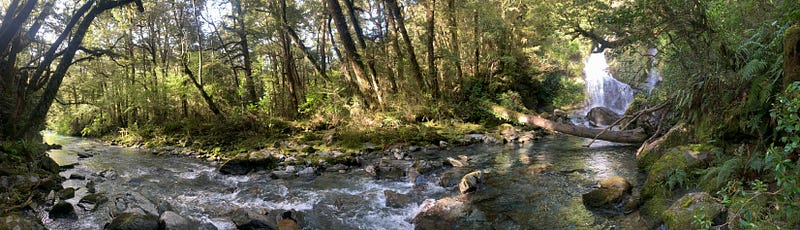
Stewart Falls, once spelled with a ‘t’ and once with a ‘d’, are located in Central Otago just a few kilometers before Haast Pass, the highest point of the highway leading to the West Coast. While the falls are just a few hundred meters away from the road, the often roaring Makarora River lies in between, which forces one to take the long walk around as we did.
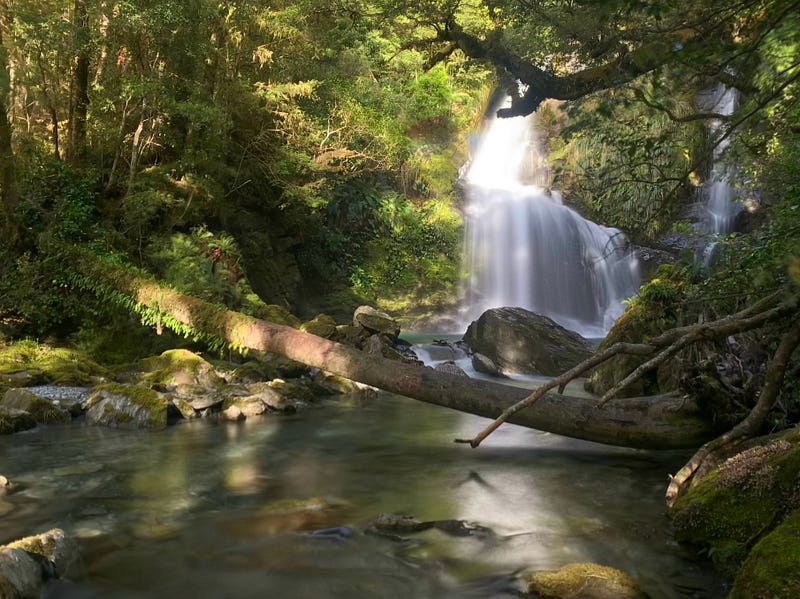
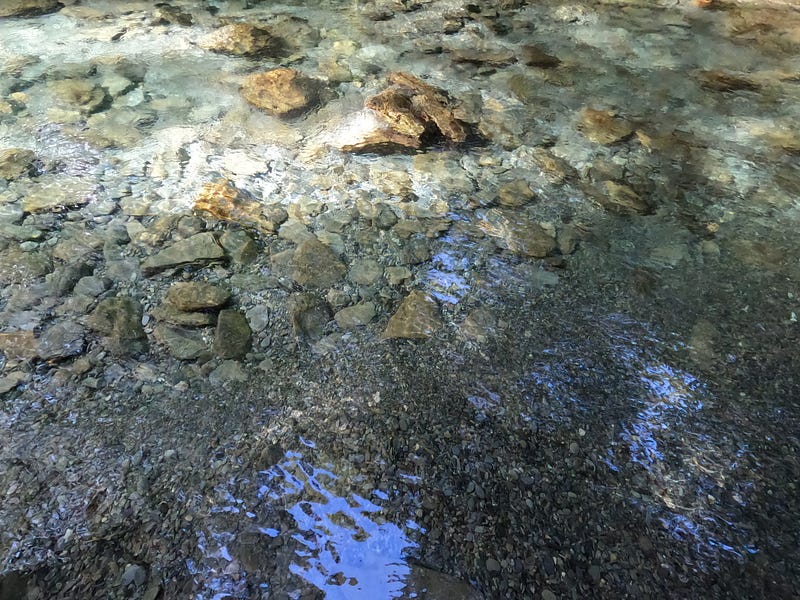
Standing at the edge of this stream coming out of the falls, we gaped in awe. The water was crystal clear and shining softly in a mixture of green and turquoise blue.
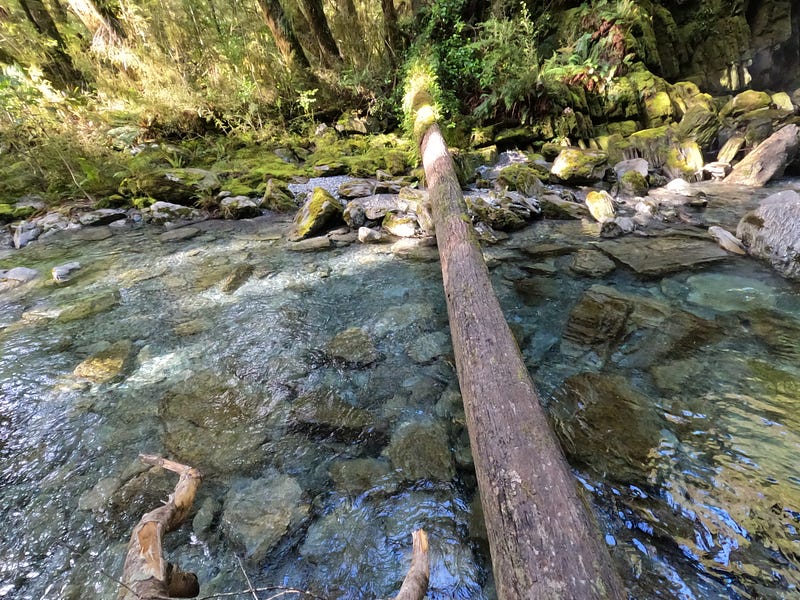
The first thing we noticed was the lack of a bridge. Yes, we knew our trail continued on the other side of the falls and the other side of the river but nothing but a fallen log was leading across.
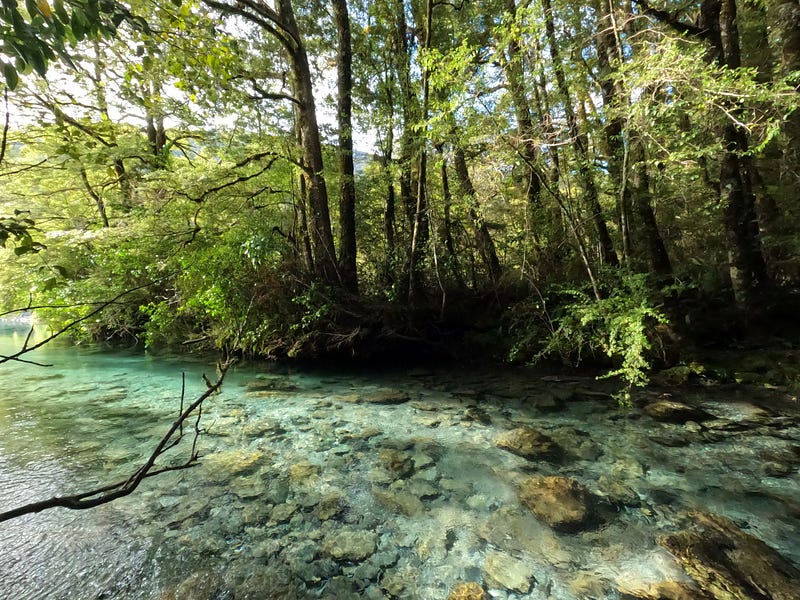
While being mesmerized by the beauty, serenity and incredible rawness of this place, we began debating our options of getting across.
While I quickly referred to the fallen log as a possible use for a bridge, just getting to that tree was a challenge as slippery and moss-covered boulders were lining the shores forcing one to scramble from the point we were standing at.
David shook his head saying the log was too high above the water and not suitable for a crossing, referring to the rocks in the water he would use to get through the stream while I ditched my backpack to scramble to the log and inspect it closer.
In the meantime, David had taken his shoes off and stepped into the cold water. Yes, this would have been the better option of the two but as he stated I had made my mind up about that fallen tree and just wanted to experience it.
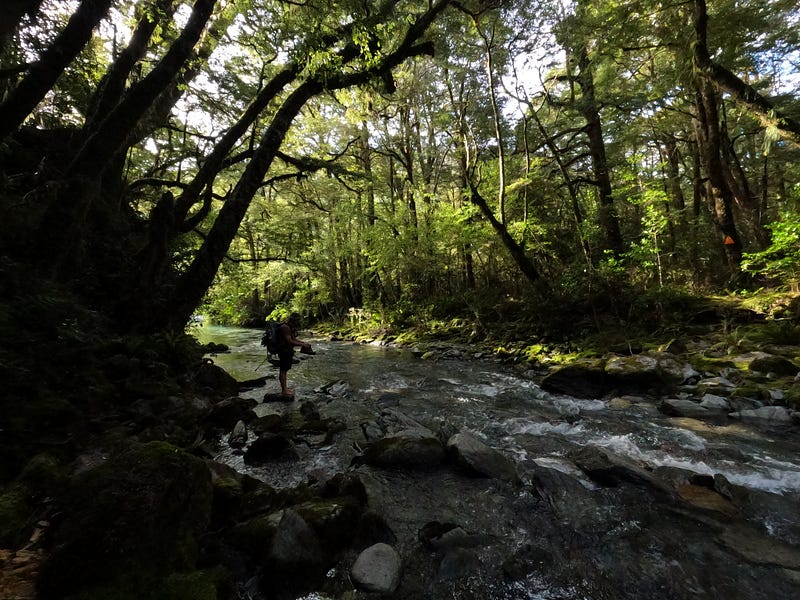
I scrambled across the boulders on the edge of the stream holding onto rocks while sliding across the slippery surface to get to my selected crossing point.
Standing on the log with a loaded backpack looking down onto the tree trunk I quickly noticed that walking across was not an option. The top of it was very narrow and possibly very slippery. The chance of me sliding off and getting hurt while falling into the water would have been too high.
And this is where I need to insert some information. Someone had asked on a previous hiking post if I had always been this adventurous and especially fearless person.
Even if it does seem to many, I am anything but fearless. I was raised in a way to become this adventurous person through many lessons in risk-taking and judging danger.
I don’t see myself as fearless when I cross a river on a fallen log as I analyze the situation, assess the danger level and then make a decision on if, how and when.
On the contrary, I see people as fearless who get into cars racing across highways or winding country roads with no or little experience on how cars behave at high speeds in different road conditions.
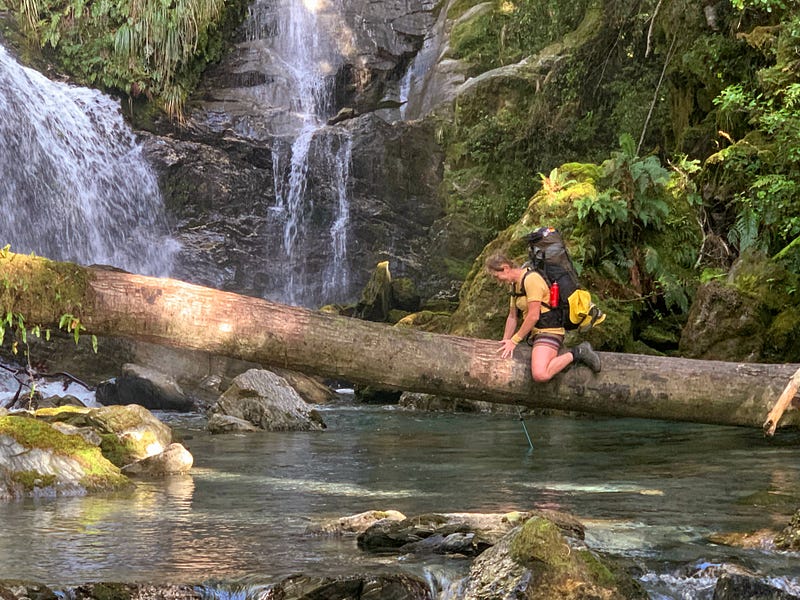
After assessing the situation, I sat down on the log, hugged the tree with my feet and slowly pushed and pulled myself forward which worked well until about past the middle of the stream where the log raised and I struggled to move even an inch due to the heavy weight on my back.
David had long crossed the river, dried his feet and put his socks and boots back on when he was half laughing, half teasing me about my stubbornness and the result of being stuck on the fallen tree.
And while I couldn’t deny his accusation, I didn’t feel weak enough not to ask for help. I don’t see asking for help as a weakness. Not sure about you.
He came toward the front of the log telling me to move half a meter further from where he then could take the backpack. I slowly moved it off my shoulders and held 16 kilos in my left hand while making sure the load wouldn’t swing me around until he could take the backpack.
And there I was. With all my stubbornness, risk taking and danger assessment skills, I made it across without getting wet and just a few scratches between my legs as I was sliding on the harsh bark of the tree.
But most importantly, I had a big smile on my face leading from one ear to the other.
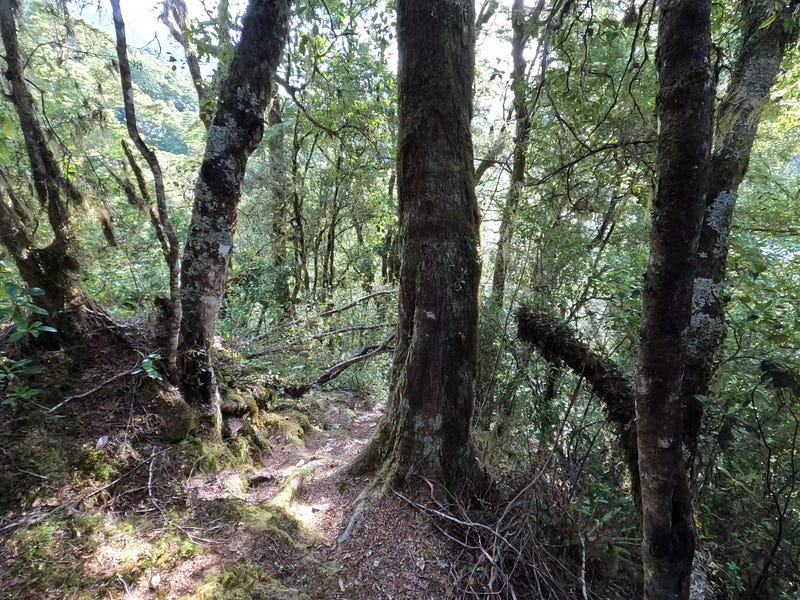
This was where the trail was now leading straight up the mountain for the next 200 meters in elevation. We discussed, stopped, looked at the map of AllTrails, continued walking, and still wondered if we’d make it across this hill and back down to the riverbed where we would want to pitch the tent before dark.
Right about here, I heard that penetrant sound of a bird and then saw the species sitting on a branch just about a meter in front of me. He was spreading his long feathered tail, lifting it up and down in some sort of dance while happily chirping along.
I froze in position while the bird flew into a nearby bush, and jumped up and down on a twig just to land again back on the forest floor and continue his dance.
While I had my camera by now in the backpack, I simply marveled at the scene I was witnessing being sure this little fella was performing some sort of a love dance trying to impress a female.
I let him be and ventured on. With a smile on my face.
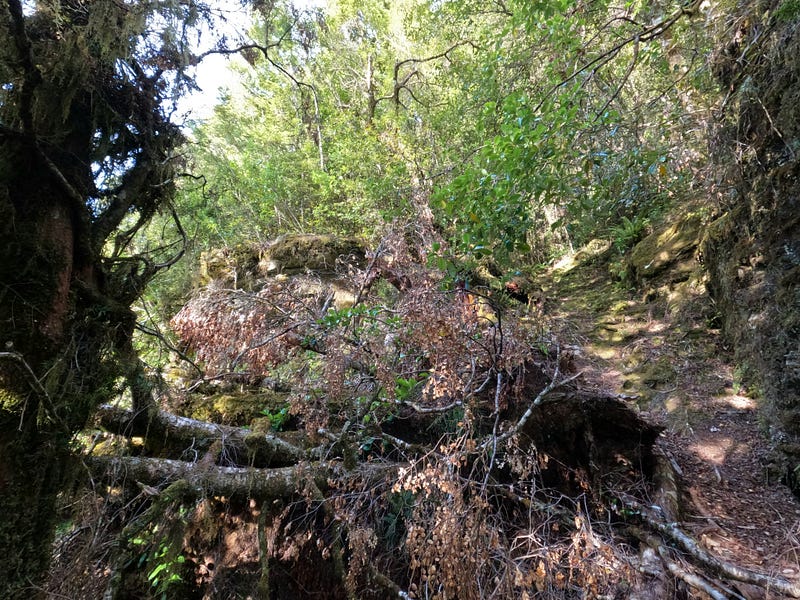
After David told me these are his least favorite kind of hikes and noticing we had taken an hour and a half to get this far, we began to have doubts if we would make it to a suitable campsite that evening.
A few meters further he decided we reached our decision point. We were moving too slowly, covering too little elevation in too much time for us to get out of this forest in daylight.
Turning around and looking for a spot back down in the valley was our only option as I mentioned to have seen a small patch of grass not far from the waterfalls where we could camp.
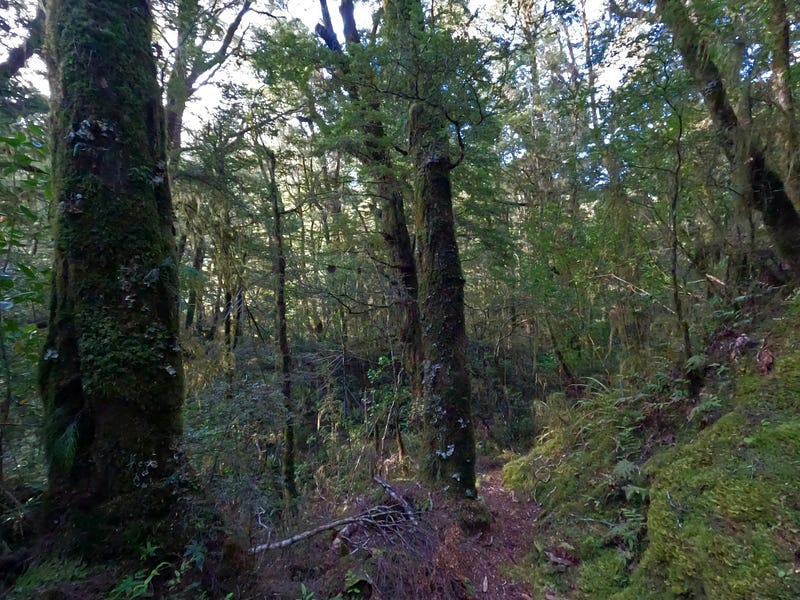
Without many more discussions, we turned around on the spot and backtracked what we had climbed up. While I was certainly disappointed, I knew this was the safest option and best decision we could have taken at this point.
Sometimes in life one has to give up on the destination to be able to continue to grow. If we had continued and not reached a suitable camping spot, we might have ended up in a much worse situation.
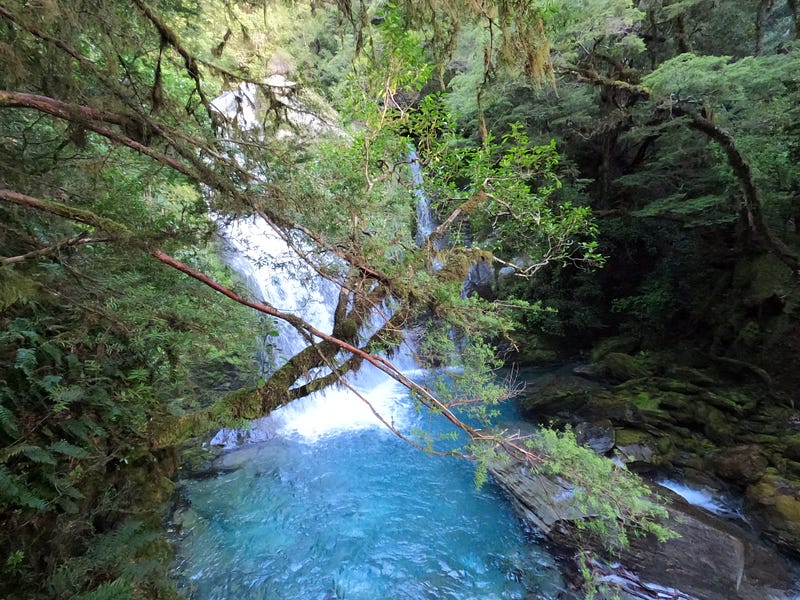
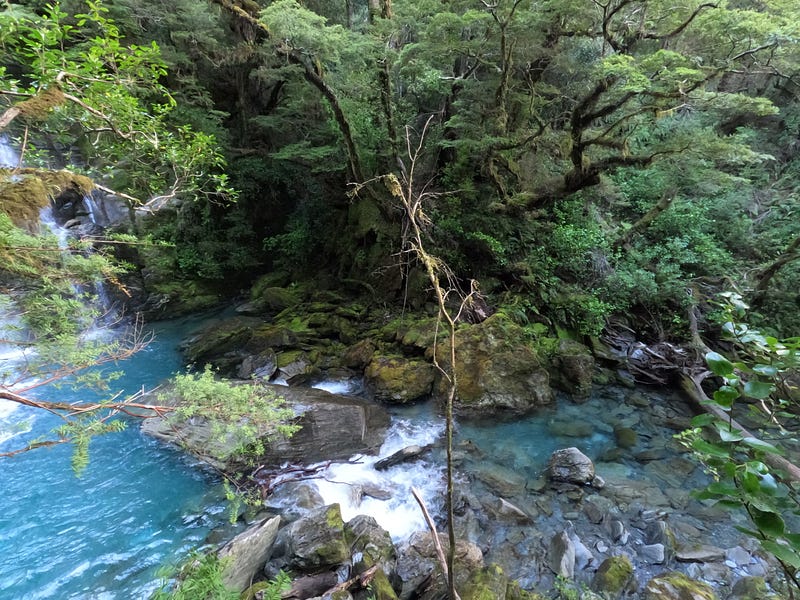
Admiring one more time Stewart Falls, we moved down from the stream without crossing the water inspecting the patch of grass I had mentioned. It would have done for a camp but wasn’t very pretty and would have certainly been infested by biting sandflies.
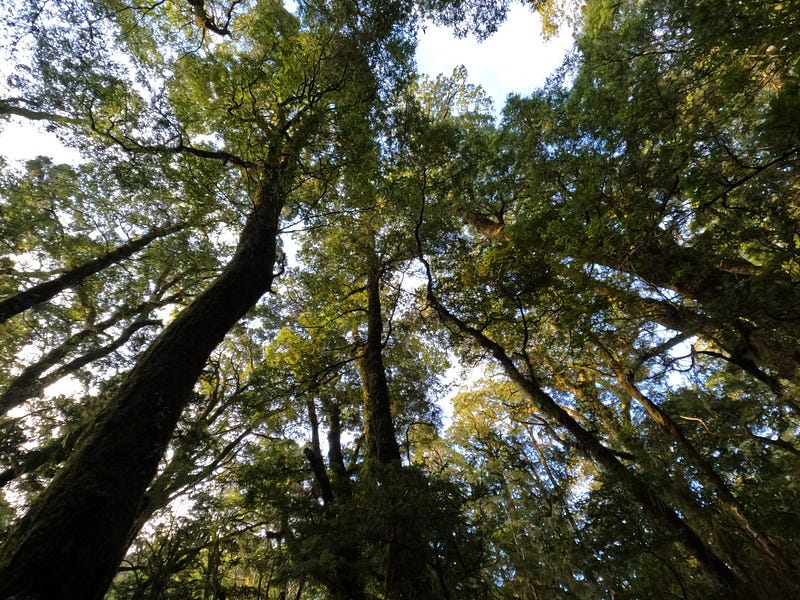
Walking further down along the riverbank of the Makarora River, we were looking out for a sandy spot but only found rocks and uneven ground.
What now? David was asking me about Plan B when I shook my head even though he said it isn’t like me not having another plan. I said camping by the waterfall was my Plan B but if we’d get to the car we could drive a few kilometers up or down, camp on an official site and drive through to the Westcoast tomorrow morning.
“How do we get there?” he asked while looking at the river ahead of us and seeing the highway running just meters behind it.
Get back on the trail, cross the creek and walk another hour through the thick forest or cross this river in front of us and walk back along the road which would probably only take a few minutes.
Before doing our first overnight hike in New Zealand, I had done a fair bit of research regarding the different conditions one should expect here compared to hikes in Europe and what other knowledge one needs.
The biggest point was river crossings. While almost every even the tiniest creek in the Alps has a bridge, fixed walkway, or at least a plank of wood leading across, here in New Zealand one has to take off the shoes and get through.
I knew to not cross a river in full flood which can be identified by the color of the water and its debris flowing along. Also, the river shouldn’t flow faster than walking speed and shouldn’t be deeper than the thigh level of the smallest person.
“Are we gonna do it?” David was asking as we both looked up and down the river. It didn’t look dirty or particularly deep but the sunlight was almost gone and we knew the water toward the far end of the shore was a lot deeper than where we were standing.
“Let’s do it”, I responded while taking my boots and socks off and tying them onto the backpack. Each having one stick as support, we slowly stepped into the cold water. The temperature soon didn’t matter to us as this was about the point where and when our insect repellent wore off and those incredibly annoying and biting sandflies began to attack us.
With one hand holding onto David’s pack and one hand gripping the stick while trying to fight off the swarm of flies, I slowly walked behind taking each step with care only putting weight onto the next foot once I knew the rock below was stable.
David just stopped to wave off some flies when he informed me about the water being knee-height. A few steps later I told him the water was now at my thighs and the current was getting stronger but we were already more than halfway across.
Knowing what I had researched about river crossings, we both knew we were at a crucial point. Since the current was strong, we took our steps very slowly and carefully. One of us moved a step at a time while the other one was standing stable. Just one misstep and we would fall into the fast-moving water.
“This is the deepest it will get, we’re almost across,” said David as a wave of water touched my shorts. But neither of us was interested in turning around.
The reason why we could cross the river safely was its incredibly clear color as we could see even at the deepest point where boulders were lying higher which we could stand on.
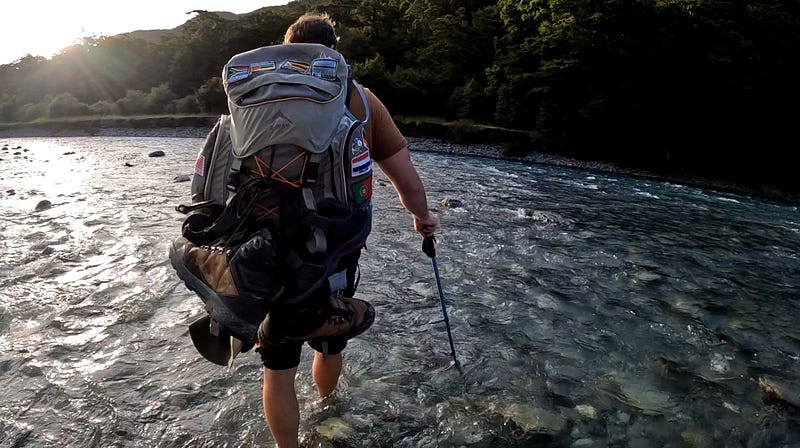
Sure enough, two steps later we were back on shore and I quickly dropped my pack to access the insect repellent as we had to reapply now or we’d have gone crazy. The crossing wasn’t that bad if it hadn’t been for the flies distracting us and pulling our attention off the current.
We climbed up the shore and were on the road. Walking just a few minutes back on the highway, we soon reached the car which was certainly quicker than going the long way through the forest with another river crossing.
A sign was indicating the nearest campground and we drove deeper into the Westcoast as the clouds were clearing above our heads. I couldn’t believe it. We still had daylight and it was long past 9 pm.
Reaching the campground we had a quick debate on where to set up camp before David exclaimed to just put it up right there, in the middle of the grassy patch.
It didn’t matter. We were here to sleep and move on in the morning again. We set up our new tent in a few minutes, moved all our luggage inside and crawled in while leaving the GoPro outside. Still recording…
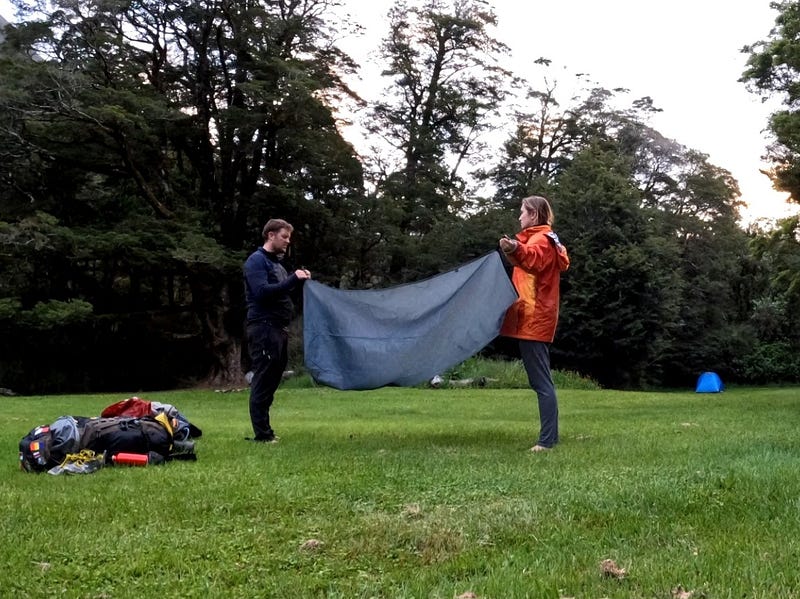
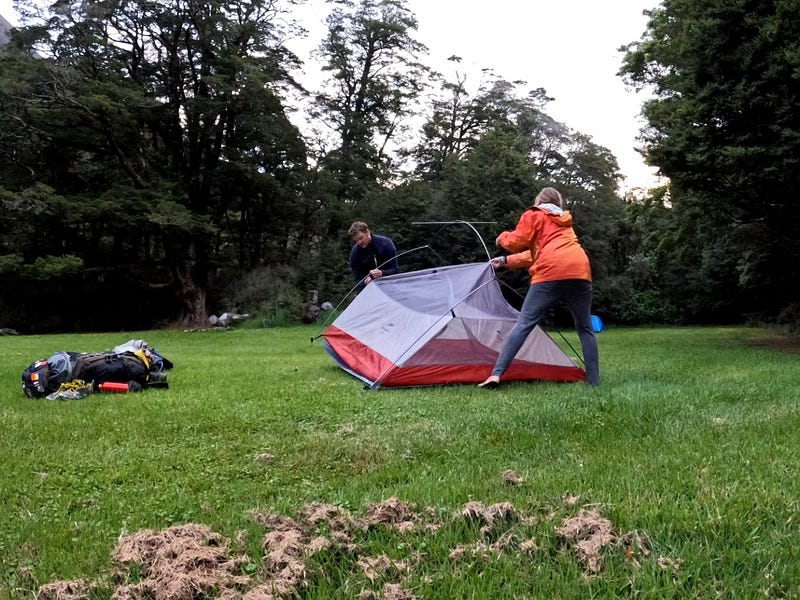
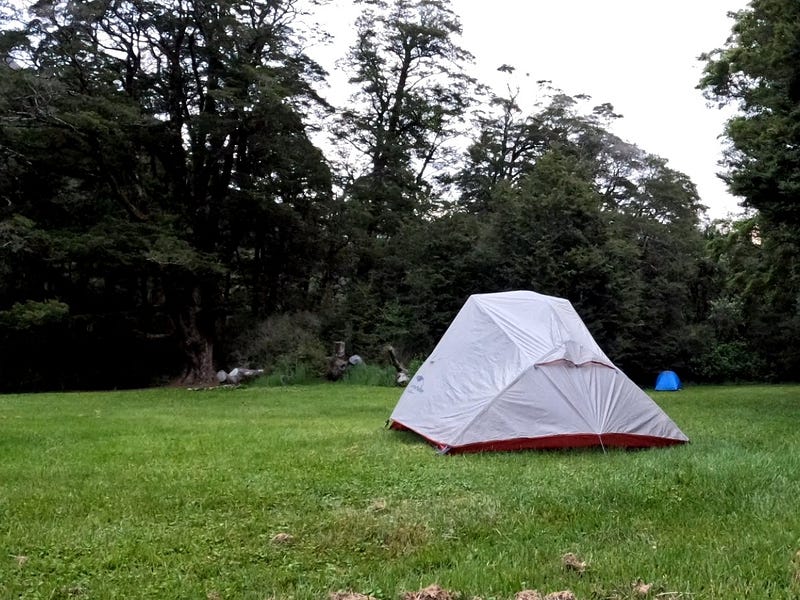
Yes, we took risks but assessed the danger level and risk ahead always by analyzing the situation, which is why we were now snuggled up in our sleeping bags. Safe and dry.
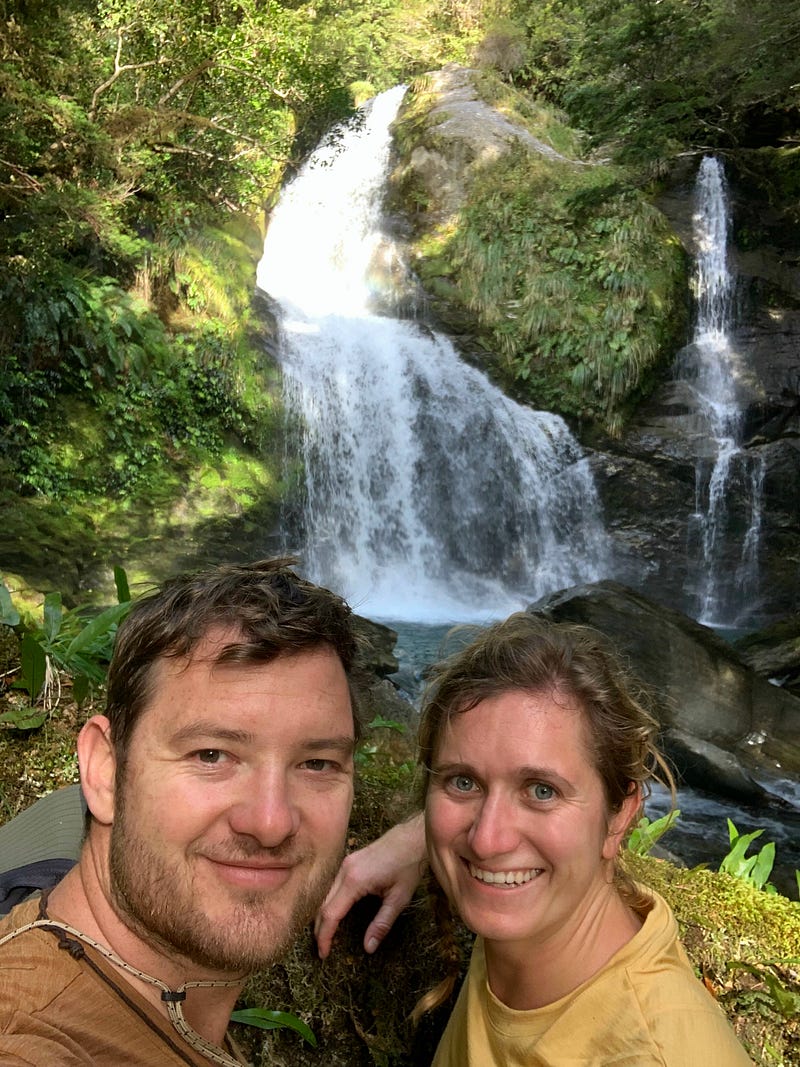
And if you still see this experience as a failure, look at our faces just after we crossed the stream below the waterfall, one way or the other. We were overly excited and happy about the adventure.
Whether we got to set up camp in the mountains or not, we had so much fun those three hours hiking in the mountains and learned a thing or two along the way.
If you’re interested in my New Zealand adventures, subscribe to my newsletter to stay updated or check in on my new list regularly. Join my email list here if you would like to read more photo essays.
Shutterstock | Instagram | YouTube | Mailchimp | Amazon | Redbubble


