Learning New Things Can Be Hard
Embracing the Suck to Find Success.
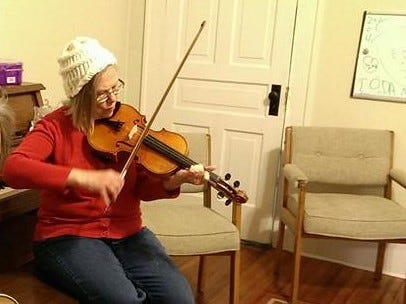
I kept coming back to Dixie’s Coffee Shop week after week for the Saturday morning Bluegrass jam, trying to learn the fiddle. Everybody could hear me screeching away in the background.
I was 62 years old when I started this adventure. It was on my bucket list.
In the Bluegrass jam tradition, local musicians showed up at Dixie’s with their instruments and cheerful chatter to play the music they loved. There were lots of animated discussions about who wrote what song and what key it’s supposed to be played in.
Bluegrass music, considered modern music, started in the 1940s by Bill Monroe. There is some disagreement about who actually started it but Bill gets most of the credit. Bluegrass combines mostly country music and old-time music. The name originated from the blue grass that grows in Kentucky.
I stepped out on stage.
On this particular Saturday, I took my place behind the microphone. This is the first time I had taken my turn to lead a song, and my hands were shaking.
I looked out over the audience of coffee-drinking patrons. I played the kickoff so the other musicians would know when to come in and launched into the only song I knew how to play, Amazing Grace. The shaking didn’t stop throughout the entire song but I fiddled on.
An amazing thing happened between, I once was lost, and But now I’m found. The audience stood up and clapped. They really did. What a feeling! I wasn’t sure what to make of it. Was that for me? Apparently, it was. Maybe they were just relieved I had finally learned to play something.
I finished the last line, Was blind but now I see, and stepped away from the mic. With a big fat grin on my face, I nodded to signal the other musicians who wanted to take a break, or play a solo, as is the bluegrass way in a jam.
I helped keep the rhythm by chopping the bow against the strings on the 2 and 4 count in time with the music. I chopped and shook while the banjo, guitar, and mandolin players took their turns.
As the song leader, I was supposed to play the last lines, stick out my foot to signal it was time to stop, and play Shave and a Haircut so we would all end the song together. I forgot all about that. I was still stunned by the claps of encouragement. Somehow we all ended together. The other musicians knew what they were doing and took up my slack.
This is how it all started.
I listened to the screeching, stepped-on-a-cat-noise that was coming out of my fiddle. I couldn’t even get a good sound out of playing just one string. It can’t possibly be that hard. Oh, my God, I will never be able to do this.
The fiddle is one of the hardest instruments to learn there is. I chose it because I love listening to Bluegrass fiddle music played by somebody who knows how to play it.
The chop, chop before all hell breaks loose and you hear the train whistle coming down the track on Orange Blossom Special is a sound that still gives me chills. I wanted to play the fiddle like that, too.
There is a lot to learn about the fiddle.
First thing, there are no frets to show you where to put your fingers. You wouldn’t be able to see the frets anyway because the neck is out by your ear.
Everything has to be just so. The bow with the perfect amount of rosin has to be pulled across the strings at the perfect angle with the right amount of pressure. Not too hard, not too soft, but just right, Baby Bear.
The shoulder rest and chin rest have to fit your body so you can hold the fiddle without breaking your neck. My shoulders are very narrow so most shoulder rests land on my arm instead of my shoulder.
I solved that problem by getting a Bon Musica shoulder rest. It curves so it hooks over the shoulder instead of lying flat. It worked so much better than the original rest I was using.
I paired that with WAVE chin rest whose shape juts out toward the chin. Ahhhhh. That’s better. Now all I have to do is turn my head to hold the fiddle.
Getting these fiddle parts was a way of supporting myself. I could now put my attention on learning to play instead of trying to keep the fiddle from falling on the floor.
Our brains don’t like change.
I know I’m not dumb. I have proof. But learning something new sure makes me feel like it. I don’t like feeling dumb. It makes me want to quit.
Learning something new is hard because our brains see it as a threat.
We are hardwired to resist change — it’s natural. Part of the brain — the amygdala — interprets change as a threat to the body and releases the hormones for fear, fight or flight. Your body is actually protecting you from change.-Chris Pennington
When we are entering uncharted territory, like we are when we’re trying to learn something new, the lizard brain kicks in and shouts warning signals, to STOP IT! GO BACK! DON’T DO THAT! YOU ARE GOING TO DIE!
There is nothing wrong with you when this happens. It’s just your brain trying to keep you alive.
When learning something new you will not be good at it at first.
And it will feel uncomfortable. That’s normal. Face the fact. Accept yourself where you are, for now. Comparing yourself to other people doesn’t help.
There are some things you can do so you don’t get knocked sideways and quit when you are starting out on a quest. You want to be able to keep on keeping on.
I wish I had known more about this when I started out with the fiddle.
Get a teacher to help you.
I did have enough sense to do that when I first started learning to play the fiddle. I found a tutor that I liked and started taking lessons. She was classically trained but played in a Bluegrass band she started herself. I liked that. I wanted to learn to read notes so I could play other kinds of music if I wanted to. She was also patient and kind and knew how to help me make subtle corrections.
There are lots of tutorials on youtube for all kinds of things. With the internet, we have so much information at our fingertips. There is no reason to delay getting starting.
Take it slowly and start small.
Assess where you are. Figure out what the next step is. Practice with intent.
Start with manageable chunks. Don’t bite off more than you can chew. It’s easy to be overwhelmed if you focus on too much all at once.
Decide what you want to learn. Break it down into steps. What is the first skill you need to work on?
Practice with the intention to learn a specific skill. Practice or work on that one specific thing. When you learn that go to the next thing.
Talk to yourself.
Sometimes a good old-fashioned pep talk is in order.
Hey, you. You can do this.
You have done hard things before.
You know how to figure this out.
Think of how much you will enjoy knowing how to do this.
Look how far you have come.
Breathe.
Shallow breathing makes your muscles tense up. It can sneak up on you. You may not realize it at the time that your breathing is shallow.
If you feel yourself tensing up, take some slow, deep breaths, starting at the lower belly, not just in your chest. You will soon feel the difference.
Be in the moment.
Try to stay in the moment and pay attention. Remove all other distractions, like the television. Turn off your phone. Turn off the music.
Appreciate this free time you have to devote to your new project.
Nothing else matters for the next few minutes or hours while you spend this time doing something that is important to you.
Sit with the discomfort.
Some people have more tolerance than others for being out of their comfort zone. I think it is something you can get used to.
Feel whatever discomfort you are feeling. You don’t have to identify the feeling. Just sit with it. Don’t jump up and go get a cookie.
Think about it: if you didn’t mind fear, rejection, sadness or hurt — that is you experience them but can tolerate them — you would become unstoppable. Don’t pursue comfort or security. Pursue discomfort. The resilience will follow. -Mark Manson
The amazing thing is, if you allow yourself to feel the anxiety or stress, it will evaporate and you will be left with peace and calm. It takes a little practice but you can do it.
I’ve made a lot of progress.
That’s good news for the people who listen to me play.
I will never be as proficient as my fiddle heroes. I know this is mainly because I’m not going to invest the amount of time it takes to be an expert. I’m fine with that.
I’ve gotten better. And I can play well enough to play with my friends and enjoy playing by myself. I will keep playing and improving.
Angeline the Baker, an old-time fiddle favorite of mine, is my stand-by tune to play in a jam. It’s a good warm-up song for me because I’m so familiar with it. Most musicians know this song and can play along.
My new favorite, Rubber Dolly, is coming along nicely. It has challenging shuffles and fast string crossings. I definitely have to use the methods suggested above when I work on this one.
I like those standing ovations. I want more of those. But mostly I like learning new songs and playing music with my friends.