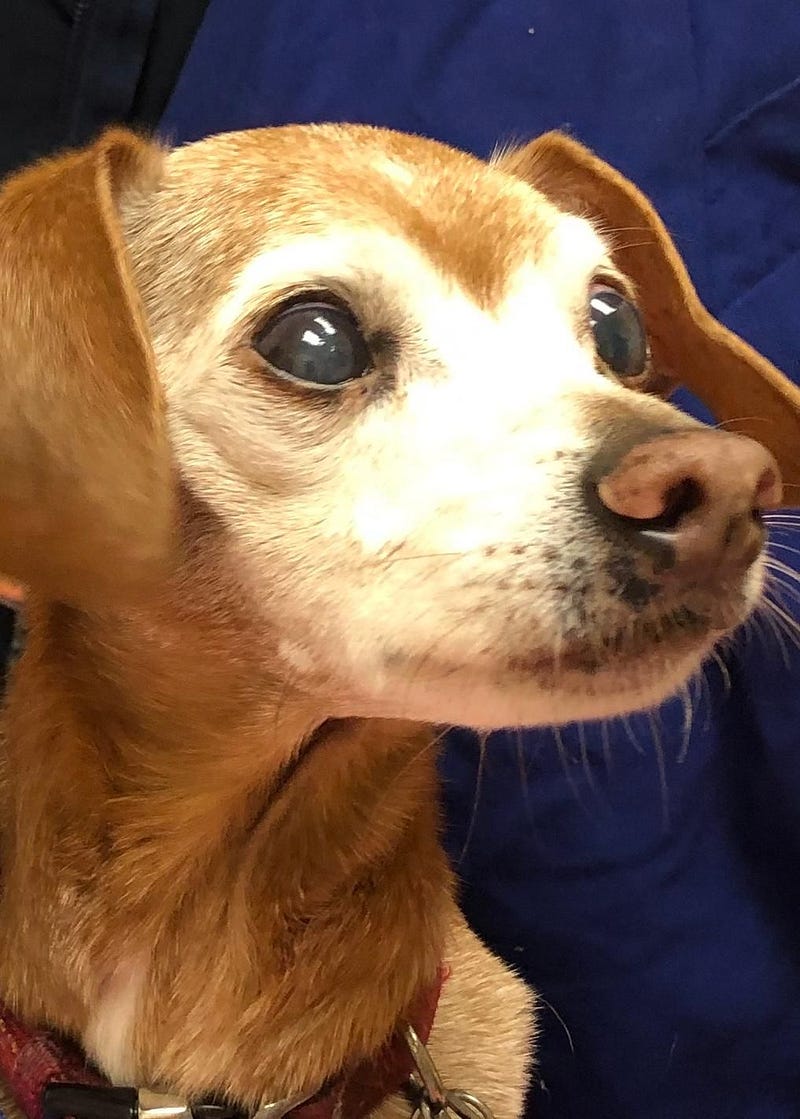
Learning from Chipper
I don’t speak Canine. But my ninety-four-year mother is fluent in this language. She has numerous conversations with Chipper, her beloved beagle. Most often they go something like this.
“Do you think it is hot out?” she asks.
“Yip yap yip.”
“Yes? Do you think it is hot out?”
“Yap yap yip.”
“Do you think it is hot out?”
“Yip yip.”
It is apparent her dog doesn’t mind her constant repeating. He jumps on her lap, curls into a ball and listens. I’ve never heard him cry in desperation. He doesn’t clench his jaw. And he favors water over wine.
Unlike me.
The sad truth is, I’m upset with my mother for getting old and forgetful and for leaving behind the woman who raised me. Because I need that other mother now more than ever. I want her advice on how to deal with her.
If only it were possible to go back a few years to when my mother was still a clear-thinking, active, energetic eighty-seven year-old widow who made the decision, on her own to sell the home she had shared with my father and move into a small apartment in a retirement village. Perhaps if she hadn’t sold that home where the memories lived, where the smells and sounds of my father followed her from room to room, she wouldn’t have lost herself.
That is something I will never know.
At first, she loved her new place. Or perhaps she was only pretending. Although void of the past, it was lovely and filled with the familiar: her worn couch, family photos, a homemade quilt. Every afternoon a buttery strip of sunlight fell across the carpet.
But as the months passed, her mind began to shift. She referred to her apartment as “that place.” The only who truly felt at home there was her dog.
Every time I said goodbye, this woman who had raised me to be strong and positive, who had dropped me off at college with the promise that I would find someone to eat with in the dorm, squeezed my hand and looked at me with frightened eyes.
I would hold her hand and promise her that very same thing. She would find her tribe and make friends. But there is one small, or rather large, difference. Going off to college is the beginning of a new life. Moving into a retirement home is the beginning of our last act.
We both saw the future and neither of us liked it. Two years later, she moved in with my husband and me.
Ever since, it’s been a slow decline into our role reversal. I wish I could shake her like a snow globe and have her mind clear as the flakes settle.
But shaking is obviously not going to land either of us in a better place. What does often bring her back to me is playing a game she has always enjoyed: Rummy Q.
And for a brief moment in time, that other mom makes an appearance.
It always starts off a bit rocky. As I scatter the tiles onto the table, she asks several times what game we are playing.
Taking a cue from Chipper, I answer each time, with kindness. I explain over and over how many tiles to pick and how many points are needed to meld.
And then we are off and running, back to the past. To a place where my mom was a sharp, witty woman who loved to talk politics, recipes and sex. She even gives me tips on how she dealt with my father in his later stages of Alzheimer’s.
My spirits soar each time she makes a complicated play. I imagine that she will once again be able to shower herself. That she won’t look at me with her mouth open slightly, her head titled as if she’s trying to figure out what she’s reading. She won’t try to call her only friend using the remote control.
But nothing lasts forever.
“We’re tired, aren’t we Chipper?” she says.
As we stack the tiles, her face travels to that blank place.
“What game did we just play?” she asks
. I close the box. The click of the latch, the loudest sound in the room, shutting out all possibilities of a different tomorrow.
“What game did we just play?” She asks Chipper as they shuffle down the hall. My mom collecting her memories. Chipper filling in the empty spaces with unconditional love
. “Yap.Yip.”
I imagine Chipper is telling her she is not alone. There is no need to be afraid.
“You’re right, Chipper,” I say before my mom can answer. “Together we will care for her and help her remember.”
“Yip. Yap. Yip.”
Author’s note — Last week, Chipper passed over the Rainbow Bridge. I can still his yipping and am remaining patient as I help my mother cope with this loss.