
Learning French is Difficult. Translate it instead.
My plan to pick up French for the next 30 days.

“All men of genius, everyone distinguished in the republic of letters, is French, whatever his, nationality.” Napoloen wrote from Milan in May 1796 to the eminent Italian astronomer Barnaba Oriani.
My Motivation
Inspired. Those words were good enough for any intellectual of his days to lean to the new world that Napoloen Bonaparte was building; where the intellectuals do not need to sequester themselves from the persecution of the church.
It was a radical thinking ahead of its time. Napoleon’s idealism of a world of equality, fraternity and liberty has stood the test of time. For one, the secrets of ancient Egypt would have remained buried if not for the discovery and deciphering of the Rosetta Stone by Napoloen and his countrymen.
Unbeknownst to many, Napoleon himself was a prolific writer who had written many forms of manuscripts, from novella to political brochure. He was a man of letters himself.
I vowed that one day I will read Napoleon’s word in his original written words.
Unfortunately, French has proven to be a tad more difficult, especially in the conjugation of verbs, gender in the nouns, irregularities and such.
For the past year, it has been an on and off affair for me until I discovered a hidden gem; a book by Celia Brickman, “ A Short Course in Reading French”.
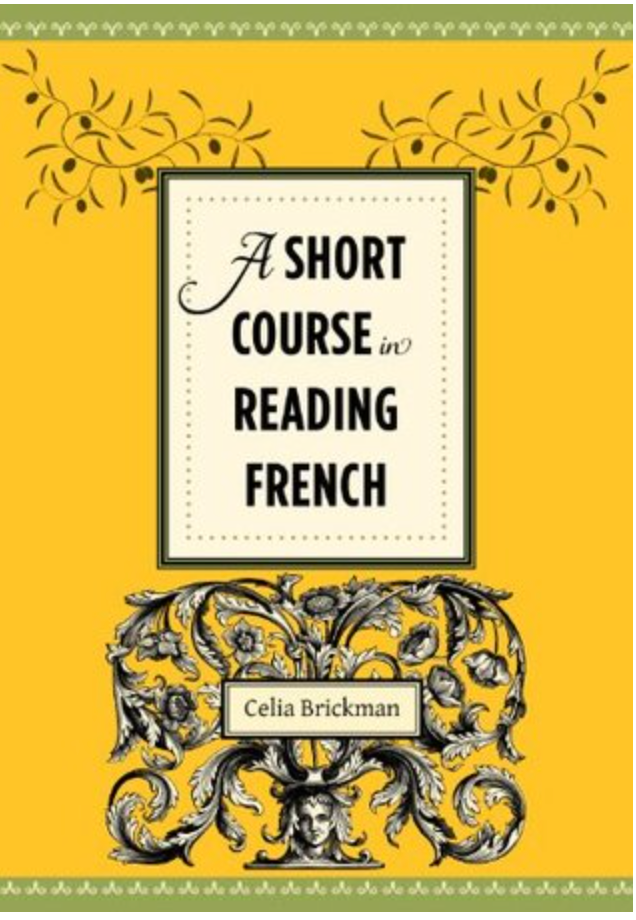
The Hidden Gem
Published in the year 2012 by the Columbia University Press; it was meant to be a supplemental reading for doctorate students of philosophy where French mastery is mandatory.
It is written to help students understand how to translate French manuscripts back to English.
You, the reader will be seen upon as a native English speaker translating French back to English. For me, that’s the best method to quicken the ability to read French.
Why Translate
Most of the other languages when we learn it from the very beginning, we need to pick it up like a child; the vocabulary, the grammatical points and the speaking ability. One of the strong reason for that need is that the language do not share similarities with any that we have known so far.
That is not the case with English and French. Although there are differences between the two languages, they also share many similarities.
For example, both the languages share the same sentence structure; they are both of the SVO format. SVO stands for “Subject-Verb-Object” unlike that of say Japanese which is a SOV format, “Subject-Object-Verb”.
Do allow me to illustrate the differences;
(a) Subject-Verb-Objet (SVO)
English : I kicked the ball. French : J’ai frappé le ballon (I have kicked the ball)
(b) Subject-Object-Verb (SOV)
Japanese :ボールを蹴った。(Ball, I kicked)
What this means would be that if we are equipped with a minimum amount of vocabulary , we should be able to read a French sentence and guess its English meaning rather easily. We do not need to understand a new sentence structure for negation or imperative or what not.
Speaking of vocabulary, a quick Google will reveal that more than 10,000 English words were borrowed from French. And within these 10,000 words, 1,700 of them are true cognates, meaning that they share the same spelling and also meaning.
Some of the examples are;
Animal Central Arrogance Importance Perseverance
Furthermore, many of the English and French words share 6 similar suffixes;
- -ation. Examples: nation/la nation ; information/l’information
- -tion. Examples: acceleration/l’accélération ; attention/attention
- -ssion. Examples: mission/une mission ; passion/la passion
- -able. Examples : capable/capable ; table/la table ; adorable/adorable
- -isme. Examples: Impressionism/l’impressionnisme ; racism/le racisme
- -if/ive. Examples: furtive/furtif/furtive; creative/créatif/créative
(source: Frenchtogether.com)
Although the spelling may not be entirely similar like the previous example, if you know an English word with a similar suffix, the chances that the meaning is the same in French is quite high.
With that you are able to compound your French vocabulary in a very short period of time.
My Plans for the Next 30 days.
Herein lies my plan to jumpstart my French reading and comprehension ability in the next 30 days, by relying on my strength in English.
Through reading Celia Brickman’s book, I am already relearning my English grammar. Surprisingly, it was rather refreshing as I begun to see the fundamental rules why English is written in a certain fashion.
Growing up, I had been taught grammar but was also encouraged to learn it by “permeation”, learn it through lots of reading so that it becomes second nature to me. It was a very good advice as I am able to speak and write effortlessly but the drawback is that I am unfamiliar in explaining the grammar points when asked.
Now with this need to translate, I have begun to revisit English grammar with a more surgical approach as Celia also explains the equivalent of the rules applied in French.
With this, my plan is to turn the entire learning experience into a reverse engineering process.
Let me illustrate further, as language learners we are already attempting to engineer forward when we constantly ask native speakers, “How do you say that in French?”
What I am attempting to do is to read a French sentence and ask myself what are the equivalent grammar points in English and form the English sentence.
For example;
Elle est montée les escaliers
Reverse engineering the sentence to English:
(i) This is a compound past : action that began and ended prior to the present
(ii) Compound past : Auxiliary Verb in present tense (to be or to have) + Past Participle (verb in past tense)
(iii) Auxiliary verb : est (to be)
(iv) Past participle : montée (climbed, went)
(v) Full translation : She went upstairs (She climbed the stairs)
Lastly, I do hope to see significant improvement in my reading comprehension from this new method. If there are folks who are interested to find out the outcome after reading this article, I would be happy to report my progress after 30 days.
Ivan Yong is an organisational psychologist, engineer, author and startup angel investor. He is also the Founding Vice President of Solidarity (Social Projects) for the European Mentoring & Coaching Council, Asia, a member of the Hong Kong Society of Economists and a published author with the book titled, “Department of Startup: Why Every Fortune 500 Needs One” by BEP New York. Last but not least, he is a big fan of history and is fluent in 5 languages.


