
Learning About the Past From Those Who Lived There
The personal side of history
I love good stories. It’s one reason I find history fascinating — historical accounts are based on stories that actually occured. Of course people don’t always remember everything accurately, or they may embellish things. However, first hand accounts of events give an emotional and detailed quality that statistics cannot.
Here are some of my favorite stories that people have shared with me from their own lives:
- An elderly neighbor grew up during the Great Depression in Texas. She told me how, as a little girl, she would get up on a stool to cook meals because her mother had to work. She married young, and when WWII came, she went out to California to work in a munitions factory. “I was like Rosie the Riveter!” she said. During that time, her husband served in the military. She was a widow when we met her.
- Another elderly neighbor I had in Ohio remembers being taken to an orphanage during the Great Depression. She actually wasn’t an orphan, but her parents couldn’t afford to care for her. I asked her what it was like and she said she really enjoyed it. “They took us out on field trips to local museums and they were very kind to us.”
- An old Jewish man I got to talking to showed me where he’d been tattooed by the Nazis. He had been in a concentration camp.
- A co-worker I met was from the former Czechoslovakia. He escaped before it split and migrated first to France and eventually the United States. I was in my 20s when I met him, he was in his late 50s. He was proud of his Czech heritage but not a fan of communism.
- Good friends of mine who are in their late 80s traveled quite a bit before they had children. They told me about living in Paris in the 1950s. She was studying for a year at the Sorbonne. They told me it was a wonderful time to be an American in Europe, and showed me pictures. Since then they have gone back to Europe many times and told me I need to go to Spain.
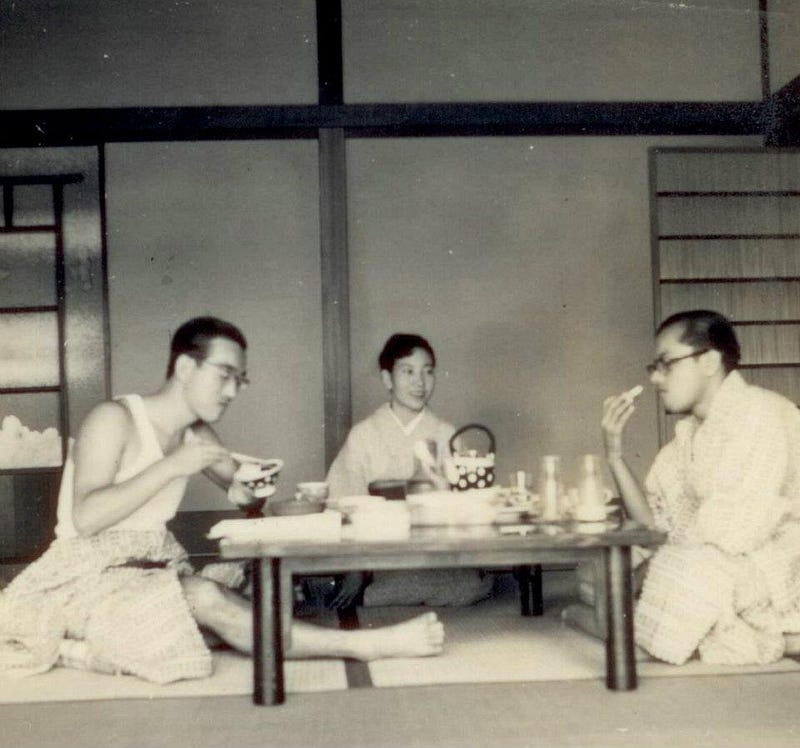
- My father traveled to Japan in the 1950s. Sadly he didn’t share his stories with me before he died, but my mother shared what he’d told her, as well as showing me the black and white photos. He was visiting a family friend who was Japanese who took him traveling through the countryside where they visited temples, parks, statues, etc. They stayed in traditional guest houses. The photos are fascinating and show women dressed in kimonos as well as in Western-style skirts.
- Older black friends recounted migrating to the North during the Great Depression. They still had a vehicle from the 1950s that the husband treated like his baby. It was very well maintained and pristine. When I was learning to drive, he gave me a couple of lessons with it. I was so very careful. His wife loved to dance and she told me stories of going to clubs and listening to jazz music after they moved North. They still maintained a garden when I met them, in the 1980s.
- My mother has told me stories about our own family history. She was born while India was fighting for independence from the British and her parents worked with Mahatma Gandhi. She told me of how she and all the little children would run and play with him, because he loved children.
- My parents (and others) remember when Kennedy was assassinated, when Neil Armstrong walked on the moon, and other events from the tumultuous 1960s and 1970s. My parents told me that all of India mourned Kennedy’s death. He had visited India earlier and they found him and his wife charming.
- An older friend of mine who grew up in the rural Midwest remembers bringing a rifle to school. He left it in his truck. It was for an after-school club that he was part of, though he also used it for hunting for the pot. I asked if this ever caused problems. He said, “If two guys got into it, they’d use their fists. No one thought of using a gun.”
- Speaking of guns, I remember an I Love Lucy episode from the ’50s in which a man brings his gun legally onto a train. It seemed to be unremarkable, as were house calls by doctors, also seen on that show.
- I myself remember seeing the destruction of the Twin Towers on 9/11. My husband at the time called me to tell me to not go into work that day, and to turn on the news. I remember the shock that hit me when I saw the coverage of the planes crashing into the WTC. It hit me particularly hard because I grew up in New York City and I remembered the old skyline, now gone. I also remember how everyone in the neighborhood put up their American flags the next day, and also have people who had never been particularly friendly went out of their way to greet each other.
There are many other things that people of my generation remember — the first PCs, the Sony Walkman, MTV… we lived in a time when children weren’t in constant cell phone contact with their parents and when there were no online dating apps. Boys (and men) had to actually talk to girls (and women), get to know them, and ask them out. Friendships sprang up from actually spending time together. While there were obviously mean girls, the culture was less toxic because social media wasn’t a thing.
So as I get older, I can share my own memories with younger people. Whether or not they would be interested — who can say? I myself have always found tales told by older friends fascinating. They remind me of how adaptable and resilient humanity is. They help to open my eyes to possibilities and be more open to change.
Learning about the past, both through books and through personal accounts helps us better understand the present and be open to possible futures.
I am fighting stage IV cancer. If you would like to help with medical bills, I would really appreciate it. Or if you enjoy my writing and would like to buy me a cup of coffee, that’s great too. Maybe someday I can return the favor.