Learn to Write Like a Human to Succeed As A Freelance Writer in 2024 and Beyond
Tips for humanizing your writing

“Is AI stealing our jobs?”
It’s the burning question on every freelance writing forum on the internet. People are up in arms about companies using robots to produce content like bunnies. Companies have replaced writing teams with “AI Generator” and “AI Editor” positions.
What does this mean for the future of freelance writers, and do we have a chance of succeeding in 2024 and beyond? Is it even worth trying to become a freelance writer in this AI-driven market?
The answer is yes!
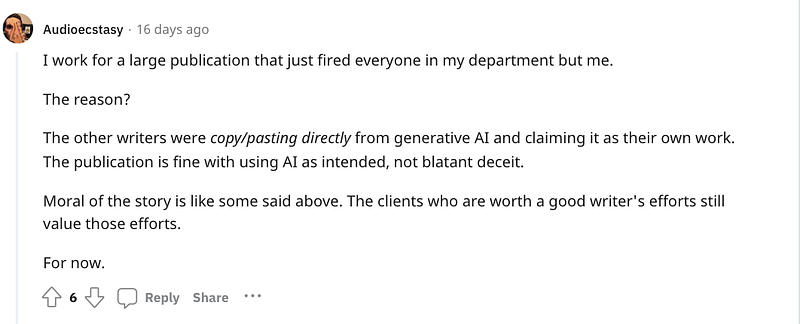
Even in a world dominated by machine learning, a place for human writing exists. Reputable publications prefer hiring humans and many use AI detectors to determine if a piece was written by a machine or a human.
The issue is that these detectors are flawed, and their ability to detect AI writing is less about whether the piece was written by AI than if it sounds like AI.
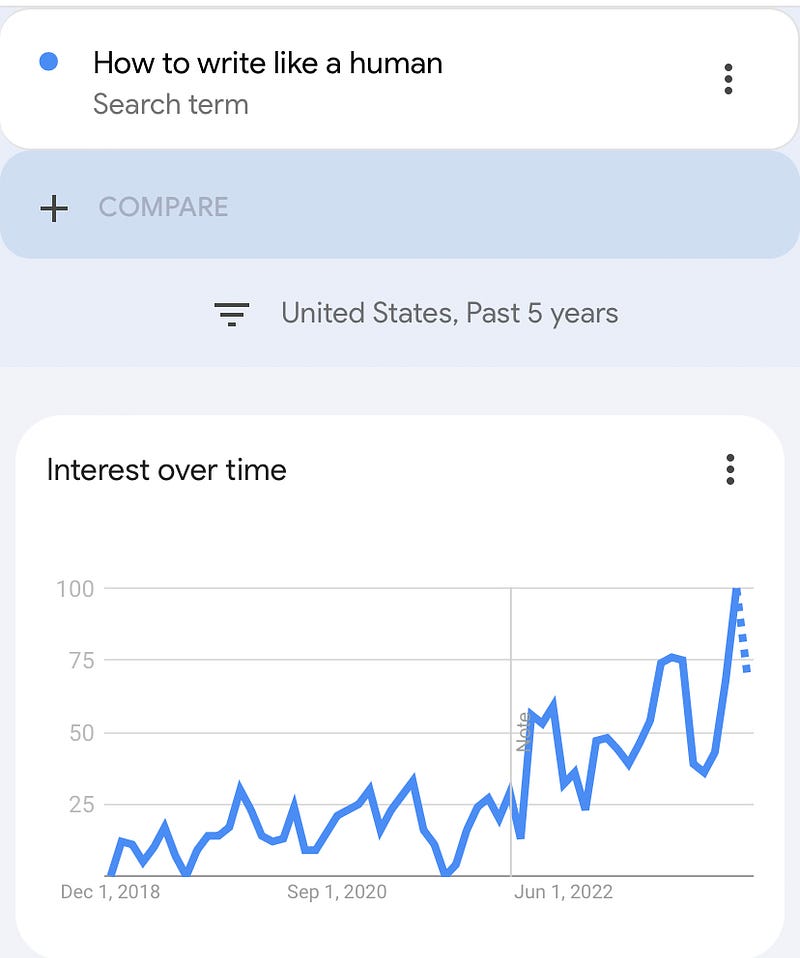
That’s why I’m on a quest to humanize my writing, and I’m not alone. Google Trends shows the keyword “how to write like a human” has drastically trended upwards over the last five years.
You’ve probably had the thought, “Shouldn’t this be obvious?” The thing is, AI mimics human language so well, that even with a careful eye, it can be difficult to spot AI-generated content.
To write like humans, we must first understand what makes us different than robots.
What Humans Have That Robots Don’t
1. Emotions
As of 2023, robots do not have emotions. Video games like Detroit Become Human* (starring the one-and-only Jesse Williams) demonstrate a futuristic world where robots develop emotions. Robots may one day learn to mimic emotions, but they don’t have emotions.
Emotions are complex sensations, felt throughout the human body. These feelings spark creativity, imagination, and intense responses.
2. Real World Experiences
A big part of being human is what we experience on a day-to-day basis. Robots emulate what humans experience when we tell them what happened.
Every day is a new day, and our experiences tell a story. One defining characteristic that stands out in AI-written work is it lacks specific experiences.
I discussed what happens when AI writes a review without real-life experience in this article.
3. Real-Time Interactions
We have the pleasure of meeting new people every day, and when we meet a new person, we get to hear about their world through our lens. It’s quite a fascinating experience.
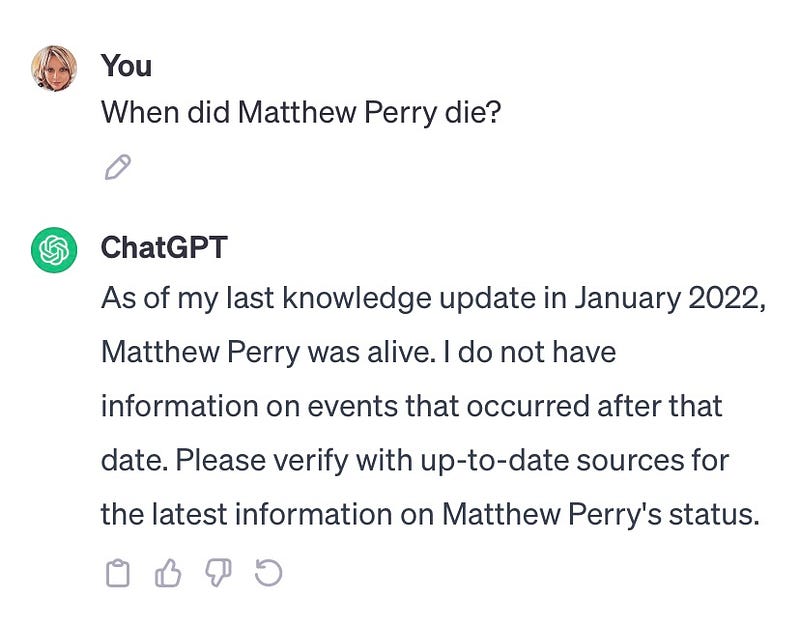
Every conversation has the ability to impact the way we think. AI has humans coding it and telling it what to do, but it does not learn in real-time. Most AI programs only have knowledge of world events up to a certain date.
4. A Complex Conscience
Humans have several levels of consciousness, which are complex and difficult to emulate. Psychologists and scholars seem to all have their own ideas of what consciousness is — and that’s the beauty of human consciousness. We can decide what it is for ourselves.
Scholar Sigmund Freud said the three levels of consciousness are the preconscious, the conscious mind, and the unconscious mind.
The Preconscious Mind: Anything readily available, but not in use
The Conscious Mind: All thoughts, memories, feelings, and wishes of which we are currently aware of
The Unconscious Mind: A reservoir of feelings, thoughts, urges, and memories outside of our conscious awareness — this contains everything unpleasant such as anxiety and pain.
Source: VeryWellMind
How to Humanize Your Writing
1. Write with emotions
Learn to use your feelings to humanize your writing.
2. Tell specific stories
Humans don’t remember the statistics that AI loves the spew out. We remember specific stories.
When I was in middle school, high school, and college, I scrolled through Thesaurus.com, searching for the perfect words to form every sentence. Looking back, I used many words incorrectly, so while trying to sound “smart,” I actually looked stupid.
Humans prefer simple, familiar language, so use the words you already know and leave the big ones for artificial intelligence.
3. Quote Others
Quotes have a powerful impact on writing. They give a piece authority because you’re essentially providing evidence to support your claim. Quote your mother, your brother, or Joe Smith down the street.
Or you can quote Martin Luther King, Jr., Gandhi, Joe Biden, or even yourself.
Humans love quotes.
4. Pass on Grammarly suggestions
Many writers and editors recommend Grammarly, and this tool can be a huge aid. It catches errors spell-check misses. However, if you rely on its suggestions — especially its premium suggestions — you remove the human from your writing.
I’m not saying to delete periods and commas, but you must be mindful of its suggestions. Not every suggestion is a good one, and you need to use your best judgment to weed out the bad ones.
Many Grammarly Premium users have complained about AI detectors claiming their writing is AI-written. If you accept too many Grammarly Premium suggestions, your writing will sound like it was written by a robot.
I used the Grammarly Premium trial and felt my writing was no longer my own, so I only use the free version (which has what I need — commas, typos, etc).
5. Ignore writing advice
Pick and choose the writing advice you want to follow, but don’t follow everything you hear.
“Don’t use adverbs,” they said. You like adverbs? Use them, then.
“Don’t post the same day you write,” they said. You feel you’ve said everything you need to say, and your work is polished? Go ahead and post it, damnit.
As a human writer, you need to learn to think for yourself and decide what’s best for you and your craft. There’s a lot of noise about what you should and shouldn’t do in the writing community. Only you know what works best for you.
6. Write About Current Events
Several writers are seeing success by writing about the news. Trending topics have always been a hit in an online era.
We live in a world where fewer people are getting their news from physical papers and television, so having access to easily-searchable internet news is a must.
Writing a response or an informational post about a current news event is something AI cannot do, but you can. ChatGTP’s last “knowledge” update was January 2022 as of the writing of the writing of this post.
7. Dive Into Your Unconscious Mind
Your unconscious mind is what makes you human, and it’s where your best writing comes from.
How many times have you been shocked by what appears on your screen? I know I have many times. It’s rare I consciously think about the words I’m typing.
The best exercise to uncover your unconscious mind is to sit in front of a blank page and let your fingers do the talking.
Moving Forward
An AI-dominated world looks scary, and every day I see writers who’ve been in the field for decades talking about quitting. If you truly love your writing, do not quit. Revise your craft — humanize it.
An * means this is an affiliate link, and I may make a tiny commission if you purchase this product

If this post resonates with you, please subscribe to receive updates when I post.


