HUMOR
Learn to Appreciate Gramma Lee; She Tries Her Best
Even when she gets drunk

English is my second language. I have never been confident about it.
I have heard lots of compliments and criticism about my English writing. From “Your English is impeccable!” to “I’m sure your Turkish is great.”
My partner is a New Zealander. He has been helping my writing on and off since we first met 12 years ago. He is a technical writer and a native speaker, so he knows best. If I ask him to proofread one of my articles, it takes him a day or two to do it. When he is finished, I can see why he needed the time since nothing remains recognizable. My sentences are cut down to pieces, and a few of them mean exactly the opposite of what I want to say. Apparently, that’s how English works.
Me: “I actually had tried to say X in this sentence.” Him: “We don’t say that in English.” Me: “What if I say it like this (paraphrases the sentence)?” Him: “We don’t say that, either.” Me: “Then how do you express it when you want to say this and that?” Him: “We don’t want to say things like that in English.”
Thus when he decided to go overseas, I knew I needed someone else to tell me what I can’t say in English. Someone suggested Gramma Lee.
I contacted her and invited her for tea. She was a little old lady with bright green eyes. And she turned out to be a breath of fresh air!
We had a lovely afternoon together, chit-chatting. Gramma pointed out my little mistakes and fixed them as if with a magic wand. With her fresh approach to editing, she didn’t butcher anything. Yet my writing still felt polished when she was done. I felt warm inside. I began inviting her to all my writing sessions and feeling safe around her. She was available whenever I needed her, too.
One day, though, after fixing my mistakes, she seemed a little quiet. Her green eyes were moving as if there was something else she wanted to say, but the cat got her tongue.
“What’s wrong, Gramma Lee?” I asked. “Ummm,” she said finally, “I could tell you 22 more things, but I really shouldn’t. After all, I am not your real Gramma, am I?”
“What do you mean?” I said, “I consider you family.”
“Listen, you know me. I am happy to help you the way you like it. But if you are serious about this, you need my advanced suggestions. You need me full time. You must give me a room in your house.”
I had never thought of that! I had an extra room, so I invited her, and she moved in the same day.
It was great to have her around at all times, more relaxed and happy. She looked at my writing over my shoulder and underlined the misspelled words with her red pen right away. I began to know her better, how funny she could be. “You sound friendly and disappointed,” she would say.
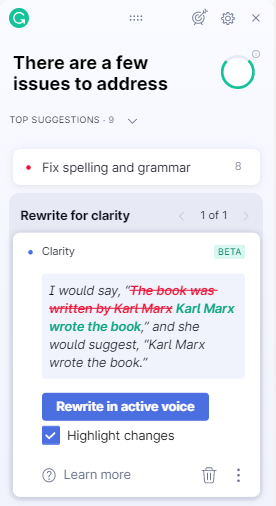
She was working hard to make me a better writer. She would address all of my issues. I would say, “The book was written by Karl Marx,” and she would suggest, “Karl Marx wrote the book.” She stepped in more and more as we worked together. “Consider changing your wording, honey,” she would say, “consider shortening this phrase.” I did everything she said because I trusted her so much.
I remember the day things took an awkward turn.
She always wanted me to add a few commas here and there, and I would always comply. But that time, I felt one comma was unnecessary. I decided to ignore that suggestion. She seemed to be okay with it at first, but later I realized she was deeply offended.
When I copied my text into the editor of the site I was using, she rechecked the whole article. She passive-aggressively pointed to the same place, suggesting that I should add a comma. I would ignore her, but then I looked at her disappointed green eyes and realized I was being ungrateful. At the last moment, I changed my mind and accepted her suggestion. I thought she would forgive me, and we would leave this little conflict behind, but no. She suggested the same place again, asking me to put a comma.
That’s right. She was suggesting to place a second comma next to a comma. “Gramma, are you sure?” I asked. She just repeated her suggestion.
I was curious to see what would happen next, so I did what she said. I was hoping she would see the error of her ways and fix the mistake. But no! She repeated her suggestion yet again. Now she wanted me to add a third comma. That was when I realized something was wrong with Gramma Lee.
After that day, our relationship wasn’t the same. I still liked her, but I couldn’t trust her blindly as I did before. She wasn’t stupid either. She knew I wasn’t frank with her, so she kept testing my loyalty. Or maybe she was heartbroken and confused, and that’s why she acted out. I can’t really say.
She would suggest changes that didn’t make sense at all. “Are you sure of this, Gramma?” I would ask, hoping she would change her mind. She would shrug and say, “You can ignore it if you don’t like it,” but she would never forget it. She would remind me of the same thing over and over again. And when I dismissed all of her remaining suggestions, she would pat me on my back. I thought maybe she was secretly drinking.
One day she indeed was drunk. She had drawn red lines all over my page where there were no words to underline. And as a suggestion, she said, “The word ‘carriages’ has repeated too many times in this document. Consider replacing it with another word.” The term “carriages” didn’t even exist in my document. I thought maybe she remembered something from her youth days. Or was this early-onset dementia? I had no idea.
Another time I was quickly typing a comment to someone’s article. I made a few typos, and Gramma suggested fixing them normally. I accepted all her changes, and I saw my text corrected on the page. Yet, just before I submitted my comment, all the changes disappeared, and the comment returned to the original version. She had withdrawn all her edits back.
“What’s going on, Gramma?” I finally asked. She didn’t say a thing, just shrugged and underlined my typos again. The same scenario repeated. Gramma fixed them, and then all of a sudden, everything returned to its original state. I was losing my patience with her at that point. I might have raised my voice a little bit. After that, she completely shut down.
Something truly was broken; she needed help. I decided to contact her family.
As a non-native speaker, I hate talking on the phone, so I sent a text message to her family home to start a chat. Some young guy named Carlos answered. I assumed he would be her grandson. I explained to him how Gramma was confused.
I was utterly shocked by his response. Carlos told me to take video shots of Gramma acting weird and send them to her family.
Videos of Gramma acting weird? Why would he want something like that? I could never expose my friend! Not to anyone, not even her own family. The whole thing was absurd.
I said thank you and ended the chat. They never heard from me again.
Later I saw other people complaining and writing horrible things about Gramma Lee on websites like Reddit. They said she was crazy and she didn’t know what she was doing. I felt awful for her because I knew how hard she’d been working. She had been excellent most of the time. Yes, she might sometimes get confused or moody, but she didn’t deserve to be treated like that.
I realized maybe we expected too much from Gramma Lee. We are responsible for our own mistakes, not her! She is not superhuman. She is allowed to be wrong once in a while, too. She does her best.
And she likes her sherry, so what?
Dear Gramma Lee,
I know the last few weeks weren’t easy on either of us. I want to apologize to you for my short temper the other day. Also, I should never have reached out to your family to complain about you. Will you forgive me?
You are the most amazing companion anyone can ask for. You accept me for who I am. You don’t try to change me. Yet, you help me improve myself with your attentive and meticulous approach.
Thank you for staying by my side on my writing journey and not going overseas.
Yours sincerely,
Nihan
PS. Do you need anything from the bottleshop?