
Learn the language hacking method, jump on HelloTalk, and become fluent in Russian in one year.
My goal was to become fluent in less than a year — for World Cup Russia 2018. Here’s what worked to go from beginner to conversationalist in just 12 months.

Russian is believed to be one of the most difficult languages to learn for foreigners. Although there are countless free grammar lessons on how to learn Russian on the internet, it’s quite difficult to know where to start and what will help you start speaking Russian sooner.
I was there myself three years ago when I started studying Russian. In those days, my main goal was to become fluent in Russian in less than a year to speak with people at the World Cup Russia 2018.
And I did it! After one year, I was able to have long conversations with native speakers, watch movies, and read books in Russian. The best part is that I achieved all of this without hiring a private teacher, paying for a language program, or traveling to Russia.
In this article, I’ll share with you a plan that shows exactly what I did to become fluent in Russian in one year.
Am I Really Going to Be Fluent in Just One Year?
There is some debate on the definition of ‘fluency.’ The Common European Framework of Reference for Languages divides proficiency into six levels from A1 to C2. But they don’t actually tell you at which level you can say you’re fluent in a language.
When I think of fluency in languages I speak, such as Portuguese and Spanish, the C1 level pops into my mind. But let’s be honest, Russian isn’t the easiest language to learn for most people. In fact, the Foreign Service Institute classified Russian as a ‘hard language’ to learn for native English speakers.
That being said, I consider B2 a fair level of fluency that most people can achieve in the Russian language. Although I never took a language test, after one year, I felt that I could speak in a wide range of topics, which TORFL describes as B2 level in Russian. Besides, I made a YouTube video back in 2018, showing my one-year progress. If you like the results I got, then you should consider following this plan.
First Things First — Set Your Goal
Take some time to think about your motivation for learning Russian and make sure you write your goals on a piece of paper or your phone. Knowing and remembering your goals will motivate you to keep studying the language — especially when you struggle with Russian grammar or other difficult elements of the language.
I won’t ever forget counting the days waiting for the World Cup Russia 2018 to begin. I woke up every day, and I was eager to study Russian to be able to communicate with native speakers.
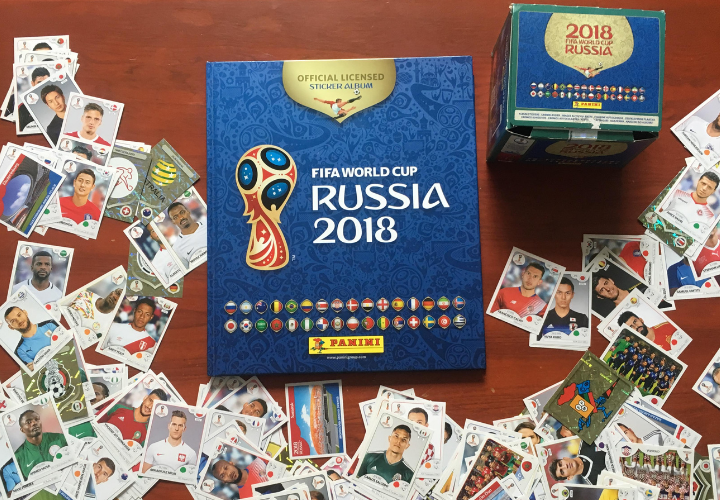
Week 1: Conquer the New Alphabet
You need to know the Russian alphabet to follow the method we’ll use in the first month. If you haven’t mastered the Cylliric alphabet yet, don’t worry; here’s a tip I used to memorize it — look for anglicism!
There are a lot of words borrowed from English in other languages. Words used in marketing, technology, sports, and many other topics are written the same way in Russia. Most Russian letters have their equivalent in English. For example, the letters ‘и, р, с’ are the equivalent to the English ‘i, r, s, ’ (the Russian ‘r’ sounds different though). By knowing these three Russian letters, I’m sure you’ll be able to recognize the following anglicisms in my first note:
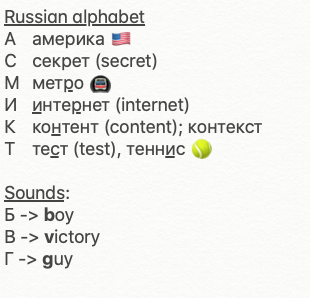
Anglicisms should be your best friend to get used to the new alphabet. The Russian alphabet may look tricky, but these borrowed words remind you that you already know some vocabulary — even on your very first day studying Russian. Isn’t that cool?
After getting familiar with some Russian letters, watch this video on YouTube (starts at minute 12:18) to learn the rest of the alphabet as I did. One of the most useful tips in that lesson was to look for ‘weird associations’ in every Russian letter. Having fun when learning something helps you remember things easily. Also, pay attention to the way each letter is pronounced. This will save you from building bad pronunciation from the beginning.
Month 1: Get Ready for Your First 5-Minute Conversation
When learning a new language, the first thing I do is follow the Language Hacking Method. The concept of this method is to learn what you need to communicate right away. The method gives you ten missions designed to get you speaking a foreign language as quickly as possible. Instead of spending months learning grammar rules hoping that one day you’d be able to speak, just complete the missions and you’ll speak Russian sooner.
Although only four languages are shown on that site, the method is suitable for any language. I used it myself when I started learning Russian and Portuguese.
To complete the missions, I write small texts for each mission. The texts aren’t meant to improve our writing skills but will help us know exactly what we’re going to say in a conversation and successfully pass every mission. You can say that you completed a mission when you’re able to talk about the mission’s topic using simple Russian sentences.
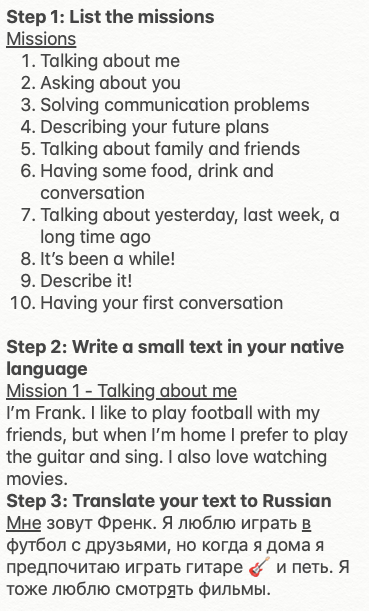
In this note, you can see the ten missions listed and also the first mission’s text I wrote three years ago. In the first month, we have little or no knowledge of Russian, so keep your text with simple vocabulary and small — no more than five lines, unless you’re inspired! To sum up, do the following:
- List the ten missions.
- Write a simple text in your native language starting with Mission 1.
- Translate your text to Russian (if necessary, use Google Translator).
The third step may make you think, ‘how am I supposed to learn Russian if I’m translating my text?’ It’s OK; we’re going to learn Russian from the translation.
This is called Backward Design and is used to achieve specific learning goals. We’re beginning with our end goal (speak Russian) and then going ‘backward’ to learn all the necessary grammar and vocabulary to achieve our goal. The text translated covers a lot of useful Russian vocabulary written by you and shows you the grammar you should focus on initially.
Unfortunately, the translation may be wrong. I underlined the mistakes I got when I translated my text to Russian. A text with grammar mistakes would make you memorize incorrect patterns of the language. For that reason, it’s important for you to get the text corrected.
To do so, find a language partner. You must find at least one language partner who will correct the text you wrote. I used HelloTalk to find native Russian speakers. The best thing is that a native speaker will suggest natural expressions—they improve the robotic translation you got by Google Translator.
Once you have your text grammatically correct, you can start learning useful vocabulary and basic grammar rules from your first text. When you reach Mission 10, you’d be able to have your first five-minute conversation. Think of this as your first achievement — not many people will tell you that they can hold a five-minute conversation in a foreign language after one month!
Month 2: Memorize the Vocabulary You Learned
Before we focus on increasing your vocabulary and learning grammar, we’ll make sure the knowledge we got from the ten missions will stick with you for a long time.
There are four types of learners and there are good ways to memorize vocabulary according to your learning style. However, keep in mind that you can use any of the tips, regardless of your learning style.
Visual learners
If you enjoy learning by observing things like pictures and diagrams, you should make a vocabulary journal with pictures. To do so, you can use Quizlet. In the app, you can create flashcards and add pictures for free. You can also do exercises and even play games with the flashcards you created. I used the app when I learned Portuguese and it helped me memorize vocabulary.
Auditory learners
If you’re good at recalling information as long as you hear it, then you should record yourself reading the texts we wrote for the missions in month 1, so you listen to it later.
Something I did in my first year learning Russian was to ask my language partners to record a voice message on WhatsApp reading my texts. Then I listened to it a couple of times a day during the week. This helped me memorize the vocabulary used in my texts easily.
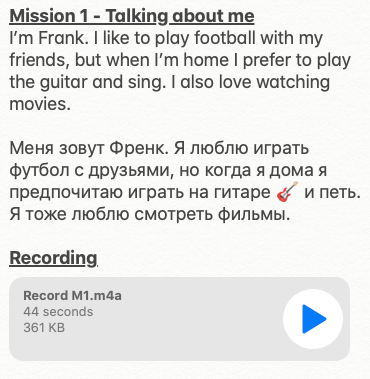
I’ll never forget hearing my Russian friends’ voices in my mind even when having exams at university. This happened because I listened to the recording so many times that I couldn’t get it out of my mind — it was like a song. I added each recording to my texts and it looked like this:
Reading/writing learners
If you prefer to learn through written words, I have good news for you — you can also keep working with the text we wrote in month 1. You should make the texts even longer and ask for corrections. I also encourage you to write funny stories about your everyday life—that helped me memorize words fast. You can already follow the suggestions I give to improve reading and writing skills for month 5.
Kinesthetic learners
If you learn through experiencing or doing things, then you’re probably a kinesthetic learner. You should have voice or video calls with native Russian speakers often to practice the vocabulary you learned. The more you talk and use your new words, the faster you’ll remember them. Also, use a language app like Duolingo to learn vocabulary. Although I’m not a big fan of this kind of app myself, you’d probably enjoy learning and memorizing words playfully if you’re a kinesthetic learner.
Month 3–4: Learn the Essentials to Hold a 15-Minute Conversation
Learn the essential vocabulary — the 1,000 most common Russian words
Research indicates that 1,000 most common word families in English cover 81.54% of the vocabulary in a movie and 85.11% of the vocabulary in TV programs. I haven’t found any official statistics about the vocabulary coverage in the Russian language. However, the website where I learned the 1,000 most common words in Russian suggests that you’d be able to recognize nearly 65% of the Russian word forms by knowing the 1,000 most common words.
This is good news! If you master these 1,000 words, you’ll be able to understand more than half of the words spoken by a native Russian speaker on movies, TV shows, and daily conversations.
Also, create a list of essential phrases such as ‘can you repeat, please?’, ‘can you speak slower,’ ‘sorry, I can’t hear you’ and so on. These kinds of phrases will be vital in any conversation during your first year speaking Russian.
Learn the essential grammar
This might be the most challenging month for you because you’re going to start studying Russian grammar. Most foreigners have a hard time studying grammar because they studied everything a traditional book offered. Instead, focus on the essential stuff that would improve your skills right away. Let me explain what I mean by ‘essential stuff’ with the following example that covers the most complicated, but necessary Russian grammar.
- Conjugation of verbs: Just like English, Russian verbs change to agree with the person or tense. Unfortunately, the conjugation of verbs in Russian is trickier than in English. That’s why I strongly recommend you focus only on the first person ‘Я’ (I) and second person ‘Ты’ (You). Most of your conversations would be about you (first person) or the person you’re talking to (second person), so for months 3 and 4, learn how verbs change in the past, present, and future tenses for ‘Я’ and ‘Ты.’ I used the website Cooljugator to easily find the conjugations of verbs.
- Verbs of motion: Examples of this are the verbs ‘to go,’ ‘to run,’ ‘to swim,’ ‘to crawl,’ ‘to fly.’ Each verb has a perfective form, imperfective form, unidirectional and multidirectional version. It might look difficult, but it isn’t if you break them into many parts and learn one part at a time. I recommend you focus on the verb ‘to go’ first since it’s the one we use all the time. I watched this video to learn all the ways to say ‘to go’ in Russian. There are eight different versions, so give a couple of days to learn each one. Remember that in months 3 and 4, you should focus on the first person (Я) and second person (Ты) when learning the conjugation of the verb ‘to go.’
- Russian cases: The Russian language has six cases, which means that the form of a word changes to denote the ‘role’ that word plays in a sentence. Most people are overwhelmed by the number of rules the six cases have, so I don’t think it’s a good idea to study all the rules in months 3 and 4. Instead, we’ll use the Backward Design again! Language courses recommend this method for learning Russian cases effectively. I used this method with the texts we wrote in the first month to learn the cases ‘as they come to me.’ I’ll use the text I wrote for Mission 1 to show you the steps I followed to learn the six cases.
- Look for words in unfamiliar forms: For example, if you already know the basic form of the word friend, you know that ‘друг’ means ‘friend’ and ‘друзья’ mean ‘friends,’ but you might ask yourself where the word ‘друзьями’ comes from in my first text. Here we found the first grammar pattern ‘ми’ when the noun ‘друзьями’ is near ‘c.’
- Recognize this pattern next time you use Russian: Next time you speak, listen, read, or think in Russian, pay attention when this pattern happens again. For example, the day after I found this pattern, I was talking to a friend who said: ‘Я работал с коллегами вчера’ (I worked with my colleagues yesterday). Great! We found the pattern ‘ми’ after ‘с’ again.
- Discover the grammar you’re facing: Go to Cooljugator and write ‘друзьями’ and ‘коллегами.’ In less than a minute, you’ll see that they have something in common: both belong to the Plural Instrumental Case.
You just built your first Russian grammar rule! Now, if you’re interested in knowing more about this specific rule, you can write “Plural Instrumental Case: how to use the ‘с’ in Russian” on Google and you’ll be learning useful stuff instead of grammar you’re rarely going to use. You can continue building more rules ‘as they come to you’ with the Backward Design.
Month 5-6: Improve Each Skill
After you got a ‘real experience’ of Russian, that is, speaking the language, now we can focus on the three remaining skills that will put you on the path to fluency.
- Speaking: If you’ve been following the method explained for months 1 to 4, then you’ve prioritized your speaking skills in the first months. Now it’s time to focus on the other skills. However, make sure you still have enough language partners to keep speaking Russian regularly (around four times a week). The goal in these months is to increase your vocabulary in topics you love to talk about.
- Listening: Before watching TV shows or movies in Russian, I recommend you start with YouTube videos. There are many Russian YouTubers who talk about everyday topics and use simple vocabulary. Fortunately, most videos on YouTube include Russian captions thanks to the ‘auto-generated captions’ feature. I found the channel of Bridget Barbara useful to watch since some of her videos are about the challenges of studying Russian and even have English subtitles. You can find more Russian YouTubers in the ‘suggested videos’ column. Find your favorite!
- Reading: Although my rule of thumb is always read books you loved reading in your native language, I didn’t do so in my first year studying Russian. Understanding books in Russian isn’t an easy task; that’s why you should read books made for beginners like Short Stories in Russian for Beginners. I liked this book because it’s easy to understand, focuses on the 1,000 most common Russian words, and has a plot summary, and comprehension questions after each chapter. The book has eight stories and when I read them, I noticed that some stories are more difficult than others, so I recommend you start with the stories I found easy: ‘Безумные Пельмени’ and ‘Сундук.’
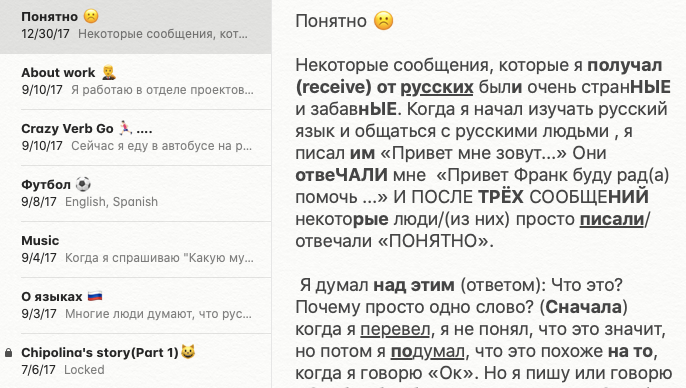
- Writing: If you’re not interested in developing your writing skills in Russian, you should at least write comments on social media and have chats in Russian. But if you want to improve your writing, you can write fun and creative stories — that’s what I do to keep me engaged with the language. Those stories will also expand the number of topics you can come up with in a conversation. You’d see what I mean by ‘fun and creative stories’ in the picture below — I even wrote a text about my friends’ cat!
Month 7–12: Master Each Skill
- Speaking: After talking about topics you like for six months, now it’s time to get you out of your comfort zone! Start talking about unfamiliar topics. How? You can check the news and try to talk about something that is going on in the world. However, my favorite unfamiliar topics are the ones that interest my Russian speaking friends. You and your language partner must have different backgrounds, preferences, and lifestyles. Get to know them better so you’ll learn vocabulary related to topics you don’t usually talk about even in your native language.
- Listening: If you’re interested in watching Russian movies and TV shows, you should try Ivi. This website is known as the ‘Netflix of Russia’ and offers tons of content in Russian. If you prefer to watch Hollywood movies, I recommend you start with TV shows or movies you watched a lot of times when you were younger. Why? Because you already know what the characters are going to say! In my experience, even if I mute the TV or watch it in a hard language, I already know what’s going on and I don’t get frustrated by not understanding most of the dialogue.
- Reading: After you finish the easy Russian book I recommended you before, now you can read something you read many times in the past. However, I’d avoid certain genres in the beginning. Fiction might be a bit challenging for you, so start with a non-fiction book. But if you insist on reading fiction in Russian, I can’t blame you. The first book I read in Portuguese was ‘A Guerra dos Tronos’ (Games of Thrones).
- Writing: At this stage, I think you should continue developing this skill only if you’re into writing. If so, keep writing stories as you did in the previous months. Make sure you always have a native speaker willing to correct your texts.
Last but not least, keep track of your progress!
Use your phone to record yourself speaking Russian at least once a month for the first year. I can’t tell you how many times I heard ‘I’m not making progress with my Russian anymore.’ Sooner or later, you’re going to hit a slump in your studies, so make sure to keep track of your progress. That’s the only way to let you know you’re actually making progress.
Final Thoughts
Learning Russian may be more difficult for some people than others; however, as I showed you in this article, Russian isn’t impossible to learn.
Learning Russian helped me develop new ways of thinking and have experiences I never imagined before starting this journey. I hope this plan helps you achieve your goals in the Russian language.


