
Learn The Fundamentals of Building a Second Brain
So that you can manage information in any app
We have so much information available within the reach of our information. We read more than anyone else ever did. We consume information more than anyone ever did. But how much of what we read do we remember? How much of what we consume helps us to move forward in our lives?
If you are not using any system to store those ideas and information, I guess it's a mere percentage. Because our brains are forgetting machines.
If you want to remember the ideas, inspirations, and information that you have gained through reading and experience, you need a system that can help you do so.
Tiago Forte’s Second Brain is the most widely used system for managing information around us.
In this story, I will take you through the fundamentals of building a second brain and how you can use those fundamentals to create a second brain in any note-taking app of your choice.
What is a second brain?
Second brain is an external system you can rely on to save important information. It is not just a system for saving information but also for retrieving it.
It is based on David Allen’s concept that:
Your brain is for having Ideas not for holding them.
Your biological brain has a limited capacity to handle the overwhelm of the explosive growth in the complexity of life.
You might argue that your subconscious is way powerful. This is true. But accessing your subconscious is very hard. You are not in control of it.
You can’t directly put information into the subconscious. Your conscious mind handles it. And it is very bad at doing so.
Therefore, you need an outside system that is designed to optimize the explosive growth in the complexity of our lives.
That’s when the second brain comes to the rescue. It helps you to manage the complexity of your life.
Why you need a second brain?
- It helps you to remember: Now you don’t have to worry about forgetting an idea or information that you just read. Put it in your second brain and you can always come back when you want.
- Sharpens your thinking: When you create a second brain, you are writing your thoughts down. And writing fills the gaps in your thinking.
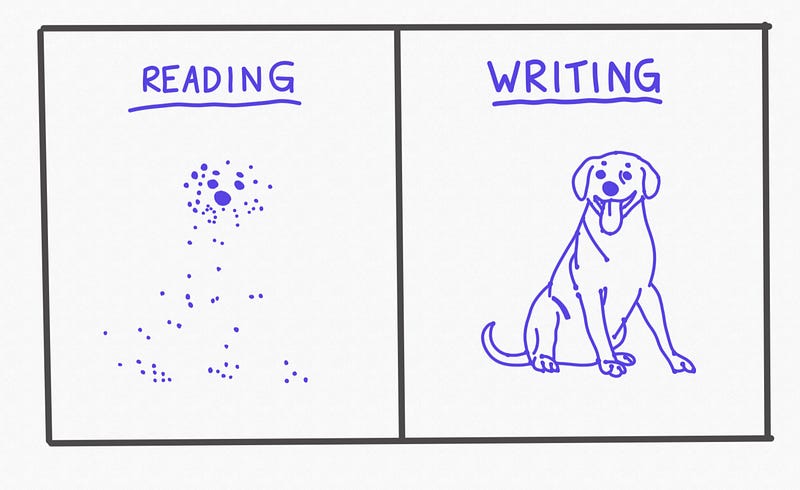
- Comprehend information better: A second brain will help you understand the hard concepts better. When you can easily go through the same information over and over and use the concepts of the second brain, it helps to comprehend the information better.
- Frees up mental space: You don’t have to keep thinking about a particular idea or information. Put it in your second brain and start doing whatever you are doing.
- Create new connections between ideas: A second brain helps to enhance your creativity. It helps you to create connections between information that you wouldn’t have otherwise made.
- Share meaningful insights & ideas to the world: It becomes easy to share information and ideas with the world. You create new ideas, let creativity do its work and your ideas can help yourself as well as others in their work.
Rethinking Note-taking
Note-taking is not about hoarding information. A lot of us start that way. But that’s the wrong way of thinking and practicing it.
Note-taking is about producing something meaningful out of the information that we have consumed. To put that information to use. To create something of real value in the world.
You don’t want to hoard information. You want to create something out of it.
The CODE Method
The CODE method is the foundation of building a second brain. Even if you are not using all the methods, if you take notes, you are using at least one of these methods. But using all of these in combination gives you better results.
CODE stands for Capture, Organize, Distill & Express. Let us go through each of them individually.
Capture: Keep what resonates
You are what you feed yourself. Just like food, the information diet is equally important. The information you consume is the seed for your brain.
Here are the things you need to capture for your second brain:
- Keep what resonates
- Keep helpful, personal, & surprising information and ideas
- Ask a question: Does this information inspire curiosity?
- Ask a question: Will this information be helpful to me in the future?
How to save
You don’t want to save the entire article you read to your second brain. Neither you want to just save the link to the article.
You have to be a curator. The value of information is not uniformly distributed over the whole content. There are only a few parts that are more interesting, helpful, and valuable to you. Find those and save those ideas.
Organize: For Action
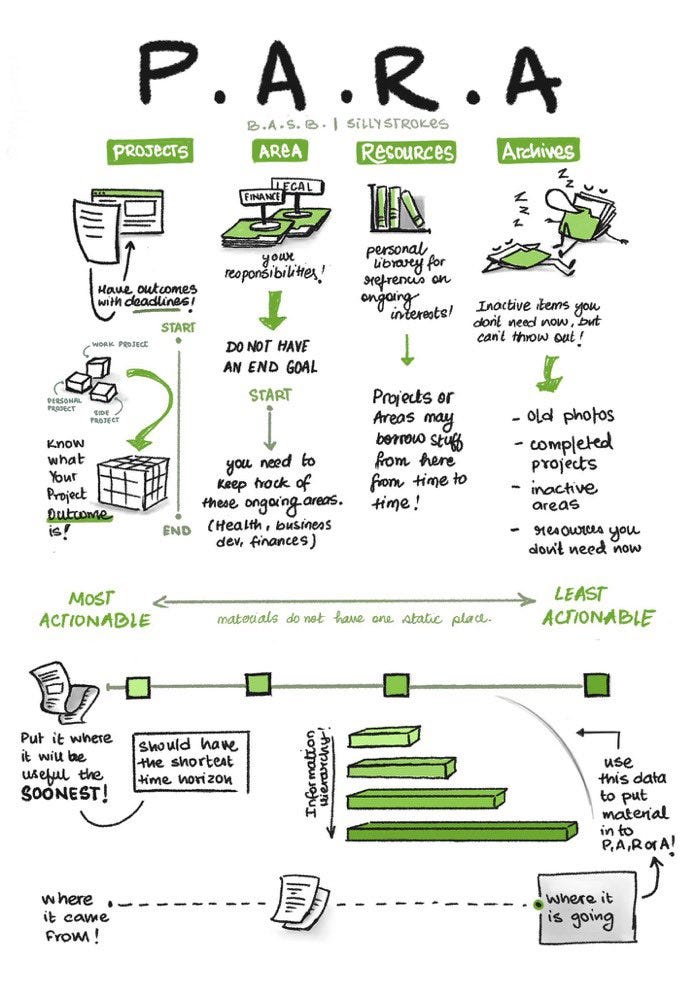
Your brain is an environment for thinking and if it's messy, you can’t think properly. Organizing your second brain helps you shape your thinking. The PARA method is used to organize your information in the second brain system.
PARA is a folder-level organization that stands for Projects, Areas, Resources & Archives. Let’s go through each of them.
Projects
Projects are the things that you are working on right now. Any information that helps you move forward in your project goes to this section.
Projects have a fixed start and end date.
For example: publishing a book, Starting a youtube channel, Going on a vacation, etc.
Areas
Areas are things that you are committed to over a lifetime. They are life-long projects which have no definite end date.
For example: Personal development, cooking, Marketing, Finance, etc.
Resources
Resources include all the information that you want to reference in the future. When a piece of information neither belongs to a project nor belongs to an area, it comes here.
For example: Topics that you are interested in. Topics that you are curious about but have no immediate plans, your hobbies, passions, etc.
Archive
Archives include completed projects and areas that are no longer relevant. Once a project is finished, move it to the archive folder. Once an area is no longer relevant, move it to archive.
If you are migrating from another note-taking system. Dump all of your notes in the archive folder and start. This reduces the clutter in your second brain without causing any loss of your information.
Where to Place Notes
PARA is not a filing or storing system. It’s a production system. It’s dynamic in nature. Your notes are not fixed in a particular place. They can move around.
So when organizing your notes, you have to ask this one question: “Where will this note be useful the soonest?”
Distill: For Discoverability
Your notes are only as good as their discoverability.
If you create a note for an article you read and it takes 10 minutes to go through that note, what is the use of note-taking anyway?
You should be able to quickly get the gist of the note by looking at the note.
That’s where the progressive summarization technique is used:
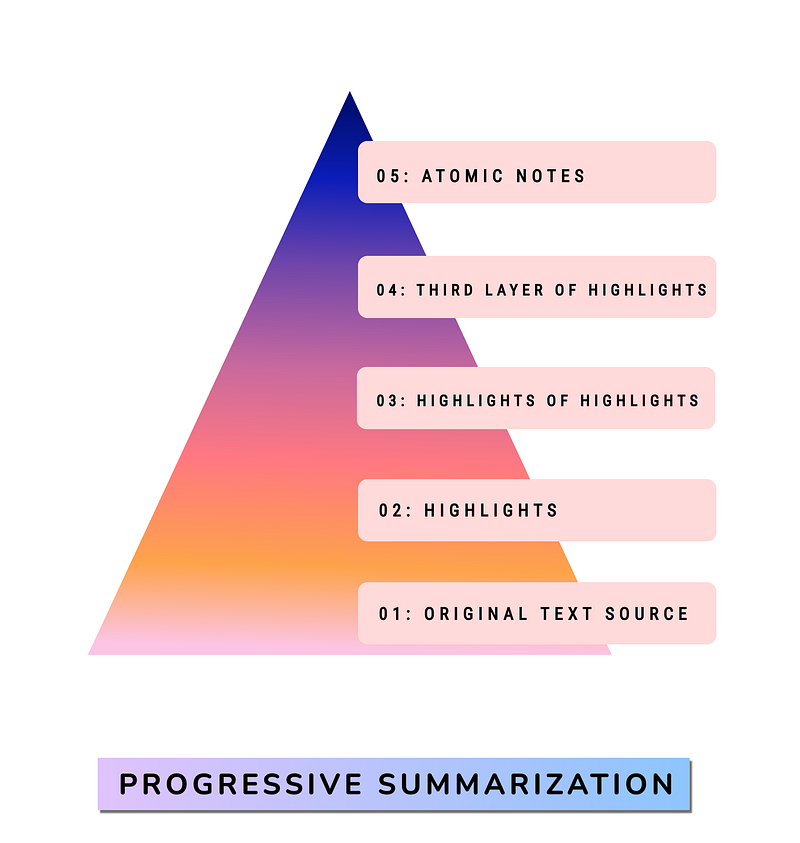
Progressive summarization is a technique of creating multiple layers of notes. This helps you to easily get the gist of the notes at a glance without losing their context.
And if you want to go back to the source for more information(which you probably would never have to), you can always go back.
Here is how progressive summarization works:
- Layer 1: Original text source
- Layer 2: Highlights of the source
- Layer 3: Highlights of highlights
- Layer 4: Highlights of the highlights of highlights
- Layer 5: Atomic Note
You see here. The note gets smaller and smaller as we move up the layers.
Progressive summarization is not a method for remembering as much as possible. It is a method for forgetting as much as possible.
Express: Show Your Work
As I stated already, the purpose of the second brain is not to hoard information. It is to help you produce something out of it. If all you do is hoard information, why bother to use the second brain system?
Every time you learn something, share it. Every time you discover new insight from a note, share it. Share your ideas with your friends, colleagues, or the world.
To know something means to put it into action. An idea sticks only when you engage with it. Your life will change when you begin to express your ideas and turn your knowledge into action.
One simple idea can change people’s lives when you share it.
With the second-brain system, you will never have to start from scratch. Because you have an abundance of notes that can assist you.
Not a Medium Member Yet?
If you liked this story, you will love the medium subscription. With only $5 a month(less than the price of a cup of coffee), you get unlimited access to the best stories and articles written on the web.
This is my referral link. If you sign up using this link, I earn a small commission with no additional charges to you.


