
Learn a New Language with SpongeBob: The Best Episodes According to Data Science
Using data to find which episodes are the best for you to learn a new language.

One of the most popular and funny cartoons in the world can help you learn a new language. You just need to be aware of the kind of vocabulary used in their episodes.
Like many cartoons, SpongeBob SquarePants contains advanced vocabulary and even words created only for the show. That’s why I analyzed the dialogues in 388 episodes to help you find episodes with simple vocabulary, so you can have fun learning a new language.
Krabby Patty — The words created in the cartoon
When you learn a new language with a TV show, you should be aware of the words created for the show. In this way, you won’t be discouraged by the high number of unknown words you’ll hear in many episodes.
Although you won’t use most of those words in everyday conversations, you need to recognize them to understand the jokes. For example, the most popular word that is not in the dictionary is Krabby Patty. Try watching SpongeBob in other languages and you’ll hear different variations for this word. For example, if you watch it in Spanish, you’ll hear the word cangreburger — a word created in the Latin American dub.
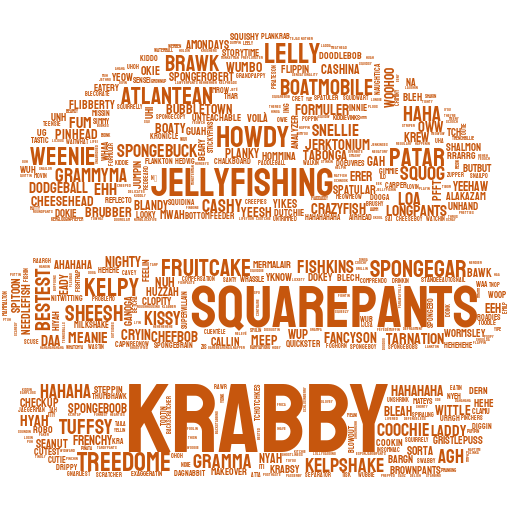
This wordcloud with the shape of a hamburger reveals the most common words spoken in SpongeBob SquarePants that most likely are not in the dictionary.
Two of the most popular are squarepants and jellyfishing. Both of them have simple translations in other languages; however, words like Krabby Patty and treedome have more complicated translations. Sometimes these new words remain the same but are pronounced and written in different ways.
What episodes among the 388 are the best for you to learn a new language?
It might be hard to believe, but cartoons don’t use simple words in their dialogues. Although they’re made for children, the vocabulary used in some episodes might be hard to understand, especially if you’re watching them in a foreign language.
Let’s use the episode Spongicus (Season 6) as an example. According to the data analysis I did, this is the episode with the most advanced vocabulary in SpongeBob SquarePants. The results don’t lie! After watching the 10-minute episode, I heard words like vow, behold, gladiators, imperial chum coliseum, etc. Imagine learning such words in French or Italian— not only they’d be hard to remember, but most likely, you won’t use them quite often.
That’s why I ranked the 388 episodes to find those who have the simplest vocabulary, so it’ll be worth watching them in order to learn a foreign language. The ranking shows that the episode Don’t Look Now (Season 9), A Day Without Tears (Season 7) and The Thing (Season 4) are the episodes in which characters used mostly basic vocabulary.
You can find the ranking of the 388 episodes in the following box. The ones that rank higher have more basic vocabulary, while those who rank lower have more advanced vocabulary.
You can also play with the graph below to find which episodes are more suitable for your language level.
The best episodes to learn a new language with SpongeBob SquarePants
Based on the analysis, the following are the top 10 episodes with the easiest vocabulary among 388 SpongeBob SquarePants episodes aired. If you watch them without subtitles, you’d probably understand more than in the rest of the episodes.
- Don't Look Now
- A Day Without Tears
- The Thing
- Broken Alarm
- Karens Baby
- Home Sweet Pineapple
- Rocka Bye Bivalve
- Fun Sized Friends
- Mid Life Crustacean
- Waiting
To find the seasons each episode belongs to, check this link.
Be careful! Cartoons’ dialogues don’t contain simple vocabulary.
Cartoons like The Simpsons and SpongeBob SquarePants have the lowest percentage of basic vocabulary (Level 1) in their dialogues. Also, If we consider the pop culture references they use for jokes and sarcasm, then it’ll even harder to understand them in a foreign language.
Fortunately, now you know which SpongeBob episodes contain simple vocabulary. These episodes will be a good way to put into practice everything you learned in language lessons.
What hard words are they saying in 388 episodes?
In case you’re learning English, the following box would come in handy when watching SpongeBob SquarePants. The box contains all the words said — from intermediate level — in the cartoon. Let me know if you’d like to have a similar box for other languages.
Search the name of an episode and learn the “hard words” before hearing them in the episode.
Conclusion
We found again that the vocabulary used in cartoons isn’t as simple as many people expect. SpongeBob SquarePants is no exception so consider watching episodes with basic vocabulary. This trick will help you worry less about understanding a lot of new words in the foreign language and allow you to have fun watching your favorite TV show.
The code behind this analysis is available on Github.


