
Leading Our Worlds With Radical Candor

World domination. Who wants that? Not me but aren’t there worlds that we do drive as individuals? They are small ones as a lover, mother, father, dog-owner, affiliate, writer, team player, community member etc.
On a doomed project I worked on recently, I had the good fortune to encounter Kim Scott’s Radical Candor. I haven’t read the book ‘Radical Candor: How To Be a Kick-Ass Boss Without Losing Your Humanity,’ cause I’m not a boss, but something about it stole my attention.
I think it’s the accessibility and perfect simplicity that lies in the idea that to be an effective leader to someone else you just have to care and be bold enough to challenge directly. There’s a wonderful mutual inclusiveness between the two things. If you didn’t care enough, you wouldn’t bother to challenge and vice versa you you bothered to challenge it is because you care.
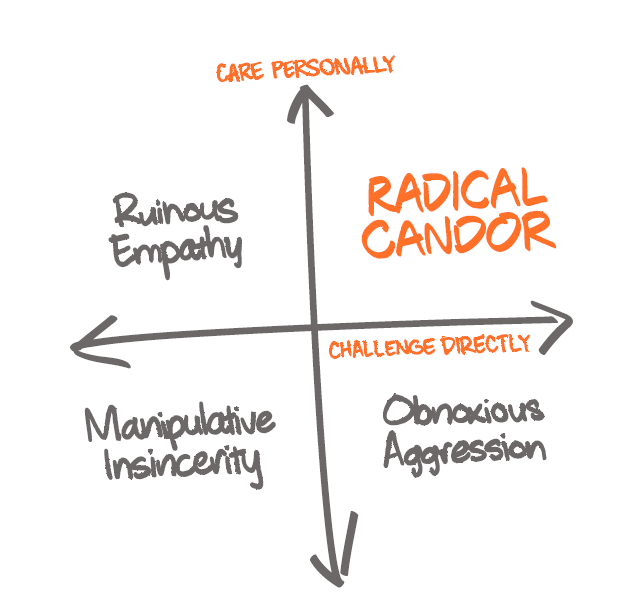
We can take the word leader right out of the principle if we’re looking at our microworlds.
“Radical Candor really just means saying what you think while also giving a damn about the person you’re saying it to.” Kim Scott
Easy?
No, of course not; the hierarchical culture that many of us experienced in our working life discourages both the act of caring personally and challenging directly. God knows what kind of chaos we would unleash if we all went around our day being kind to each other and helping each other out with constructive challenges.
It could just knock a few ‘leaders’ and newspaper moguls off their perch.
But back to us.
I see two useful applications for non-bosses with Radical Candor — inwards to ourselves and outwards to the people that matter in our lives. If the solution sounds simple, it is, but the road to delivery is hard.
Radical Candor To Ourselves
So obviously we’re aiming for behaviour on the top right-hand quadrant. Where do you fall in the other sections?
Does the idea of caring personally about yourself seem strange? How does the way you treat yourself compare with the way you treat others? Are you more likely to drop everything to go the rescue of someone else than to your own rescue?
These might be strange times to talk about self-interest, but if you are not good to yourself, you’re not much better to anyone else. It’s why the air hosts always tell you to put your seat belt on first in the event of a crash.
But Radical Candor isn’t about merely pleasing; the challenge directly criteria condition forces you to be honest about the story you tell yourself.
For example, I missed my script deadline at the end of March because I was busy with business things.
Manipulative insincerity will tell you ‘it is what it is, you can’t win all the time.’
Ruinous empathy will say something equally unhelpful ‘sometimes you take on too much.’
Neither of these things represents a challenge nor a fix.
Radical candor would probe the situation; what other goals did I achieve instead of this one? What did I spend my time on over the last month? Do I have what it takes to be a screenwriter if I’m missing goals? Is there an underlying emotion such as fear or uncertainty that is governing the distraction.
I tell myself all kinds of stories about overeating, drinking too much, not doing exercise, fussing about on the internet, checking my follower stats too often and that’s fine until it gets in the way of what I want. That’s when I need to roll out some radical candor.
What about you? If you’re not in need of some redirection then lucky you but if so why don’t you view your situation as you would consider the case of a friend you were trying to help?
Radical Candor To Our Friends and Affiliates
It’s precisely the same process.
A friend has been talking about going back to doing her artwork — all of the materials are in her garage, it’s just a case of getting them out and starting again. But she’s been talking about this for fifteen years.
Last week she called to tell me about a property she wants to buy so that she can do her artwork. Her move will be the missing link.
Manipulative insincerity says ‘good, that’s just what you need to get started,’ ruinous empathy says something similar ‘good.’
Obnoxious aggression would tell her she’s too old to get started on her artwork again and to throw the materials in the bin.
Radical candor reminds her that she already has a room at the back of her house where she could get started and that she’s been saying the same thing so what’s really stopping her? Fear? Has she disconnected with her artwork?
These are small examples, but sometimes it’s the tiny pieces of tough love advice that snap us into shape. It’s a good standard to live by when pushing yourself on to achieve more or friends or clients.
As a writer, it’s necessary to be able to discern advice from people who ‘care personally’ from those who don’t. Not everyone you know has to care personally, and you don’t have to care personally about the whole world.
But a little bit of radical candor for those around you, including yourself can make a big difference.
Do watch this anecdote-ful Ted Talk by Kim Scott.


