

Leadership; the art of balance and the three most powerful words
A Leadership Spark
I read or listen to a lot of clever people, people who have achieved a great deal of success in their respective fields. One of the best shows I’ve listened too is The Learning Leader podcast with Ryan Hawk. In one of his early shows he interviewed a lady called Kat Cole (her story is very inspiring).
Ryan likes to lead with a consistent question in his interviews; what are the common characteristics or traits of leaders who sustain excellence?
Kat’s answer was profoundly insightful;
Productive achievers have, on one side, courage and confidence. They take risks, they believe in their point of view — and therefore, others do, too. But on the other side of that scale is another bucket of characteristics that has to be equally weighted. That is curiosity and humility. Leaders that have curiosity and humility convey to others that they don’t know everything, and therefore, that [they] need the people around them, that they’re a part of something bigger. And what I have both experienced and observed is that if you get one of those buckets of behaviour’s too far over-weighted from the other and they get out of balance, it’s really difficult to have sustained success and be a productive achiever.
So, if you’re only courageous and confident and you don’t have the humility and curiosity to balance it out, you’re just a bull in a china shop. We’ve all worked for those leaders who charge so far ahead that they actually end up looking behind them and seeing no one there. On the other side, if you’re only humble and curious, it’s difficult to convey confidence when you are sitting back and questioning. No matter the industry, regardless of the maturity of the leader, regardless of the age or the culture, I truly believe that the balance of those two characteristics is the single greatest determiner of long-term success.
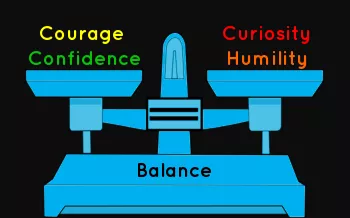
Read more of the interview here including the incredible 7 years that saw her rise from Hooters hostess to CEO of Cinnabon, listen to Ryan’s interview here.
So how do you balance confidence and courage, curiosity and humility? All it takes is three words; “I don’t know”. Sounds simple right? For some reason it is incredibly hard to say in a work environment.
If someone walks up to you in a city you are visiting on holiday and asks for directions, you are likely to say “I actually don’t know, we can have a look at my phone and try and work it out”. You’ve been in cities before, you’ve given directions before — this is close enough for you to be able to make something up and seem like you know what is going on…. Right? You’re probably not going to think like that in this situation. You know that the right thing to do is say you don’t know and find out together, or point them to the person or place with the right information.
However, if someone walks up to you at the office, and asks something related to your work in a field you have some knowledge on, you may be tempted to give them the knowledge you do have, perhaps even if you know deep down you don’t have all the information they need. This becomes harder if you are in the position of leadership, and they are a part of your team… In much the same way as giving street directions outside of your confidence area, there is value in saying “I don’t know, but I think we can find it out together”.
Not only does this show curiosity and humility, it also shows courage and confidence (in your self and your value as a leader). Those who are insecure will try to provide that knowledge, in an effort to boost the perception of them having value, but most often taking the courageous approach and being humble and curious, will actually provide the biggest boost to your staffs confidence in you as a leader.
So, say it in that meeting or when having a conversation and you hear something that doesn’t make sense. There are lots of ways to say I don’t know. You can use, “what I thought I heard was”, or “the story that ran through my head when you said that was”, or “you said something I’m not sure on, could you expand on …”, or “I don’t think I understand”.
So, give yourself permission to say you don’t know. Give your peers the chance to say they don’t know, give your team permission always. In fact, challenge yourself to honestly say it once a day, once a meeting, or as often as you need. Learning is the objective, learn small but learn often.
Here is a link to a post about the 4 things my Mother taught me about leadership. When my Mother read it she cried and laughed and reflected that “sometimes you don’t realise when people are paying attention”.
Stay safe and keep smiling
Leon
[high-fives]


