
Leadership is a Process, Not a Person
We need to focus on the ecology of work not just on leaders

It is 1607 in the Italian city of Mantua. The city is situated between and slightly to the south of Milan and Venice. It’s early summer and the composer Claudio Monteverdi assembled a huge ensemble of musicians.
Up until this point in history, most composers prioritized the specific musical melodies for an ensemble not necessarily specific parts to particular instruments. Monteverdi had something else in mind. He had written parts for specific instruments. He also intended to do this with a much larger ensemble than was usually the case.
He led the ensemble through a musical experience that would set in motion much of what we recognize in modern orchestras and was one of the pioneers in the development of opera.
Modern orchestras now boast some one hundred musicians. It takes quite the coordination to find a cohesion we recognize as music.
Our workplaces are like orchestras and our culture is obsessed with maestros. Workplace culture is fixated on leaders. Magazines proclaim them as ‘Person of the Year’. Documentaires and Hollywood films obsess about the faces of well-known corporate leaders.
This is the equivalent of thinking that the most important person in that orchestra is the person on the box waving a stick. But orchestra music, like so many vocational outcomes of our modern world, cannot be produced by a single person. Orchestras demonstrate beautifully the power of the human collective engaged in a group process.
We can gain something valuable by turning away from a preoccupation with leaders and toward the systems they serve. Leaders, too, could benefit from this systems perspective. Leadership, then, becomes a group process.
A Focus on Systems
In ancient Greece, thinkers knew that there were important reasons to appreciate the interconnected web of things. Aristotle, for example, claimed that “the whole is of necessity prior to the part.”
Since that time, systems and holistic theories have been utilized in business, education, healthcare, and technology. Good leaders need to be good at systemic thinking. They need to understand and appreciate the system as a whole, not just its component parts.
Good leaders need to have the capacity to snap onto different perspectives within the system they are leading. And perhaps most importantly, leaders need to share a deep appreciation that they are part of a larger system.
All of this requires that we drop the notion that leaders are special and above the systems they serve.
Now I know what you are thinking, don’t leaders matter? Yes, of course. But our culture puts too much emphasis on the person who is the leader and not enough attention on leadership as a facilitated process — a group dynamic.
The device you are reading this on is a great example of systems theory and the leadership necessary to produce it. This device is the amalgamation of thousands of people’s efforts, both historically and presently. Ideas developed, elevated, elaborated, and improved. People who know about materials, labor, manufacturing, technology, psychology, business. It is the product of human relationships that took glimmers of ideas and turned them into industries. A single human being would never be able to accomplish such miracles! And yet often a single human (or some small few) gets all the credit. This device exists because of the workplace ecology that supported it.
Leaders Don’t “Deserve” Their Position
We have to start this journey into leadership processes by de-throning our leader preoccupation.
Being promoted to a leadership position is an exciting and thrilling feeling. Don’t let any leader convince you that they weren’t content with the status they obtained by being a leader. And, quite frankly, we shouldn’t take that away from people.
The problem is not the status of leadership. The problem is an entitlement that can follow the status.
Being promoted, hired, or elected toward leadership is not a position of entitlement. It is a temporary privilege. Even if you created the company. Even if people have erected statues in your honor.
For some, they will be leaders in that position for a long time and others may be less. But for all leaders, there is no right to leadership. Leaders who lay claim to this supposed right ensure certain and eventual destruction.
While most leaders would be quick to agree that it is improper to act entitled, the truth is that entitlement is not necessarily a fully conscious attitude. Instead, it may very well present itself in the implicit attitudes leaders have in their position.
Our workplaces are like orchestras and our culture is obsessed with maestros.
Dutch psychologists David de Cremer and Eric van Dijk were able to demonstrate that simply identifying or being labeled as a leader can lead to potentially unhelpful entitlements to resources. Their experiments showed that those who were simply told they showed an above-average aptitude for leadership were more likely to take more resources from the group irrespective of their actual contributions.
This social-psychological process is sometimes referred to as entitlement bias. What this research on entitlement bias demonstrates is that leaders need to be vigilant of the tendency to engage in egocentric motivations and behaviors.
In other words, we need to make sure our leadership position is not getting to our head. And what I generally recommend to leaders is to remove the word ‘deserve’ from their vocabulary.
Leaders do not deserve — leaders serve. Stephen Covey states it clearly in another way, “leadership is a choice, not a position.”
You are an entrusted steward of an ecology. And you have already learned this lesson from the Lion King. When Scar takes over leadership, he is selfish and greedy. He is entitled, which actually motivated him to take the throne. The results speak for themselves. His actions lead to degradation to the ecology and all suffered for it — including him! He believed himself superior to others, was resistant to feedback, and did not trust the team. He did not understand his role.
An effective leader must embrace authentic humility. Leaders have to actively resist the potential corruption that the role of leader can provoke.
If we allow the role of leader to get to our heads, then we very well might justify behaviors that are unproductive, even harmful. We will forget we are a part of a system not above it.
Leadership without Ego
We’ve heard the business adage: ‘It’s not personal; it’s business.’ My experience, however, is that leaders have a poor habit of taking way too many things personally.
And it’s not entirely leaders’ fault. This is the side effect of our work culture being obsessed with individual leaders. There is the misplaced myth that the leader is what makes a workplace.
Think of a highly successful business. Now give me the names of 20 people that led to the success of that business. If you are struggling you are not alone. Okay, now think of a single person who you think represents a successful leader. Done, see much easier. We attribute success and failure almost singlehandedly to leaders and yet we know, for a fact, that it is more complicated than that.
Systems thinking provides a more comprehensive answer. The relationships and interactions of various subsystems of a workplace ecology have the greatest impact on long-term success. The task of an effective leader is to find the dynamic balance between the relationships of subsystems and the organization as a whole’s values and goals. It is the synergy and trust of the components of a system that ultimately determines success or failure.
An effective leader must embrace authentic humility in the face of a role that plays to the ego. Leaders have to actively resist the potential corruption that the role of leader can provoke.
In order to be successful, leaders are best to check their egos at the door. When we lead from our ego, we will have the tendency to act in a manner that prioritizes accolades (e.g., “winning”), being right, demanding compliance, being less sensitivity toward subordinates, avoiding contexts of failure or ridicule, and prioritizing ourselves above subordinates and organizational needs.
The ultimate costs, in this context, are transferred to workers and organizational outcomes. And there is a spectrum of specific destructive leadership behaviors that are worth mentioning. Social psychologist Merethe Schanke Aasland and colleagues identified four categories of destructive leadership behaviors. The researchers categorized these as tyrannical leadership behavior, derailed leadership behavior, laissez-faire leadership behaviors, and supportive-disloyal leadership.
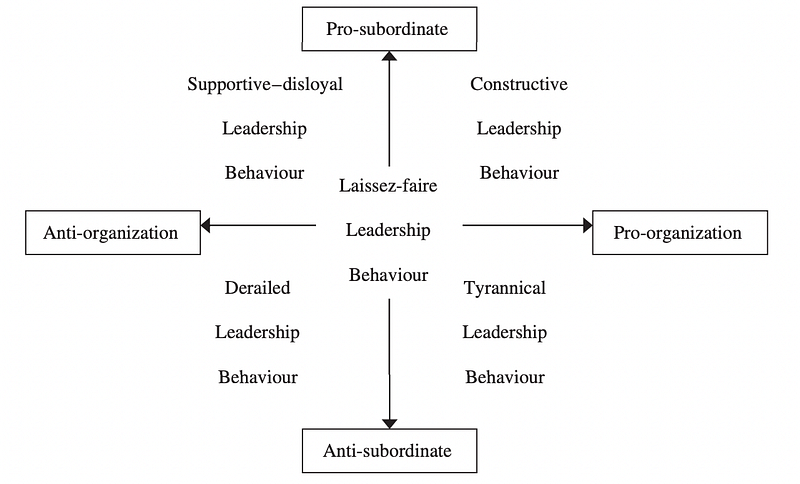
All of these destructive leadership behaviors have something in common. They are expressions of a leader who has become too entangled in the role and misappropriates their power.
Leaders who do not pay attention to the larger system and the people in it will cross these kinds of issues. Without this larger systemic awareness, a leader might become too narrowly focused on themselves, narrowing their perception of problems and solutions. They might become too emotionally entangled in the situation and less receptive to feedback from others. They may prioritize their needs at the expense of others or the organization. They might isolate themselves in problematic ways.
When we understand that leadership is a process, not an outcome, we have a greater capacity to pay attention to the wider context that gives rise to problems and solutions. We can monitor the possibility of destructive leadership behaviors. And when we recognize that leadership is something facilitated, leaders can find a healthy distance to take on the challenges.
With this healthy distance, leaders reduce the risk of becoming entangled in proving their worth or asserting their power and more energy can be freed up to address the needs of the organization.
And those we work with, no longer feel as though part of their unwritten job description is to tend to your ego in service of making their workplace more habitable. This frees everyone to be more constructive in their work.
A Pathway to Successful Workplace Ecologies
Systems-oriented leadership promotes sensitivity and responsiveness to workplace ecology. When leadership is engaged in this manner, leaders can identify workplace issues that exist at various levels of the system, from individual workers to groups.
Leaders need to understand that productivity is not a mechanical concept but a deeply humanistic one. A systems-oriented leader has to be able to snap their perception to different levels of the organization while recognizing the human element at all levels of the system.
This is multi-modal thinking — a skill that leaders need to develop proficiency in. Work on solving an issue, then step back and approach it from different systemic perspectives. Then zoom to some individual workers. Then zoom back. This capacity to fluctuate our perceptions allows for a more comprehensive analysis of the consequences of our decisions.
This can be a challenging and dizzying endeavor. Some of you might be confused already. That’s okay.
Let’s start at a simple place. Communication. A common strategy of leader communication is to simply communicate from a top-down manner.
A school district’s administration comes up with a decision and then broadcasts it to teachers to follow. Without context, teachers begin to feel like they are at the mercy of orders from on high. This is a disempowering systemic context that produces poor outcomes, including burnout.
Our work environments are terribly burnt out. As I’ve written about prior, leaders and organizations need to identify how they contribute to burnout — since it is often organizational factors that often have the strongest contributions toward burnout.
A human systems perspective recognizes that workers don’t just need information but insight into how decisions came about. Leaders, then, need to be more than merely information delivery people.
Leaders need to understand that productivity is not a mechanical concept but a deeply humanistic one.
Instead, leaders ought to give workers access to the information they have and how they are thinking. Trust workers with what you know and how you are organizing what you know. I’m not saying groups need to know every detail. But if your team is left too much in the dark, then problems will usually follow.
It can be helpful for a leader to be transparent with the group about how they came up with a decision, the factors that were involved, and the limitations of the decision. People are more likely to follow a leader if they can see the process by which a leader is coming to decisions. Too often the case is quite the opposite.
A common pitfall I see with some leaders is they think their power comes from having information their subordinates do not. In fact, I’ve worked for some toxic leaders who would purposefully withhold information from the rest of the team. They withheld information believing this makes them irreplaceable and makes their authority legitimate. This came at the cost of organizational harmony and productive outcomes.
Workplace trust is built not in the spaces of withholding but with transparency. Leaders who can communicate their decision-making process and the information they are making those decisions on are more likely to have trusting workplaces.
The beauty of a systems orientation to leadership and organization is that you can apply it to many organizations’ needs, values, and challenges. It simply requires a shift of perspective.
The modern workplace is fraught with many challenges and leaders have a significant charge in addressing these. A human systemic orientation can aid in the creation of a richer, more sustainable workplace ecology. It encourages all of us to focus on the whole organization, not just its leaders or individual workers. ∎