
Leaders: Respect This Trinity
Better some method than madness

Leadership coaches and gurus like Robin Sharma and John Maxwell encourage care for peers and subordinates as a vital attribute of good leadership. But an excellent professional leader needs to respect two other aspects that are crucial to success— Roles & Responsibilities and Method. The pictorial below shows these essential aspects of institutional respect.
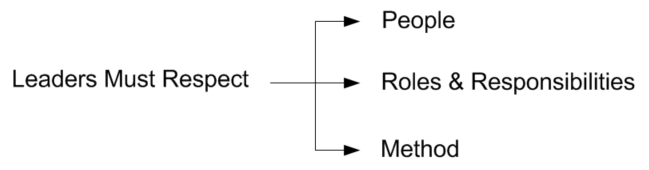
The absence of a clear definition of each team member's role and responsibilities, and adherence to it, makes it very unlikely that a work unit of any size and at any level in the organisation will realise its potential. Although it may be obvious, it has been my experience over decades of work that many employees do not know their precise role, and even when they do, they will often not be performing to it or performing it well. It is either due to organisational slackness or their inclinations.
Also, not having a method to deliver the organisation's outputs can make it turbulent, wasteful of energy, and prevent the institutionalising of learning. Methods enable repeatability and efficiency that provide quality, economy, and faster outcomes. It is as accurate of white-collar work as, say, manufacturing. Unfortunately, it is also my experience that the need to bring 'method to the madness' of chaotic work is a common situation. (I have avoided the word 'process' here due to the negativity associated with it in the sense of 'red tape' or 'bureaucracy'. But, having a defined process is analogous to having a method.)
Management and leadership based on a respectful attitude simultaneously for People, Roles & Responsibilities, and Method are not weak. Instead, it is the best recipe for long-term success. Managers and organisations that practise this are likely to have a healthy and productive working environment and foster success.
Some will feel that all this can make work tedious, but creativity does not die from doing things in an orderly way. Method and innovation can co-exist, nurture each other and flourish. That's a topic for another day.
Shashi Sastry quality-thinking.com
Please consider Medium membership to clap, comment, highlight, and get full access to my stories and those of other excellent writers. (It's only $5 a month. Give it a go!)


