
Launch Day to Mars
Scientific exploration of Mars gives way to life and death struggle
Helen Gould was grateful for the clean room enclosure that prevented her from seeing the ground. She was not fearful of heights, but at this moment she did not want the added anxiety associated with seeing the ground 200 feet below. She was all too aware that she was atop a rocket that was nothing more than a controlled bomb, every part built by the lowest bidder — or so the old joke went.
She crossed the hatch’s threshold and entered the Orion spacecraft.
As she had practiced a dozen times, she paused in the hatch and waited for Albert Wagner. In a moment, the launch crew chief turned and disconnected the portable air conditioner from her pressure suit. He shook her hand, as best one can do in a pressure suit, and stared into her glass helmet.
“God speed,” he whispered, holding her gaze.
“Thank you, Mr. Wagner.” She was careful to pronounce his name: VAHG-nur, but she was certain he couldn’t hear her through the helmet. If anything went wrong, his face would be the last she would ever see.
The pressure suit would protect her in the event the crew was forced to eject from an altitude above 15,000 feet. If that happened, the suit might shield her from the cold, low oxygen air, but it probably would not protect her from whatever catastrophe caused the ejection in the first place. For Helen, the suit’s primary function for this launch was to maintain her status of isolation. For the past two months, she had been living in a biological isolation chamber with her fellow crew members. The goal was to ensure that everyone was healthy, and free of viruses that would bloom on the way to Mars.
I’m going to Mars, she mused to herself for the thousandth time since being notified that she had been selected.
Two other ground crew members helped her into her acceleration couch — her seat for the ride up to the International Space Station, better known as the ISS. A harness was cinched, buckling her in. The last step was to attach a hose linking her suit with the spaceship’s air supply.
Being the crew member seated farthest from the hatch, she had been the first one to enter.
She listened to the radio chatter from the launch team. It was all very familiar from the simulations. As it droned on, the monotonous conversation became comforting. Helen willed her adrenal glands to relax; she didn’t need adrenaline spiking her heart rate and blood pressure now. The excitement and anxiety of being launched into space were stress enough. There were still two hours of waiting until the launch. She was purely a passenger on this flight, with no tasks to keep her mind occupied. This was the worst part.
The Delta IV Heavy rocket assembly below her was well tested. This assembly had already lifted six components of her Mars mission into orbit, plus many other payloads. This flight contained the final four Mars explorers. A second Delta IV Heavy was in transit from the Vehicle Assembly Building to the 37-B launch pad. This unmanned rocket would launch three days hence. It would ferry the fuel tanks for the Mars insertion burn — the rocket blast that would accelerate the Mars spacecraft well beyond Earth’s escape velocity, sending them to Mars. The fuel was difficult-to-store liquid hydrogen and oxygen. This payload had been saved for last as the tanks were not expected to contain the volatile, super-cold liquids for more than a few days.
To say this assembly was well tested, was not saying a whole lot. Unlike the Space Shuttle system, the Delta IV Heavy was a disposable rocket. This specific collection of a billion parts had never flown into space before. Unlike the rocket, the Orion spacecraft were reusable. NASA had two of them currently in operation. This specific mission was designated OF-6 as it was the sixth Orion flight.
Helen watched the five other crew members take their seats in the same manner she had. The hatch was closed.
“OF-6, crew check,” she heard the CapCom announce in her headset. She listened as he called out the names. First, he called the OF-6 commander, “Luther Fernandez.”
“Fernandez, a-okay,” Luther announced.
Helen smiled, hearing the popularized expression: a-okay. Urban legend attributed its origin to Alan Shepard, the first astronaut to fly in a Mercury capsule. However, it seemed to have been in regular use long before that flight in 1961. Supposedly, early engineers found the sharper sound of A cut through the static better than that of O. Additionally, a replay of the communication tapes indicated that Shepard never used the term. Nonetheless, it had been used by every astronaut since Shepard.
Astronauts were a superstitious lot.
“Owen Glover,” CapCom called the Orion pilot. The term CapCom was another holdover from the good ole days. To avoid confusion, only one person in launch control was permitted to converse with the astronauts — the Capsule Communicator. All verbal exchanges came through him. The name CapCom remained, although the Orion was considered a spaceship, not a capsule.
“Glover, a-okay.”
“Marion Kowalski.”
Helen chuckled, hearing the CapCom use Kowalski’s first name. “No one calls me Marion and lives,” he had said to Helen when they first met. Better known as ‘Ski’, Kowalski was the Mars mission’s flight engineer and jack-of-all-trades. At 30 years of age, he was the youngest member of the team. Helen was 36, and the oldest Mars team member. None of them were married, although two of the men were divorced. None of them had spawned any children, or had any dependents. These were required characteristics in NASA’s selection process for the Mars crew.
“Kowalski, a-okay.”
“Roger Borman.”
“Borman, a-okay.” Roger was the chemist for the exploration of Mars. Like Helen, he was a scientist and would be as useful as an appendix until the team landed on the Martian surface.
“Martin Greystone.”
“Greystone, a-okay.” Martin was the team biologist and ship’s doctor. While all of the mission scientists were PhD’s, he was the only one referred to as ‘Doc’, or occasionally, ‘Doc Martin’ in reference to the British television series.
“Helen Gould.”
“Gould, a-okay.” Helen heard her voice echo inside the pressure suit helmet. She was the mission geophysicist, and the only woman on the flight to Mars.
Of the six of them, only Luther, and Ski had been in space before. Luther had been the pilot of an earlier Orion mission and Ski had spent six months on the ISS two years earlier.
Helen sensed the Orion sway, and her stomach rebelled. She swallowed hard to keep the astronaut traditional steak and eggs breakfast down. While this motion was not included in the simulations, she had been told to expect it. The launch tower had been removed; the rocket was standing on its own, subject to the wind. She felt it quiver and shake like a race horse nervously waiting at the starting gate. This resulted from the contraction as the fuel tanks were topped off with liquid hydrogen and oxygen.
Thirty minutes to go. Helen felt her palms sweat; she gripped the knobs at the end of the arm supports.
She busied her mind with meaningless details. The total weight of the Delta IV Heavy was over one and a half million pounds, not including its payload. This was only a fraction of the Saturn V rocket’s weight, the rocket that launched the Apollo missions to the moon. The Delta IV Heavy could lift a payload of fifty-seven thousand pounds to the ISS, and this was the exact weight of the Orion. While it could put over seventeen thousand pounds directly into a Mars transfer orbit, this was far less than the weight of their Mars spacecraft. The rocket consisted of a group of three cores in the first stage and one in the second stage.
Her headset crackled. “Ten-nine-eight…”
Helen tried to force her body to relax. She concentrated on slow, even breaths. She settled her head in the center of her helmet, aligned exactly along the rocket’s axis to equalize the acceleration’s effect on her two inner ears. The rocket engines roared to life. The Orion began to shudder violently.
“Three… two… one…”
An elephant sat on her chest. Like the Space Shuttle, the Orion-Delta IV Heavy assembly executed a quick take-off. Instead of a slow, lumbering acceleration like the Saturn V, this beast was clear of the tower in a few seconds.
Helen’s vision blurred, and she lost all concentration on the voices coming over her headset. The acceleration continued to increase, and with it, the weight of the elephant sitting on her chest. She had to force herself to breathe. After forty-four seconds, the acceleration eased off a bit as the central rocket core was throttled back, but almost immediately the acceleration began building again. As fuel was consumed, the weight of the rocket decreased, but with the constant thrust from the three cores, acceleration increased. Four minutes after launch, the two outside cores exhausted their fuel and were ejected. The remaining central core returned to full thrust, but the roar began to lessen. Another minute and a half later, this core’s fuel was depleted, and the second stage was ignited. The acceleration eased off dramatically as this stage burned for eighteen minutes. This part of the ride, in the near vacuum of space, was smooth and quiet. Then, they were in orbit around the Earth.
The elephant vanished, and Helen was weightless.
CapCom asked for another crew check, and Helen announced, “Gould, a-okay,” when her name was called.
Slowly, everyone released their restraints. They helped each other remove and stow the pressure suits. Wearing powder-blue flight suits with matching booties, the four passengers took turns looking down at the big, beautiful, blue-green Earth through the single, small window. Luther and Owen remained in their seats while the Orion completed three orbits, a hundred miles up. They worked with Houston ground control to verify their orbit’s altitude and tilt, and to calculate the exact burn necessary to put them into a transfer orbit to the ISS, three hundred miles above sea level.
Helen watched the sun set behind the curved surface of the Earth. She cupped her hands to block out the cabin lights and saw the naked brilliance of the stars.
“It’s beautiful, isn’t it?”
She had not been aware of Martin floating beside her. “It sure is, Doc,” she said.
Almost five hours after launch, the second stage was reignited to push the Orion higher, up to the ISS. The second stage was ejected where it would swing back into the atmosphere and burn up. Forty-five minutes later, the rocket motor in the Orion’s service module fired to synchronize the spaceship with the space station. The Orion held its position a few hundred feet from the ISS for a couple of hours to ensure that its orbit matched that of the ISS.
Helen and the three passengers examined their Mars spaceship. The first interplanetary vessel had been assembled from pieces shot into orbit by earlier Delta IV Heavy launches. The Enterprise would be their home for the nine-month voyage to Mars, and then the nine-month voyage back to Earth. The ship was named after the first Space Shuttle, which in turn was named after the famed starship in the Star Trek television series of the 1960’s. While this first Shuttle never flew in space, it was used to test the vehicle’s aerodynamic flight characteristics in 1977. While it had been NASA’s intent to use the Enterprise Shuttle in actual space flight, it was never launched.
“It doesn’t look like much,” Kowalski said.
“No, not at all like in the movies,” Helen answered.
The stark appearance of the Enterprise was not a surprise; they had known exactly what it looked like. However, it was a simple machine, as spaceships go. It had none of the spinning chambers to create artificial gravity from centrifugal force familiar in science fiction movies. Attached to the ISS, it looked like an add-on piece to the space station. This was partly because it was fabricated from leftover ISS parts. The Enterprise, like every aspect of the Mars mission, was built on a shoestring budget.
In its current configuration, the Enterprise was a cylindrical section attached to what appeared to be an Orion ship. The cylinder had a strong resemblance to, and was about the same size as, an Amtrak railroad car. This would house the six astronauts for the nine-month trans-orbit from Earth to Mars. What looked like an Orion ship was indeed a stripped down Orion that had been used for early unmanned test flights. To save weight, the heat shield, parachutes, and the like had been removed. This was the command module for the entire spaceship, and the only part that would be coming back. As it was incapable of entering the Earth’s atmosphere, it would return to the ISS in just under three years. Helen and her fellow travelers would be ferried back to Earth in Orion ships.
Finally, eight hours after their launch, the Orion OF-6 docked with the ISS.
Helen and the other three passengers waited impatiently as the air pressure in the Orion and the interconnecting tunnel was equalized with that in the ISS. Then, Luther removed the tunnel hatch while someone in the ISS removed the one on their end. Finally, greetings were exchanged between the two excited groups.
They all knew each other, having worked together in the astronaut corps for years. Even the two cosmonauts were acquaintances to all.
Luther pulled his head out of the tunnel and turned to Helen. “Ladies first.”
Smiling, Helen floated through the short connection between the Orion and the ISS, and popped out the other side.
“Helen, how was the flight?” Don Rosenberg, the Mars mission commander, asked.
“Splendid, positively splendid.” She was determined not to show any of the fear that had consumed her thoughts.
Hands passed her weightless body along the line of ISS personnel. She shook hands, as best one can shake hands in weightlessness, and hugged her friends. Doc followed behind her as she greeted Stanley Malone, better known as “Stickshift”. Helen had heard the nickname came from his collegiate football teammates. He was the pilot for both the Enterprise and the Dejah Thoris. The latter was the Mars lander that was already positioned in orbit around Mars. This ship resembled a larger version of the Apollo lunar lander, and was named for the Princess of Helium (aka Mars) from the Edgar Rice Burroughs books.
Devin Miller and Bryan Phillips were the two American astronauts stationed on the ISS. Devin had been aboard for three months while Bryan was nearly finished with his year-long tour.
Until the recent completion of the Orion spacecraft, the only means to ferry humans to and from the ISS had been aboard the Russian Soyuz craft. Heightened tensions between the United States and Russia had strained this arrangement, nearly to the breaking point. The agreement was the linchpin that kept the ISS viable after the cancellation of the Space Shuttle program in 2011, and was a political football that was tossed around at every US-Russian argument. The Russians had known that the Americans could not allow the agreement to end. In the big picture, the agreement played only a small role, but it was during this time that the Russians moved into the eastern Ukraine, backed the Syrian government in its battle with rebels not-so-secretly supported by the CIA, supported Iran’s harassment of US-backed Iraq and Israel, and most recently supported North Korea with its nuclear program.
Using economic threats, the Americans had been successful in keeping Chinese support of North Korea at bay. However, the Russians had filled the void.
With the advent of the Orion, the politics between the two nations strained even more as the Russians no longer held the silver bullet to silence American opposition to their aggressive actions. Additionally, a Soyuz capsule was still the emergency escape vehicle for the ISS crew. Its automatic flight programming would direct it to land inside Russia.
The astronauts and cosmonauts did their best to ignore the political tension between their two countries. Sergie Ivanishin warmly shook hands with Helen, and Natasha Sarafanov hugged her.
“Darling, it has simply been ages,” Natasha Sarafanov said, mimicking the exaggerated accent of Natasha Fatale’s character from the Bullwinkle cartoons. She pretended to kiss Helen on both cheeks.
Helen was a tad jealous of Natasha’s dark brown hair, pulled back in a ponytail. In preparation for the long, weightless trip, Helen had cut her hair very short — barely an inch long. As her hair was blonde, the style left her looking like a boy with a halo. She planned to keep her hair short for most of the trip. A few months before they returned to the ISS, she would let it grow out with the hopes that she would look feminine for the celebration pictures.
“Yes, it has been, what, two years? How have you been?” Helen answered with questions.
Natasha glanced at the growing crowd filling the small chamber as the Orion emptied, and whispered in Helen’s ear, “We will talk later,” as though she held a secret. She patted Helen’s shoulder and turned to greet Doc.
THE END
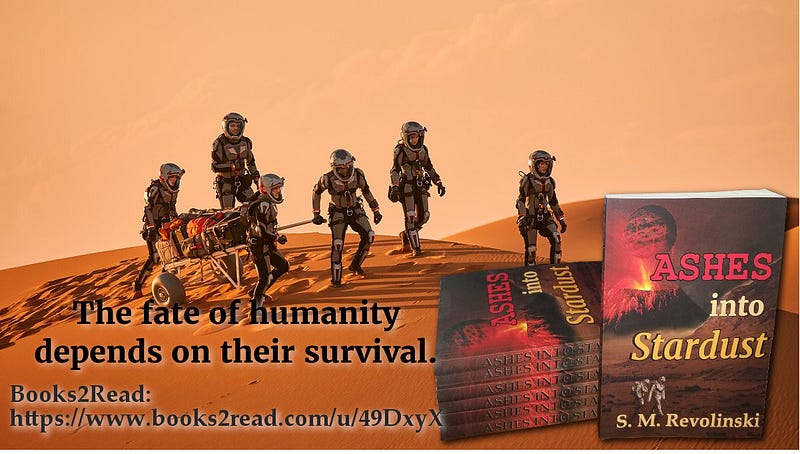
This segment introduces Helen Gould, the female protagonist in my book Ashes Into Stardust.

***
There was a great earthquake and the sun became black as sackcloth; every mountain and island were moved out of their places.
Fire rained down from the heavens, consuming whole cities and their populations; dense smoke covered the land like fumes from a furnace.
What do the Yellowstone supervolcano and Mars have in common?
Frank and Helen Gould are brother and sister geophysicists. Following the eruption of the Yellowstone supervolcano, the siblings are cast into a web of survival. Frank struggles in the post- apocalyptic world as North America is thrown into a volcanic winter. The collapsing government disbands NASA, leaving Helen stranded on Mars.
Driven to rescue his sister, Frank works with the Army as it becomes the new governing power. NASA left a rescue rocket at Cape Canaveral, but no one alive knows how to launch it.
Scientific exploration of Mars gives way to life and death struggle. Having lost contact with Earth, Helen searches for the water her team needs to survive. Alone, they realize rescue is not coming.
***
Enjoy the full story from a book seller near you. Click here for ebook and click here for paperback.
***
Copyright ©2023 by S. M. Revolinski All Rights Reserved
Thank you for reading my story, I hope you enjoyed it. Check my profile for more stories for you to enjoy. I have more stories and books published on Amazon and other ebook retailers for your reading pleasure.


