
Latest Tech Trends: Updates on React 19, Oxc, ESLint 9.0.0 Beta, and Hono 4.0.0
React 19 to Support Web Components
An issue titled “Plans for Custom Element Attributes in React 19” was opened in October 2017, and it has garnered over 285 comments in more than 5 years.
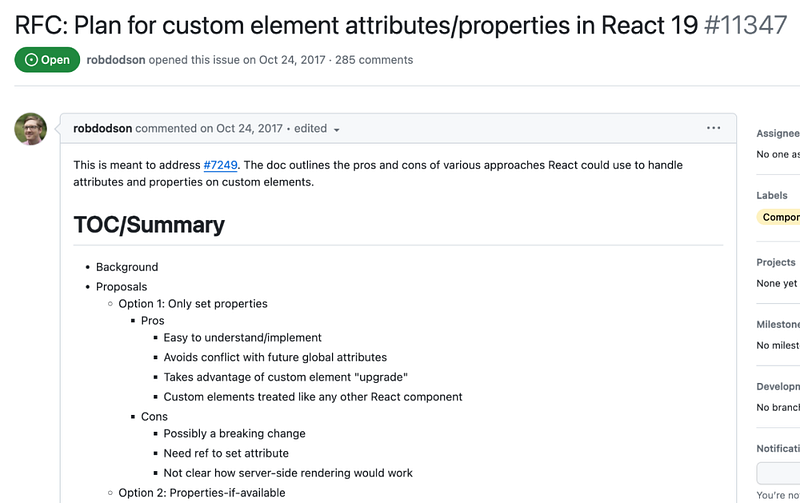
Recently, there have been new developments on this issue: plans to support custom elements in the next stable version.
Update: The plan is to release in React 19, where support for custom elements will be directly provided. Developers can expect that all tests on custom-elements-everywhere.com will pass by default, just as they do currently in the experimental channel. The release date and documentation for the supported features are yet to be announced.
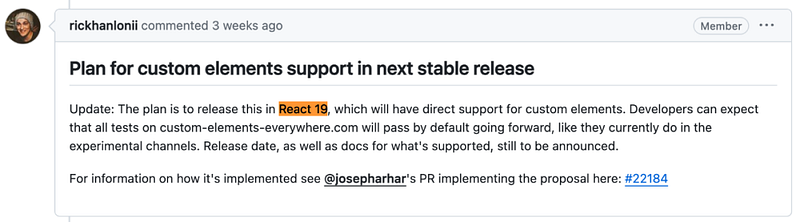
For further reference: https://github.com/facebook/react/issues/11347
Oxc Parser Performance Boost by 21.55%

Oxc (Oxidation Compiler) is creating a suite of high-performance tools for JavaScript and TypeScript. Oxc is building a parser, linter, formatter, converter, compressor, and more, all written in Rust, showcasing excellent performance. Oxlint — A New JavaScript Linter Faster Than ESLint by 50–100 Times
The Oxc project shares the same principles with Biome and Ruff:
- JavaScript tools can be rewritten in more performant languages.
- An integrated toolchain can enhance efficiency, a feat not achievable by individual tools.
In the latest Benchmark conclusions from the CodeSpeed Performance Report, the Oxc parser’s performance increased by 21.55%. The Oxc parser is three times faster than the @swc_rs parser and 4.4 times faster than the @biomejs parser.
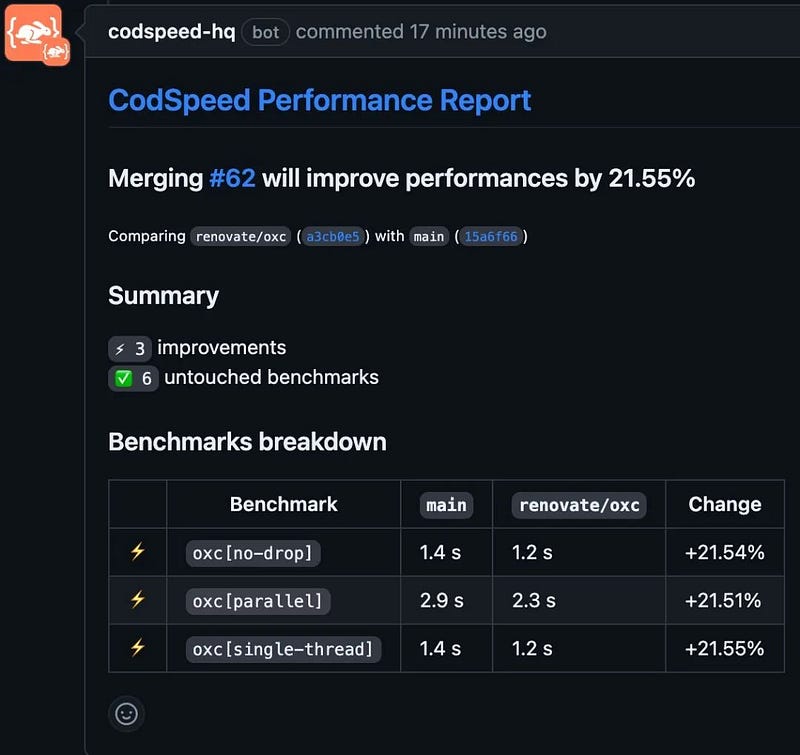
For further reference: https://github.com/oxc-project/oxc/pulls?q=is%3Apr+label%3AA-parser+is%3Aclosed
ESLint 9.0.0 Beta Released

ESLint has just released ESLint v9.0.0-beta.0, marking a significant version upgrade. This version introduces several new features and fixes several bugs found in the previous version. It also includes some breaking changes. Front-end News | ESLint v9.0.0 Major Update!
Highlights include:
- Adjustment of default values for certain rule options, such as
no-unused-varsandno-useless-computed-keyrules. - More rigorous validation in RuleTester; this version adds more checks in RuleTester.
- New API
loadESLint(), ESLint now exports a new function namedloadESLint()from its main entry point. Integrations can use this function to retrieve the ESLint class (previously FlatESLint class) or LegacyESLint class (previously ESLint class), facilitating switching between flat configuration and eslintrc API. - There are also some breaking changes, bug fixes, and documentation updates.
The release of the beta version indicates that ESLint 9.0.0 is not far from stable release.
Additionally, several ESLint-related packages have also been updated, such as: eslint/espree v10.0.1, eslint-visitor-keys v4.0.0, eslint/eslintrc v3.0.1 versions released.
For further reference: https://eslint.org/blog/2024/02/eslint-v9.0.0-beta.0-released/
Hono 4.0.0 Released
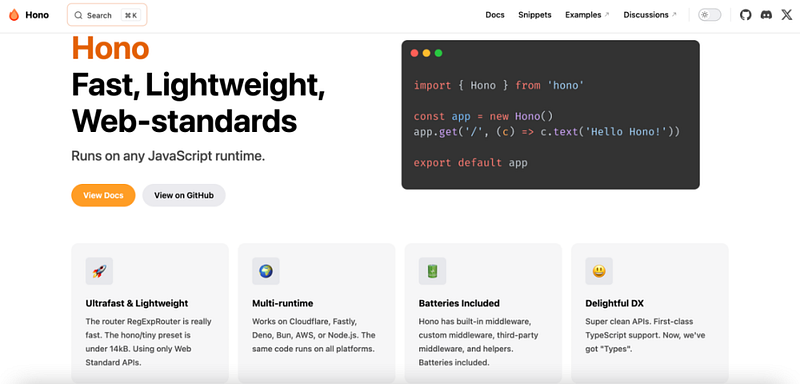
In Japanese, “Hono” means flame🔥, and it’s a compact, simple, and super-fast networking framework. It is suitable for any JavaScript runtime: Cloudflare Workers, Fastly Compute, Deno, Bun, Vercel, Netlify, Lagon, AWS Lambda, Lambda@Edge, and Node.js. Perfectly Replace Express and Koa! I Recommend These Two Frameworks
Hono boasts many features like lightweight, multi-runtime support, and a good development experience:
- Superfast 🚀 — The router RegExpRouter is incredibly fast. It doesn’t use linear loops.
- Lightweight 🪶 — Hono/tiny preset is less than 14kB. Hono has zero dependencies and only uses Web standard APIs.
- Multi-runtime 🌍 — Can run on Cloudflare Workers, Fastly Compute, Deno, Bun, Lagon, AWS Lambda, or Node.js. The same code can run on all platforms.
- Power-packed 🔋 — Hono comes with built-in middleware, custom middleware, third-party middleware, and utilities.
- Pleasant Development Experience 😃 — Extremely simple API. First-class TypeScript support.
Hono v4.0.0 is officially released! This major update includes some groundbreaking changes and three new features:
- Static website generation
- Client-side components
- File-based route selection
Thus, with this update, Hono moves towards being full-stack while keeping its core code as small as possible.
For further reference: https://github.com/honojs/hono/releases/tag/v4.0.0


