
Later Daters Makes Me Feel More Hopeful About Old Age
This dating sim game is as unapologetically queer and horny as it is heartwarming, and proof that sex and romance don’t completely vanish in old age
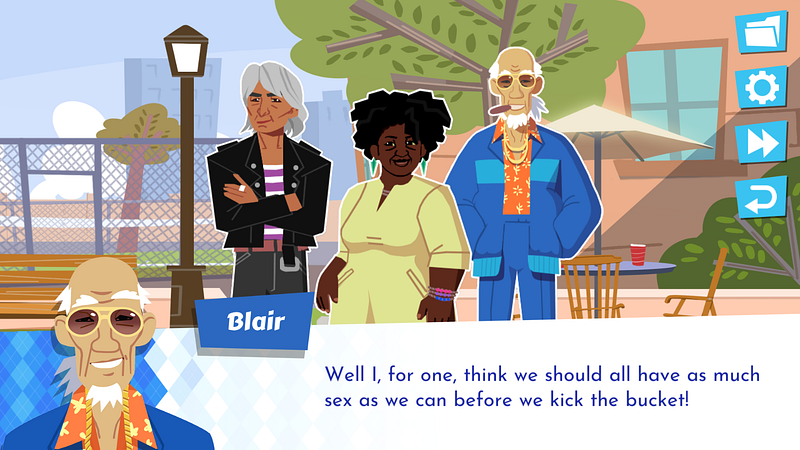
Why are most love stories, in virtually any medium but particularly in video games, limited to the early years of life? There’s got to be a boundless number of college-centered dating sims, RPGs, and visual novels, when frankly, you couldn’t give me a million bucks and a paid off condo on Miracle Mile to be 21 again.
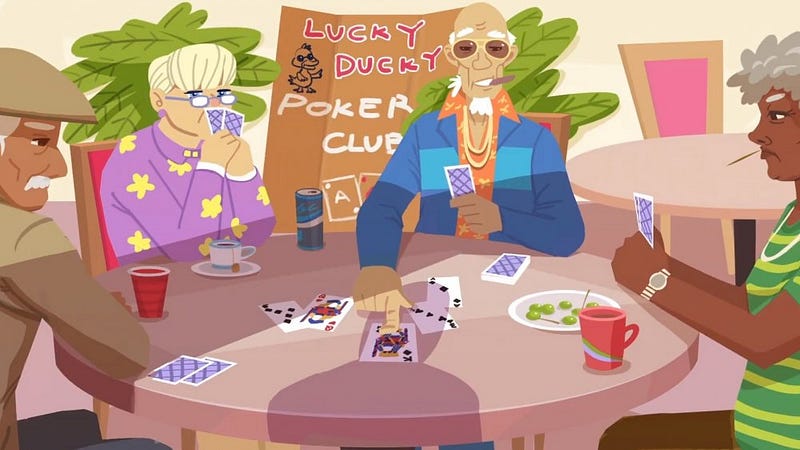
Later Daters does the complete opposite and focuses on sex and romance in old age: something we’re honestly long overdue for in a video game, as older characters are often not represented at all. Even in film and TV, stories that center older people are seldom told unless they’re played for laughs, even though we were lucky to get the raucous hilarity and touching moments of The Golden Girls in the 80s and early 90s.
We especially don’t get to see older queer stories in most mediums, and Later Daters certainly has you covered there. It’s unapologetically queer, horny, and approaches tough topics like grief, loneliness, and death with humor and heart.
I covered dating sims and visual novels overwhelmingly taking place in schools, and it’s mostly from an expedience standpoint in game design. It’s simply easier to map out a school, plus maybe two or three peripheral locations like a character’s home or a popular hangout, than a more dynamic setting like a city or workplace.
The latter can be done, and I’m attempting it in my own game, but schools remain such a popular choice in this genre out of that expedience and in providing a believable setting for constantly seeing the same group of people. It turns out that assisted living centers also make for a conveniently contained game world that’s easy to design around, where it’s plausible that these characters will frequently see each other, have cliques and conflicts, and easily turn a budding romance into a bloom.
I played it through a couple times, pursuing different characters and playing as one of three genders with your choice of pets. While the overarching story remains the same, the outcomes are mostly based on how you respond to people, how much you date or socialize, and how close you get to the community at Ye Olde, the assisted living center in which the game takes place.
And sure, it’s just a game: but one that was based on actual research conducted at assisted living centers. There’s more to our golden years than we realize, and it’s never too late for sex and romance — even if you’ve had a hip replacement and a pacemaker put in. As yet another elder Millennial with middle age sneaking up on me while I’m unattached, playing this game as an 80-year-old actually gave me a great deal of hope.
Yet I came across at least two snippets in the gaming press about Later Daters that described it as “the most bizarre dating sim yet”, after we’ve seen dating sims starring pigeons, tanks, refrigerators, and all manner of monsters.

Seriously, are people that weirded out at the idea of old people hooking up?
So look, I get that the games press sometimes has a disconnect from what’s actually going on with players. I mean, look at how many reporters are stunned that several million people on social media are horny over a 9 foot tall vampire lady in Resident Evil and post graphic fantasies about how they’d love to have her step on them. Their headlines on this topic spew confusion and complete bewilderment that people find more types of women attractive now.
As for finding Later Daters bizarre, especially after a game where you pursue a bunch of pigeons and can uncover this crazy subplot about what Pigeonations Academy is being used for, have they seen how senior citizen STD rates hit historic highs?
Older people have needs and desires for companionship and sex just like younger people do. They send each other sexts and racy images, and hit on each other online (with and without dating apps). It’s really not that shocking?!
Because imagine that you’ve lived to 80, and most of your friends and family are dead. If you have adult children, they may not be very involved in your day to day life because they’ve got lives and families of their own. You fear the loss of autonomy that comes with nursing homes, so you move to an assisted living center for your final years with no idea how many of them you’ll have.
You’re surrounded by your peers, can’t get pregnant, don’t have to work, and you all made it this far still in full control of your cognizance: honestly, who wouldn’t be hooking up like they were Congressmen bursting into a spring break party on the coast of Italy?
Hell, even as I look back on my twenties with a mid-thirties lens, there’s guys I’d consider now who I wouldn’t have given time of day to back then — and vice versa. There’s things I wouldn’t have done in bed at 24 that I’m open to doing at 36. If I still haven’t done them at 80, you bet your ass I’m snapping at the chance to do so with a happily consenting partner before we both kick the bucket. If I don’t survive it, it would be one hell of a way to go!
Moreover, locking it down when you’re young is no guarantee that you’ll still have a partner in old age.
Those of us who didn’t know a time before no-fault divorce don’t know how lucky we are. And well…we’re all going to die one day, that includes our partners. So many of us fear dying alone, but unless you both die in a plane crash or a mass shooting at the same time, one of you eventually is going to unless you pair off again prior to your death. Even then.
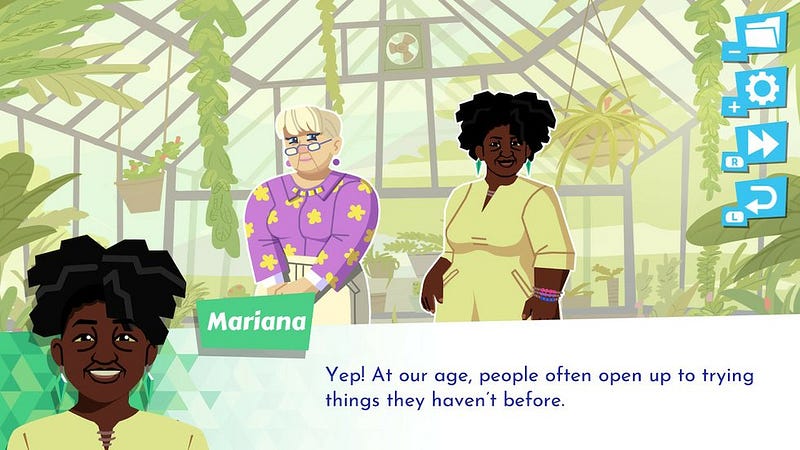
Later Daters portrays this with most of the romanceable NPCs being widows or widowers, and the way that they discuss their former partners is incredibly moving. Mariana comes across as a bubbly character who can get more action than many people half her age, but she was married twice and finds that she still grieves her spouse when she goes on a Tinder date. Crystal is a trans woman whose late wife Astrid accepted her for who she is, and she was able to be herself when they were at home and it was unsafe for her to be openly trans, but one of her children does not accept her and this causes conflict that only compounds her grief.
Even if it becomes easier to accept your mortality at old age, you still grieve. Grief is a powerful force and it isn’t always linear.
When you know you’re near the end of the line with no guarantee when you’ll go, it only makes sense that you’ll act on your desire to have someone near you. After a playthrough with these characters in about two weeks’ worth of game time, it felt like I really got to know the community: think about how that feels when you meet someone who you click with platonically or romantically, it suddenly feels like you’ve known them forever?
Distraction can be a great way to handle grief, but so is focusing on what and who you have right now, and building new relationships can help patch up the holes in your heart even though they will never be fully recovered. But it helps you live in the now instead of focusing on what you no longer have: a life lesson we need at all ages, not just beyond 70.
When you’re old and everyone you knew and loved is gone, but you’ve got this new community to blend right into, it’s not surprising in the least that things eventually turn into a geriatric fuckfest. Really, I don’t get why people are shocked about this and game journos think it’s “bizarre”.
You can also choose whether the protagonist had a spouse or made it to 80 having never married — also a groundbreaking option I don’t think I’d ever seen in a game before.
I distinctly remember Aveyond being the first game where you can choose to end it with one of two men (one of which represented the “true” ending, which was more epic and ceremonial than your other options) or settling down to a quiet life as a single woman in a cabin in the woods. While that was an RPG where the romance threads weren’t what drove the plot and gameplay, it was still the first time I remember it ever being seen as an actual option.
In Later Daters, you can start the game as having never married and even end it without choosing a paramour (or more, you can be poly at Ye Olde!) if you so desire. There is one character who reads as asexual, possibly aromantic as well, and neither of these concepts tend to be shown in any genre without attempting to invoke pity and/or mocking. We’re shown long-term single people who might not even have sexual desire and it’s in an extremely compassionate way that should repeated not just in games, but in other mediums!
After all, romance doesn’t have to be defined by what went on in your twenties or even thirties, but it is possible to make it to old age unpartnered and it doesn’t have to be a sad thing necessarily.
Art imitates life. The following is a message reposted with my friend’s permission:
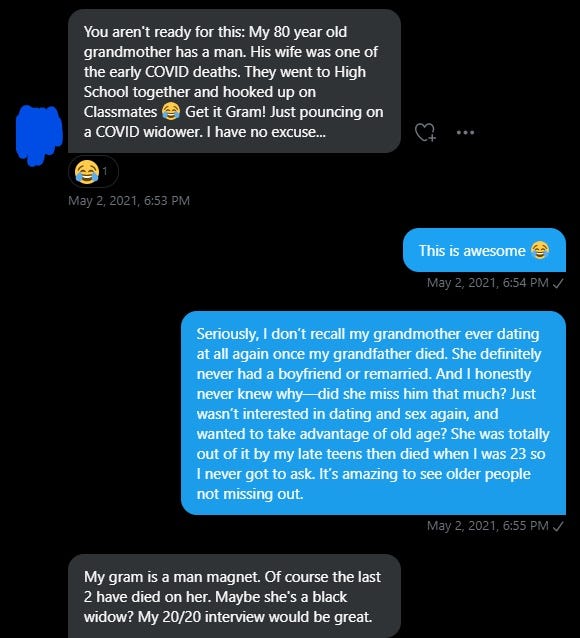
It’s interesting: if you want to have kids, we rush dating in our late twenties and early thirties to settle down before it’s too late. When you’re old, you rush dating because you don’t know how long you’ll both live. I feel grateful I got the luxury of time since I don’t want kids, and I realize it wasn’t meant to happen in the last chapter. But I’m only turning 36, not at death’s door. And if my Twitter DMs are any indication of things, I got options.
You truly have no guarantee of how tomorrow, let alone old age, will turn out. But even if you feel that you’re missing out now, you could have a last chance in your sunset years.
Later Daters also shows the reality of aging with great attention to the little details.
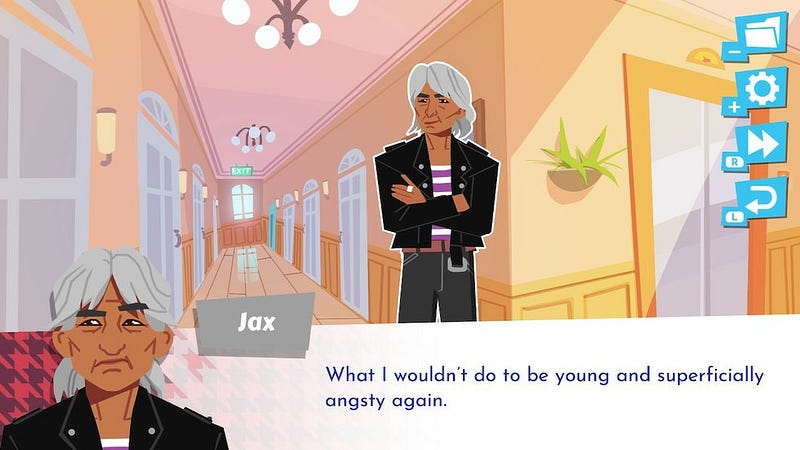
It comes up frequently in the dialog, such as characters needing to sit down more, monitor blood pressure and other health metrics more closely, and giving more literal support to others when it’s needed.
While it’s not clear which precise era the game takes place in, you got characters like Jax Argo above, who appears to be a David Bowie type figure in that he was a visionary musician and sometime actor who still performs. Jax is HIV-positive and talks of losing friends in the AIDS crisis. So the game does a fantastic job at keeping things overall positive and light-hearted, but also touches upon the darker realities that older marginalized people have faced and still contend with. The AIDS crisis brutally halted the lives of an entire generation of queer people, particularly queer people of color, and unjustly did not see much amelioration until it also began to affect white cishet people who did not get the disease through sexual transmission.
If you get to know Jax, he discusses how AIDS has taken a toll on him and how much work it is to stay in remission with a massive drug cocktail. It’s not just the usual bad knees and bad heart that you’re more apt to see with older people, though those also come up with Mariana and Blair respectively.
A minor character also dies, when he appeared totally normal that very day. This spurs a discussion about end of life planning from Nelson, the on-site barber and therapist, and letting go of the fear of death while gambling man Blair reveals that he had a death pool going — one of the worst kept secrets of most senior communities along with all the sex that goes on there.
That aforementioned fear about losing autonomy or worse yet, control over yourself? That’s also portrayed in the game not just with the protagonist musing about how they’re no longer home, but also with Blair and Haroun. Blair is capable of caring for himself but was placed in Ye Olde by his sister against his will. Haroun has dementia and this causes strain between his wife Salema, their children, and the management of Ye Olde who believe that he needs more advanced care than an assisted living arrangement can provide.
Seeing Haroun with Salema hit home as my grandmother had dementia and it got to the point that she couldn’t live by herself after 10 years of doing so after my grandfather passed away, and none of us were able to take care of her. It makes you question the sad state of our care infrastructure and what could happen to us if we don’t have any family but can’t take care of ourselves anymore, all while only 1 in 30 Americans have some form of long-term care insurance and Medicaid can ensure you don’t leave anything behind for your beneficiaries, be they kids, friends, or causes you care about.
Where once again: how is ANY of this bizarre? This is some of the most realistic stuff I’ve ever seen in a game!
But it still left me feeling hopeful, even though if I died tomorrow the buck essentially stops here.
People, but especially women, are often told that they need to just settle down so they won’t be alone and to live a life so cavalierly means they’ll be lonely in old age. I’ve found that this patently isn’t true despite the massive pressure there is to make choices you might regret just so you won’t be lonely when you’re old.
After all, there’s a myriad of forces that have a vested interest in pushing this “you must settle like this” narrative on us.
Honestly, playing Later Daters not only made me empathize more with older people who were both at peace with how they lived their lives and how they wished things had gone different — something I’ve been going through in my mid-thirties immensely throughout the pandemic — it also showed me that we don’t have to buy the panic about settling for a partner we’re incompatible with at best, is shitty to us at worst, in the vain hope we can stave off loneliness. It’s better to enjoy your life now and let the right one — or ones — in when the time comes, and that time might not be until late in life. Hell, Millennial loneliness is on par with or even exceeding senior loneliness, and I think they’re having more sex than us.
But if things right now aren’t what you hoped they’d be, you still have a chance for sex and romance when you’re old. I’ve learned to enjoy my dalliances with men for what they are even if they didn’t lead to relationships. Even a one-night stand teaches us something no matter how old we are, or at the very least it hopefully gave you a good time and story. The sunset is a beautiful time of day, indeed.