

LANGCHAIN — Is Fine-Tuning the Future for ChatOpenSource and LangChain?
In the software world, the moment you start using someone else’s software, you are living in their world, under their philosophy. — Richard Stallman
Fine-tuning AI models has become an essential practice to enhance model performance and achieve cost-efficiency. In this tutorial, we will explore the concept of fine-tuning and demonstrate its application using LangSmith, an AI evaluator from LangChain. We will delve into the code examples and explanations to understand the process of fine-tuning and its benefits.
Why Fine-Tuning should interest you
Fine-tuning is crucial when standard models fail to meet specific requirements. It allows you to enhance model understanding, consistency, and reliability, making it a game-changer in AI development.
Mastering Data Prep: The Secret Sauce of Fine-Tuning
Before fine-tuning, it’s essential to prepare a robust set of training examples that align with the desired model performance. The following JSON structure illustrates a sample training setup for fine-tuning:
{
    "messages": [{
        "role": "system",
        "content": "Given a product review, provide the following fields in a JSON dict, where applicable: \"product\", \"star_rating\", \"specific_likes\", and \"specific_dislikes\"."
    },
    {
        "role": "user",
        "content": "This desk chair gets 2 stars from me. It's uncomfortable and the height adjustment is faulty."
    },
    {
        "role": "assistant",
        "content": """{
            "product": "desk chair",
            "star_rating": 2,
            "specific_likes": [],
            "specific_dislikes": ["Uncomfortable", "faulty height adjustment"]
        }"""
    }]
}
Including edge-case examples and high-quality datasets optimizes the fine-tuning process.
Cost Efficiency with Fine-Tuning
Fine-tuning not only enhances model performance but also offers cost-saving advantages. By comparing the cost models of different AI frameworks, we can evaluate the economic benefits of fine-tuning.
How LangSmith Evaluation Works
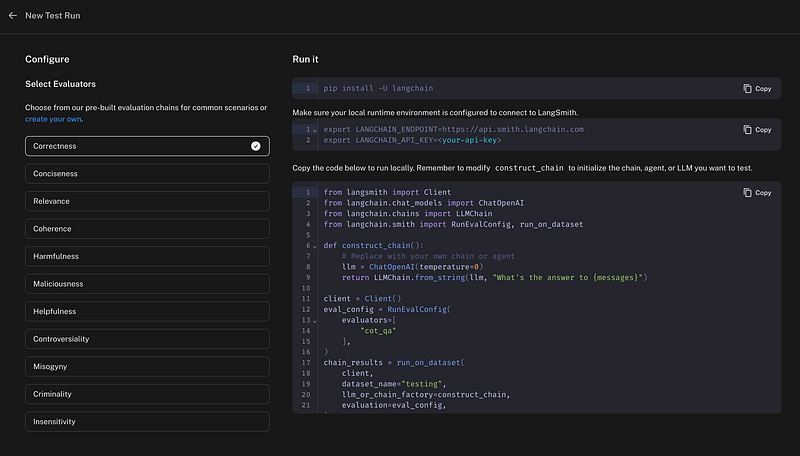
LangSmith provides ready-to-use evaluators for assessing model performance. An example of evaluating a fine-tuned model using LangSmith is depicted below:
Benchmarking Performance
We can utilize LangSmith to measure the performance of fine-tuned models against their baseline counterparts. The comparison helps in understanding the efficacy of fine-tuning in terms of accuracy, response time, and cost-efficiency.
In Conclusion
Fine-tuning is not just an option but a strategic necessity for organizations seeking to optimize their AI models. Through LangSmith, we have demonstrated the substantial benefits of fine-tuning a gpt-3.5-turbo model, surpassing even gpt-4 in accuracy, response time, and cost-efficiency.
In this tutorial, we have explored the significance of fine-tuning and its practical implementation using LangSmith. By fine-tuning AI models, organizations can achieve superior performance and cost-effectiveness, positioning themselves at the forefront of the AI revolution.
In conclusion, this tutorial has provided an in-depth understanding of the concept of fine-tuning and its application using LangSmith. By leveraging code snippets and examples, we have demonstrated the practical implementation of fine-tuning in AI development. Fine-tuning allows organizations to optimize model performance and achieve cost-efficiency, making it a strategic necessity in the AI landscape.


