
Lana Del Rey and her Affinity for the American Aesthetic
Intrigued by the Intangible Ideal of Nationalism and Nostalgia
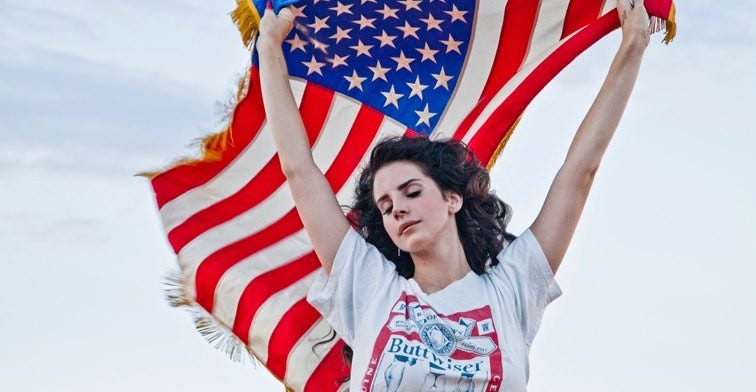
Although Donald Trump’s presidency prompted Lana Del Rey to abandon the American flag as a part of her visual identity, her aesthetic is still built around American nostalgia. Since her debut Born to Die, Del Rey has played with visuals inherent to American culture in her videos, and murmured lyrical musings of the American dream in which she reaches towards a glamourous future while still doting on the past.
She embodies the sublime feeling of the Sunshine State in “West Coast”, plays the Kennedys alongside A$AP Rocky in “National Anthem”, embraces a bad boy in front of the American flag in “Born to Die”, and then blankets herself in it in “Ride”.
But Del Rey doesn’t stop at the explicit depictions of American aesthetics in her videos. America is gently woven into her smokey notes and seductive lyrics: a tenor that leaves listeners mesmerized and maudlin. “Tell me I’m your National Anthem”, she pleads to a man with who she shares a love that seems invincible in “National Anthem”. “Be young, be dope, be proud, like an American”, she coos to listeners in “American”. “Come on down to Florida, I got something for ya” she drawls in “Florida Kilos”, of course, to a man who’s naturally no good for her.
There is something haunting about Del Rey’s fixation on American culture. Donald Trump’s presidency has emphasized a return to an America he claims was once “great”: he captivated millions of Americans simply by playing on their nostalgia. Of course, America was never great: it is a country built on enslavement and colonization. But with his campaign slogan, Trump holds up a mirror to his followers, specifically white males, and asks: remember when we were free?
Although Del Rey has lucidly expressed she does not support Trump or his campaign, her videos and lyrics evoke a nostalgia for an American that was once great. In California, she casually calls for her friend to return to America, a place where it is evident they shared good times. She promises they’ll do all the things they used to: “hit up all the old places”, “have a party”, “dance ‘til dawn”. But those days are behind her now like the American flag she waves in “Ride”; she’s left for a longing for a land now lost in time.
“California” is just one example of a song poignantly nostalgic for the past; “The Greatest” is also full of “missings”. “I miss Long Beach and I miss you, babe / I miss dancin’ with you the most of all / I miss the bar where the Beach Boys would go” she begins in perhaps one of her most emotionally expressive songs. Long Beach is a place she misses, but she doesn’t confine her missings to just one American location: “I miss New York” she breathes a few verses later. She evokes a nostalgia specific to American cities, which she characterizes as places that were good and fun. The tense in which the song is written in, all the missings and the wantings, show that she can’t have what she had back. Could “the greatest loss of them all” not be a person, but a place — an America with values that is slowly crumbling before her eyes?
Her fifth and latest album, Norman F*****g Rockwell!, is a lyrical masterpiece commenting on this contemporary culture. The American dream is both eulogized and condemned, showing her listeners that the America that helped bring her to fame has its faults. Norman Rockwell, the American painter the album is named after is used as a metaphorical figure for the side of the American dream we want to believe in, and its hidden underbelly that tells us we shouldn’t.
Rockwell built his artistic career through his paintings of the domestic everyday. He depicted the American dream in a romantic light, however, failed to acknowledge the racism, poverty, and inequality the American dream was, and is, built on. And so Del Rey’s album not only helps illuminate the American dream Rockwell so beautifully animated, but the foundations of the American dream he left out.
In her song “Venice B****”, Del Rey sings about a relationship she knows can’t last, but romanticizes anyways. “You’re beautiful and I’m insane / We’re American-made” seems, to me, a haunting allusion to F. Scott Fitzgerald’s novel The Great Gastby: Daisy, the beautiful, and Gatsby, the insane. The tension between a love that is within reach but not exactly reachable hinted at in these lyrics parallels the love, and the American dream, Gatsby reached out to grasp, but of course, fell short of attaining. We’re tormented with the taste of the American dream but we will never quite touch it, which is what Del Rey reminds us in her soft and dusty hums.
The American dream has always been intangible, but politicians promise us that one day it can be tangible, as long as we work a little harder, a little longer, and a little smarter. Del Rey notes the tireless efforts that must be executed to make a stable living in a neoliberal era. “Maybe the way that I’m living is killing me” she ponders in “F*** it I love you”, and sighs “I guess that I’m burned out after all”, in “The Greatest”, manifesting the thoughts of an average worker who is barely scraping the surface. She loves America but she simultaneously wishes to escape its troubling tenets, and she uses her latest album to grapple with just that.
Throughout her career, Del Rey has been explicitly patriotic, but we are listening to her become dubious about what America has become. She longs for the perfect America, the one that Rockwell illustrated, while still acknowledging its a facade in light of the political climate Americans endorse. And so Norman F*****g Rockwell! is an ode to America: a desperate call to return to what once was, and a celebration of the fragments of beauty she still has the eye to find.


