Lagaan: Once Upon a Time in India
Revisiting a great big Indian sports epic, embraced across the world.
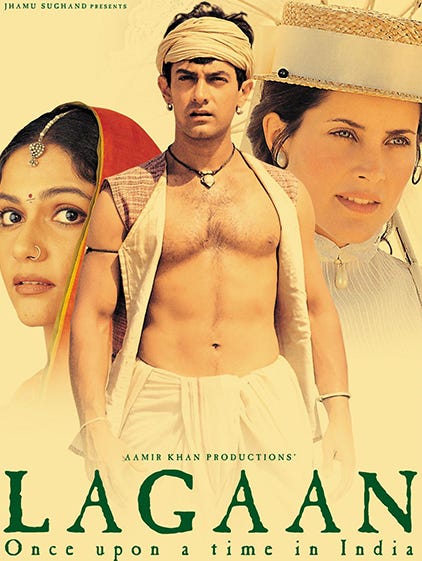
I watched Lagaan again last month. Almost 22 years after it was first released. My first thought was that the film had not aged well. But perhaps it is I who had changed. Then I thought about it again.
For those who don’t know too much about Indian cinema, Lagaan was the RRR of 2001 in its appeal across the world as an Indian film. Of course, it’s a completely different kind of film and even belongs to a different genre, but like RRR today, it was an Indian film that travelled the world in an era before things went viral as they do today. It was also only the third Indian film to be nominated for Best Foreign Language Film at the 74th Academy Awards after Salaam Bombay (1988) and Mother India (1957). In fact, since 2002, no other Indian film has ever been nominated for this award again, including RRR.
Like RRR, it is also a period film, set during the time when India was a part of the British Empire, and has an anti-imperialistic stance along with themes of colonialism. But the similarity ends there. While Lagaan was an Awadhi language film made by the Hindi film industry, RRR is a Telugu language film. Lagaan was also a sports film shot on an epic scale. The sport was Cricket, which though revered in India, is hardly a global sport. Yet Lagaan still found an international audience. Even the four hour length of the film didn’t deter them. It’s also interesting to consider the film’s huge success in India, where traditionally both historical and sports films have not been popular.
The film, directed by Ashutosh Gowarikar, is set in the village of Champaner in Central India during the time of Victorian England. The village is struggling under a repressive tax (lagaan in Hindi) imposed by the British, which must be paid even during drought. They go to King Puran Singh to repeal this unjust tax. But thanks to an altercation between a young man from the village Bhuvan (played by Aamir Khan) and the captain of the British regiment Andrew Russel (played by Paul Blackthorne), they are challenged to a game of cricket instead. If they win, the tax will be cancelled for the next three years. But if they lose, they will have to pay three times the current rate. The rest of the film pivots around the climactic match and the events leading up to it as the villagers build a team to take on the British.
As I returned to the film after almost two decades, what still worked for me was the film’s large patchwork cast of simple village folk and their idiosyncrasies. While the story does center around the events related to Bhuvan and the women who love him, Gauri (Gracy Singh) and Elizabeth (Rachel Shelley), the supporting characters in the Cricket team Bhuvan builds are memorable and hold their own. The lead actors are strong, but never overpowering. So, what you get is a vibrant ensemble cast and a film with many shades of the colors of village life. This remains to me one of the finest achievements of the film.
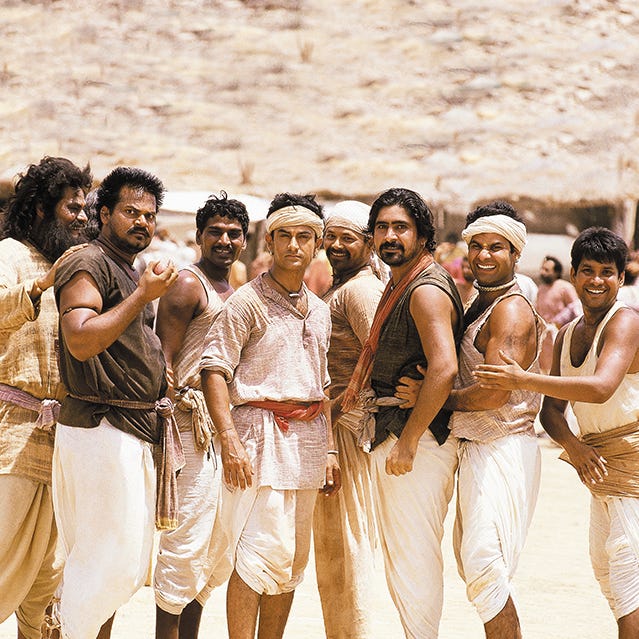
The film’s use of Awadhi, instead of Hindi, is also an important choice. While the film was made by the Hindi film industry, the villager’s dialogue is in the Awadhi dialect spoken in West India, which adds authenticity of the film. So, practically every actor in the film learnt a new language to be a part of Lagaan. While the British actors like Rachel Shelley learnt Hindi, the Indian actors learnt Awadhi. The film was also not shot in studios, but largely on location against the arid desert sands of Bhuj in Gujarat. It is this vast landscape, helped in no small measure by Anil Mehta’s cinematography, which gives the film its epic proportions and also accentuates the genuine nature of the film’s storytelling.
It is perhaps this sincerity of purpose that still to speaks to viewers. The action itself is predictable but remains heartwarming, held together by the many human elements which scriptwriter and director Ashutosh Gowarikar weaves into the narrative. These are universal elements — love, jealousy, heartbreak, community — each etched in simply but honestly. And you still find yourself smiling at all the right points.
The use of sport, specifically cricket, as a narrative tool was a tricky experiment that could have easily backfired on the director. But Gowarikar weaves the nuances of a complex sport like Cricket into the story, with the same simplicity he uses for the film’s human elements, so that its technicalities seem irrelevant. The simplicity of the storytelling is the film’s greatest strength.
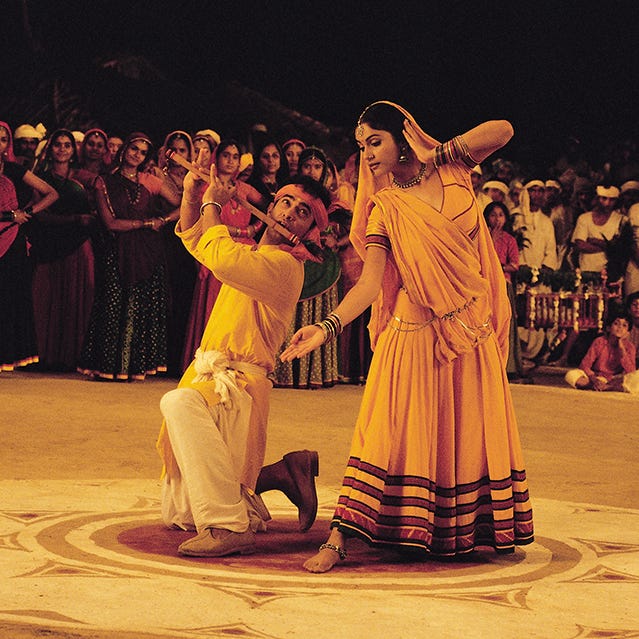
Like most Indian films, Lagaan is also a musical. So, any analysis of the film must also touch on its music. Here, the compositions directed by AR Rehman endure and resonate as richly and strongly as when I first watched the movie. It adds another layer to the many folk elements Gowarikar brings to the film. Yet when one considers how Hindi films increasingly began to use songs as background score in the years that followed, one wonders whether Lagaan would have benefitted from this treatment as well.
My principal discomfort lies with unrealistic elements of the plot, however briefly these may appear, and when simple becomes simplistic. I remember having this impression the first time I saw the film as well. But in the many intervening years, that feeling has now become more pronounced. For instance, Elizabeth’s love for Bhuvan. It’s an interesting dimension to the story. Yet it’s not clear how or why that develops.
However, it is the production of the film that remains exemplary and elevates it over these deficiencies for me. If you enjoy analyzing how films are made, it’s a joy to watch the film’s use of crowds in its sporting sequences, which accentuate the film’s epic scale. Just as it was done in Gandhi, incidentally also shot in India. The biggest crowd scene at the film’s cricketing climax, with as many as 10,000 extras, is a lesson not just in how an endless sea of people can be used to make a powerful cinematic moment, but also how a crowd can be managed, entertained, and motivated to create that scene. Many anecdotes around this abound in accounts on the making of Lagaan.
The Indian film director Dharmesh Darshan once told me “The audience of the Hindi film is the most difficult audience. It is so diverse — from Bangalore to Banaras, Mumbai’s modern sensibility to Patna, London to Ludhiana, New York to Chennai. This is a very multidimensional audience. This segmentation is not only based on cities, but even within the Indian structure; it is multi-racial, multi-lingual and has economic disparity. So it’s almost like the audience for a circus.” The beauty of Lagaan is not just that it appealed to this diverse audience, but also that it appealed to the world.
For all these reasons, if I were recommending a list of 100 films you should see to understand Indian cinema better, I would recommend you put Lagaan on it.


