
Ladies Holding Court
A review of the women of the supreme court.
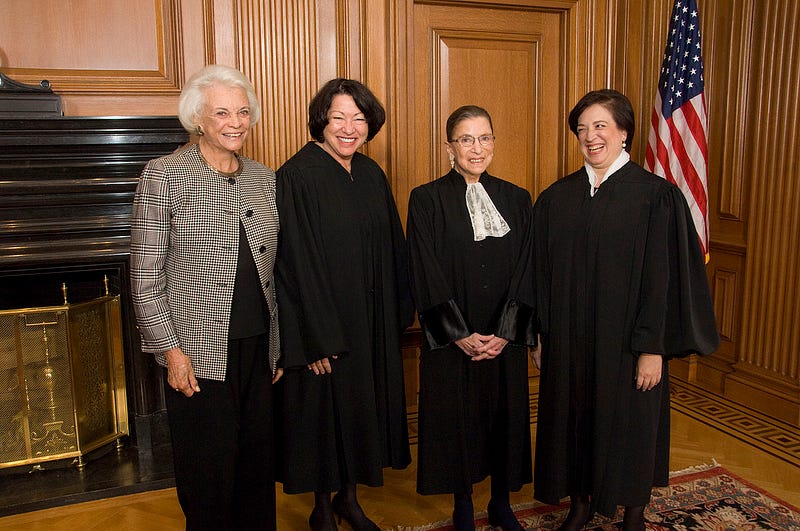
“There will be enough women on the Supreme Court when there are nine.” — Justice Ruth Bader Ginsberg
An unprecedented move was made during the 1980 Presidential Election. Republican Candidate, Ronald Reagan pledged to nominate and appoint the first female judge to the supreme court.
Sandra Day O’Connor
At sixteen, Sandra Day O’Connor was admitted to Stanford University, where she earned a bachelor’s degree in Economics. In 1950 she was admitted to Stanford Law. During her time at Stanford Law, she worked on the board of editors for the Stanford Law Review. She completed law school in just two years as opposed to the usual three. She graduated third in her class, with one of the students ahead of her being fellow future justice, William H. Rehnquist. She began a career in practicing law in 1954.
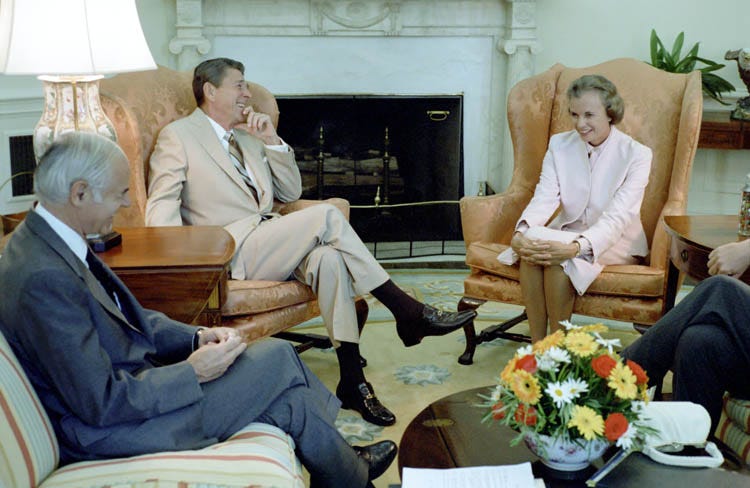
Ronald Reagan won the presidency in 1980. The world was entering into a more moderate era in history. Seven months into his presidency, and just a few weeks before 750 million people tuned in to watch the marriage of Prince Charles, the Prince of Wales to Lady Diana Spencer, Reagan journaled in his diary on July 6, 1981: “Called Judge O’Connor and told her she was my nominee for supreme court. Already the flak is starting and from my own supporters. Right to Life people say she is pro-abortion. She declares abortion is personally repugnant to her. I think she’ll make a good justice.”
On July 7th, 1981, President Reagan held a press conference. He made this statement:
“Ladies and gentlemen, I have a statement to make. And then following that statement, if there are any questions you might have, I shall refer you to the Attorney General.
As President of the United States, I have the honor and the privilege to pick thousands of appointees for positions in the Federal Government. Each is important and deserves a great deal of care for each individual called upon make his or her contribution, often at a personal sacrifice, to shaping the policy of the Nation. Thus each has an obligation to you, in varying degrees, has an impact on your life.
In addition, as President, I have the privilege to make a certain number of nominations which have a more lasting influence on our lives, for they are the lifetime appointments of those men and women called upon to serve in the judiciary in our Federal district courts and courts of appeals. These individuals dispense justice and provide for us these most cherished guarantees of protections of our criminal and civil laws. But, without doubt, the most awesome appointment is a guarantee to us of so many things, because it is a President — as a President, I can make an appointment to the United States Supreme Court.
Those who sit in the Supreme Court interpret the laws of our land and truly do leave their footprints on the sands of time. Long after the policies of Presidents and Senators and Congressmen of any given era may have passed from public memory, they’ll be remembered.
After very careful review and consideration, I have made the decision as to my nominee to fill the vacancy on the United States Supreme Court created by the resignation of Justice Stewart. Since I am aware of the great amount of speculation about this appointment, I want to share this very important decision with you as soon as possible.
Needless to say, most of the speculation has centered on the question of whether I would consider a woman to fill this first vacancy. As the press has accurately pointed out, during my campaign for the Presidency I made a commitment that one of my first appointments to the Supreme Court vacancy would be the most qualified woman that I could possibly find.
Now, this is not to say that I would appoint a woman merely to do so. That would not be fair to women nor to future generations of all Americans whose lives are so deeply affected by decisions of the Court. Rather, I pledged to appoint a woman who meets the very high standards that I demand of all court appointees. I have identified such a person.
So today, I’m pleased to announce that upon completion of all the necessary checks by the Federal Bureau of Investigation, I will send to the Senate the nomination of Judge Sandra Day O’Connor of Arizona Court of Appeals for confirmation as an Associate Justice of the United States Supreme Court.
She is truly a person for all seasons, possessing those unique qualities of temperament, fairness, intellectual capacity, and devotion to the public good which have characterized the 101 brethren who have preceded her. I commend her to you, and I urge the Senate’s swift bipartisan confirmation so that as soon as possible she may take her seat on the Court and her place in history.”
O’Connor informed Reagan that she did not recollect whether she had supported the view of repealing Arizona’s law banning abortion. However, she had cast a preliminary vote in the Arizona State Senate in 1970 in favor of a bill to repeal the state’s criminal-abortion statute. In 1974, O’Connor had opined against a measure to prohibit abortions in some Arizona hospitals. Pro-life and religious groups opposed O’Connor’s nomination because they suspected, correctly, she would not be willing to overturn Roe v Wade. U.S. Senate Republicans, including Don Nickles of Oklahoma, Steve Symms of Idaho, and Jesse Helms of North Carolina called the White House to express their discontent over the nomination; Nickles said he and “other pro-family Republican senators would not support” O’Connor. Helms, Nickles, and Symms nevertheless voted for confirmation.
She received unanimous Senate approval and made history as the first woman justice to serve on the nation’s highest court.
“We don’t accomplish anything in the world alone and whatever happens is the result of the whole tapestry off one’s life and all the weavings of individual threads from one to another that create something.” ― Justice Sandra Day O’Connor
In 1992, Sandra Day O’Connor served as the swing vote that reaffirmed the Roe v. Wade decision in the abortion rights case Planned Parenthood v. Casey. She voted in favor despite the Republican push to overturn Roe. O’Connor continually promoted women’s interests. Particularly in two cases that protected the rights of young girls in school being harassed by their classmates and held the schools liable for such harassment. Over her two decades on the court, the conservative justice became known as a somewhat unpredictable voter. She was known for being a majority builder whenever possible, but also for being a swing vote in the divisive cases. In cases lacking a consensus, she wrote as narrow a decision as possible.
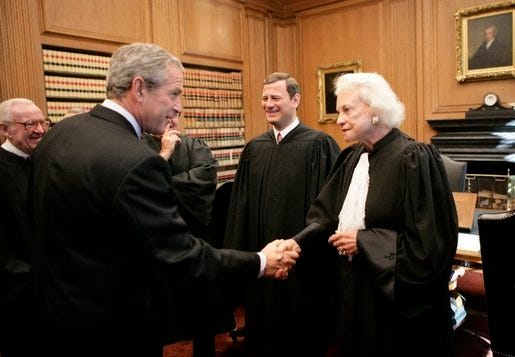
She retired from the bench in 2006 to care for her husband, who was diagnosed with Alzheimer’s disease. Since her retirement, she has advocated for educating America’s young people on how they can be involved in civics and government. She founded iCivics, a website dedicated to providing creative and effective teaching tools on the subject of civic engagement.
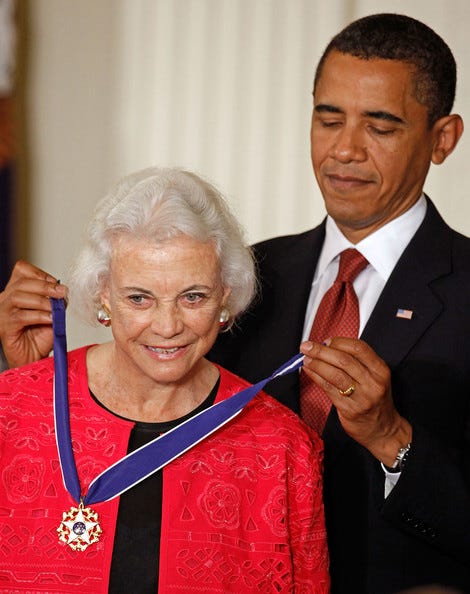
In recognition of her lifetime achievements, President Barack Obama awarded Justice Sandra Day O’Connor with the nation’s highest civilian honor, the Presidential Medal of Freedom, on August 12, 2009. This medal, along with portraits, sculpture, and personal items such as her Bench chair highlights her story and role in American History as being the first woman to sit on the bench of the U.S. Supreme Court.
Ruth Bader Ginsberg
The beloved RBG has one of the most unique stories in the history of American law. From an early age her mother, Celia Amster Bader, instilled in her the love of education. Ruth demonstrated that love by excelling tremendously in academia while in high school. Her mother passed away from cancer the day before Ruth’s graduation.
“My mother told me to be a lady. And for her, that meant be your own person, be independent.” — Justice Ruth Bader Ginsberg
Ginsburg’s success in academia continued throughout her years at Cornell University, where she graduated at the top of her class in 1954, earning high honors in Government and distinction in all subjects. She was also the College of Arts and Sciences Class Marshal. After graduation, she put her education on hold to start a family. Ginsburg enrolled at Harvard Law in the late 1950s. She faced gender-based discrimination from even the highest authorities at the Ivy League University, who chastised her for taking a man’s spot at Harvard Law. She served as the first female member of the Harvard Law Review. Her husband Martin graduated from Harvard and they relocated to New York City. Ruth Bader Ginsburg had one more year of law school left, so she transferred to Columbia Law School and served on their law review as well. She graduated first in her class at Columbia Law in 1959.
In 1963, Ginsburg began as a Professor of Law at Rutgers University School of Law and taught classes until 1972. Ruth Bader Ginsberg continued her work in education as a professor at Columbia University. There, she became the first female professor at Columbia to earn tenure. Ginsburg also directed the influential Women’s Rights Project of the American Civil Liberties Union during the 1970s. In this position, she led the fight against gender discrimination and successfully argued six landmark cases before the U.S. Supreme Court. Ginsburg took a broad look at gender discrimination, fighting not just for the women left behind, but also for the men who were discriminated against. Ginsburg experienced her share of gender discrimination, even going so far as to hide her pregnancy from her Rutgers colleagues.
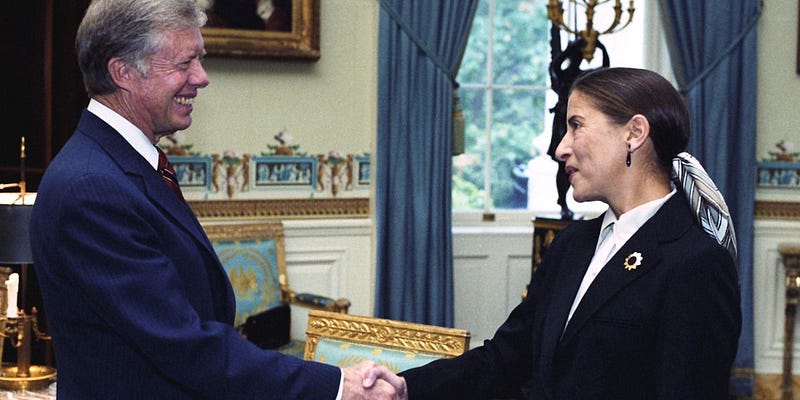
Ginsburg accepted Jimmy Carter’s appointment to the U.S. Court of Appeals for the District of Columbia in 1980.
Just months after the tragic Waco siege authorized by the President, Bill Clinton happily nominated Ruth Bader Ginsberg as an Associate Justice of the Supreme Court. He made this nomination on June 14th, 1993 to fill the seat vacated by Justice Byron White who retired from the bench.
President Clinton held a press conference in the Rose Garden at the White House making this statement:
“Please be seated. I wish you all a good afternoon, and I thank the Members of the Congress and other interested Americans who are here.
In just a few days when the Supreme Court concludes its term, Justice Byron White will begin a new chapter in his long and productive life. He has served the Court as he has lived, with distinction, intelligence, and honor. And he retires from public service with the deep gratitude of all the American people.
Article II, section 2 of the United States Constitution empowers the President to select a nominee to fill a vacancy on the Supreme Court of the United States. This responsibility is one of the most significant duties assigned to the President by the Constitution. A Supreme Court Justice has life tenure, unlike the President, and along with his or her colleagues decides the most significant questions of our time and shapes the continuing contours of our liberty. I care a lot about this responsibility, not only because I am a lawyer but because I used to teach constitutional law and I served my State as attorney general. I know well how the Supreme Court affects the lives of all Americans personally and deeply. I know clearly that a Supreme Court Justice should have the heart and spirit, the talent and discipline, the knowledge, common sense, and wisdom to translate the hopes of the American people, as presented in the cases before it, into an enduring body of constitutional law, constitutional law that will preserve our most cherished values that are enshrined in that Constitution and, at the same time, enable the American people to move forward.
That is what I promised the American people in a Justice when I ran for President, and I believe it is a promise that I am delivering on today. After careful reflection, I am proud to nominate for Associate Justice of the Supreme Court Judge Ruth Bader Ginsburg of the United States Court of Appeals for the District of Columbia. I will send her name to the Senate to fill the vacancy created by Justice White’s retirement.
As I told Judge Ginsburg last night when I called to ask her to accept the nomination, I decided on her for three reasons. First, in her years on the bench she has genuinely distinguished herself as one of our Nation’s best judges, progressive in outlook, wise in judgment, balanced and fair in her opinions. Second, over the course of a lifetime, in her pioneering work in behalf of the women of this country, she has compiled a truly historic record of achievement in the finest traditions of American law and citizenship. And finally, I believe that in the years ahead she will be able to be a force for consensus-building on the Supreme Court, just as she has been on the Court of Appeals, so that our judges can become an instrument of our common unity in the expression of their fidelity to the Constitution.
Judge Ginsburg received her undergraduate degree from Cornell. She attended both Harvard and Columbia Law Schools and served on the law reviews of both institutions, the first woman to have earned this distinction. She was a law clerk to a Federal judge, a law professor at Rutgers and Columbia Law Schools. She argued six landmark cases on behalf of women before the United States Supreme Court and, happily, won five out of six. For the past 13 years she has served on the United States Court of Appeals for the District of Columbia, the second highest court in our country, where her work has brought her national acclaim and on which she was able to amass a record that caused a national legal journal in 1991 to name her as one of the Nation’s leading centrist judges.
In the months and years ahead, the country will have the opportunity to get to know much more about Ruth Ginsburg’s achievements, decency, humanity, and fairness. People will find, as I have, that this nominee is a person of immense character. Quite simply, what’s in her record speaks volumes about what is in her heart. Throughout her life she has repeatedly stood for the individual, the person less well-off, the outsider in society, and has given those people greater hope by telling them that they have a place in our legal system, by giving them a sense that the Constitution and the laws protect all the American people, not simply the powerful. Judge Ginsburg has also proven herself to be a healer, what attorneys call a moderate. Time and again, her moral imagination has cooled the fires of her colleagues’ discord, ensuring that the right of jurists to dissent ennobles the law without entangling the court.
The announcement of this vacancy brought forth a unique outpouring of support for distinguished Americans on Judge Ginsburg’s behalf. What caused that outpouring is the essential quality of the judge herself: her deep respect for others and her willingness to subvert self-interest to the interest of our people and their institutions.
In one of her own writings about what it is like to be a Justice, Judge Ginsburg quotes Justice Louis Brandeis, who once said, “The Supreme Court is not a place for solo performers.” If this is a time for consensus-building on the Court, and I believe it is, Judge Ginsburg will be an able and effective architect of that effort.
It is important to me that Judge Ginsburg came to her views and attitudes by doing, not merely by reading and studying. Despite her enormous ability and academic achievements, she could not get a job with a law firm in the early 1960’s because she was a woman and the mother of a small child. Having experienced discrimination, she devoted the next 20 years of her career to fighting it and making this country a better place for our wives, our mothers, our sisters, and our daughters. She herself argued and won many of the women’s rights cases before the Supreme Court in the 1970’s. Many admirers of her work say that she is to the women’s movement what former Supreme Court Justice Thurgood Marshall was to the movement for the rights of African-Americans. I can think of no greater compliment to bestow on an American lawyer. And she has done all of this and a lot of other things as well by raising a family with her husband, Marty, whom she married 39 years ago as a very young woman. Together they had two children, Jane and James, and they now have two grandchildren. Hers is a remarkable record of distinction and achievement, both professional and personal.
During the selection process, we reviewed the qualifications of more than 40 potential nominees. It was a long, exhaustive search. And during that time we identified several wonderful Americans whom I think could be outstanding nominees to the Supreme Court in the future. Among the best were the Secretary of the Interior, Bruce Babbitt, whose strong legal background as Arizona’s attorney general and recent work balancing the competing interests of environmentalists and others in the very difficult issues affecting the American West made him a highly qualified candidate for the Court. And I had the unusual experience, something unique to me, of being flooded with calls all across America from Babbitt admirers who pleaded with me not to put him on the Court and take him away from the Interior Department. I also carefully considered the chief judge of the first circuit, Judge Stephen Breyer of Boston, a man whose character, confidence, and legal scholarship impressed me very greatly. I believe he has a very major role to play in public life. I believe he is superbly qualified to be on the Court. And I think either one of these candidates, as well as the handful of others whom I closely considered, may well find themselves in that position someday in the future.
Let me say in closing that Ruth Bader Ginsburg cannot be called a liberal or a conservative; she has proved herself too thoughtful for such labels. As she herself put it in one of her articles, and I quote, “The greatest figures of the American judiciary have been independent thinking individuals with open but not empty minds; individuals willing to listen and to learn. They have exhibited a readiness to reexamine their own premises, liberal or conservative, as thoroughly as those of others.” That, I believe, describes Judge Ginsburg. And those, I too believe, are the qualities of a great Justice.
If, as I believe, the measure of a person’s values can best be measured by examining the life the person lives, then Judge Ginsburg’s values are the very ones that represent the best in America. I am proud to nominate this path-breaking attorney, advocate, and judge to be the 107th Justice to the United States Supreme Court.”
At the time of her nomination, Ginsburg was viewed as a moderate. Clinton was reportedly looking to increase the court’s diversity, which Ginsburg did as the first Jewish justice since the 1969 resignation of Justice Abe Fortas. She was the second-ever female justice, and the first Jewish female justice. She eventually became the longest-serving Jewish justice ever. The American Bar Association’s Standing Committee on the Federal Judiciary rated Ginsburg as “well qualified”, it’s highest possible rating for a prospective justice.
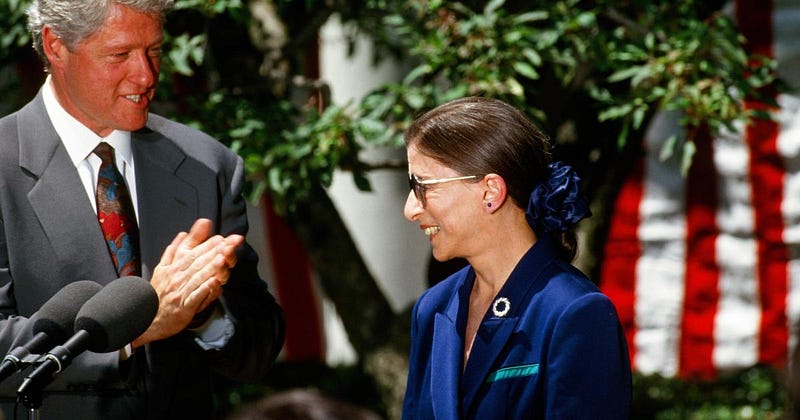
In 1996, Ginsburg wrote the majority opinion in United States v. Virginia, stating that qualified women could not be denied admission to Virginia Military Institute.
Her modus operandi in advocating from the bench matches her methodology from her time at the ACLU. A style that is slow but steady and calculated. Instead of creating sweeping limitations on gender discrimination, she attacked and drew focus on specific areas of discrimination and violations of women’s rights one at a time, so as to send a message to the legislatures on what is permitted and was is not. Her core belief is that major social change should not come from the courts, but rather from Congress and other legislatures. This method allows for social change to remain in Congress’ power while also receiving guidance from the court.
Ginsburg does not shy away from giving pointed guidance when she feels the need. She dissented in Ledbetter v. Goodyear Tire & Rubber Co. where the plaintiff, a female worker being paid significantly less than males with her same qualifications, sued under Title VII however was denied relief under a statute of limitations issue. The facts of this case mixed her passion of federal procedure and gender discrimination. She broke tradition and wrote a highly colloquial version of her dissent to read from the bench. Additionally, she called for Congress to undo this improper interpretation of the law in her dissent, and then worked with President Barack Obama to pass the very first piece of legislation he signed, the Lilly Ledbetter Fair Pay Act of 2009, a copy of which hangs proudly in her office.
Despite coping with on-going health issues, Ruth Bader Ginsberg continues to serve today on the bench of the supreme court of the United States of America.
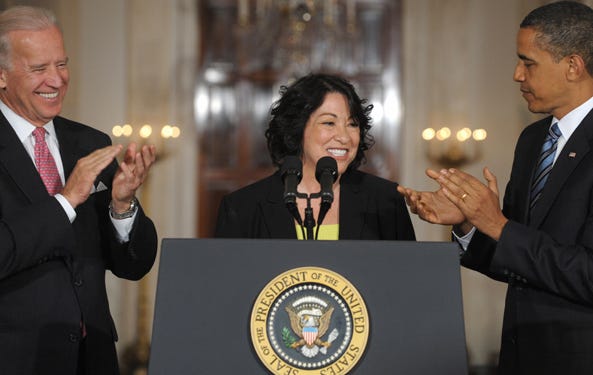
Sonia Sotomayor
Born in New York City of Puerto Rican parents, she has been known to refer to herself as a “Nuyorican”. Sotomayor is also generally regarded as the first Hispanic justice, although some sources claim that this distinction belongs to former Justice Benjamin N. Cardozo.
Sonia’s mother was a huge inspiration for her. Mrs. Sotomayor lost her parents at a young age and then joined the U.S. Army during WWII. In her 40s she went to college and got her nursing degree. Sonia’s mother set the bar for placing a high value on education.
Sotomayor graduated from Cardinal Spellman High School in the Bronx in 1972 and entered the Ivy League. She was accepted at Princeton University. Sonya felt overwhelmed by her new school; after she received low marks on the first mid-term paper, she sought help, taking more English and writing classes. She also became highly involved with the Puerto Rican groups on campus, including Acción Puertorriqueña and the Third World Center.
The school was “an alien land for me,” Sotomayor recalled two decades later, describing how Puerto Rican activism and the hub of minority politics, The Third World Center, “provided me with an anchor I needed to ground myself in that new and different world.”
She also worked with the university’s discipline committee, where she started developing her legal skills.
In the bicentennial year of 1976, Sonia graduated summa cum laude from Princeton University. Awarded the Pyne Prize, which is the highest academic award given to Princeton undergraduates, her hard work had paid off. That same year, Sotomayor entered Yale Law School, where she was an editor for the Yale Law Journal. She received her J.D. in 1979, passed the bar in 1980, and immediately began work as an assistant district attorney in Manhattan, serving as a trial lawyer under District Attorney Robert Morgenthau.
As a bold advocate of law and order, Sotomayor was responsible for prosecuting robbery, assault, murder, police brutality, and child pornography cases.
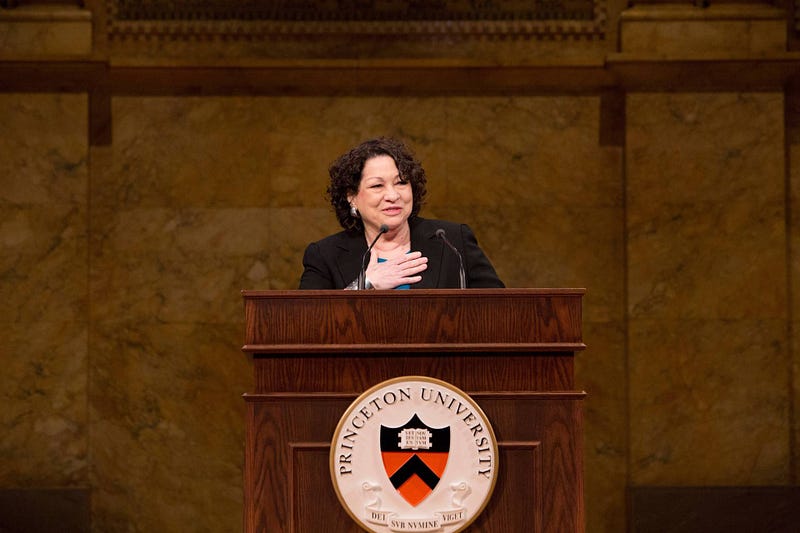
Moved by the children she fought to protect under the law, she was inspired to write the book, Just Ask! Be Different, Be Brave, Be You. When asked by Trevor Noah on The Daily Show why she wrote a children’s book versus writing a book about law, she stated:
“I write law every single day. And most of it is going to go down in the history books. After much time passes, some people may read one or two of those decisions. But if I can affect the lives of children, if I can inspire them to be bigger, better, and braver than they believe they can be, then I’ve left a real legacy.” — Justice Sonia Sotomayor
In 1984, Sotomayor entered private practice, making partner at the commercial litigation firm Pavia & Harcourt, where she specialized in intellectual property litigation. In 1988, the firm made her partner. While she climbed the ladder there, Sotomayor also served on the board of the Puerto Rican Legal Defense and Education Fund, the New York City Campaign Finance Board, and the State of New York Mortgage Agency.
Sotomayor was nominated to the U.S. District Court for the Southern District of New York by President George H. W. Bush in 1991. The confirmation followed in 1992. In 1997, she was nominated by President Bill Clinton to the U.S. Court of Appeals for the Second Circuit. Her nomination was slowed by the Republican majority in the United States Senate, however, she was eventually confirmed in 1998. On the Second Circuit, Sotomayor heard appeals in more than 3,000 cases and wrote about 380 opinions.
Like some of the fellow Supreme Court Justices, Sotomayor has taught at the New York University School of Law and Columbia Law School.
“Judge Sotomayor is one of our nation’s most accomplished judges,” said Richard Revesz, Dean and Lawrence King Professor of Law at NYU School of Law. “NYU Law School was privileged to have her as an adjunct professor from 1998 to 2007 when she taught trial and appellate advocacy and a federal appellate court seminar. As a result of her intellect and determination, she overcame great adversity and went on to graduate summa cum laude from Princeton University and to receive a J.D. from Yale Law School, where she was an editor of the Yale Law Journal. Judge Sotomayor’s years of experience as a former prosecutor, law firm partner, and trial and appellate court judge make her uniquely qualified to serve on the Supreme Court.”
On May 30th, 2009 President Barack Obama made this statement:
“This week, I nominated Judge Sonia Sotomayor of the U.S. Court of Appeals to replace Justice David Souter, who is retiring after nearly two decades on the Supreme Court. After reviewing many terrific candidates, I am certain that she is the right choice. In fact, there has not been a nominee in several generations who has brought the depth of judicial experience to this job that she offers.
Judge Sotomayor’s career began when she served as an Assistant District Attorney in New York, prosecuting violent crimes in America’s largest city. After leaving the DA’s office, she became a litigator, representing clients in complex international legal disputes. She was appointed to the U.S. District Court, serving six years as a trial judge where she presided over hundreds of cases. And most recently, she has spent eleven years on the U.S. Court of Appeals, our nation’s second-highest court, grappling with some of the most difficult constitutional and legal issues we face as a nation. She has more experience on the federal bench than any incoming Supreme Court Justice in the past 100 years. Quite simply, Judge Sotomayor has a deep familiarity with our judicial system from almost every angle.
And her achievements are all the more impressive when you consider what she had to overcome in order to achieve them. Judge Sotomayor grew up in a housing project in the South Bronx; her parents came to New York from Puerto Rico during the Second World War. Her father was a factory worker with a third-grade education; when she was just nine years old, he passed away. Her mother worked six days a week as a nurse to provide for her and her brother, buying the only set of encyclopedias in the neighborhood and sending her children to Catholic school. That’s what made it possible for Judge Sotomayor to attend two of America’s leading universities, graduating at the top of her class at Princeton University, and studying at Yale Law School where she won a prestigious post as an editor of the school’s Law Journal.
These many years later, it was hard not to be moved by Judge Sotomayor’s mother, sitting in the front row at the White House, her eyes welling with tears, as her daughter — who had come so far, for whom she sacrificed so much — was nominated to the highest court in the land.
And this is what makes Judge Sotomayor so extraordinary. Even as she has reached the heights of her profession, she has never forgotten where she began. She has faced down barriers, overcome difficult odds, and lived the American dream. As a Justice of the Supreme Court, she will bring not only the experience acquired over the course of a brilliant legal career, but the wisdom accumulated over the course of an extraordinary journey — a journey defined by hard work, fierce intelligence, and the enduring faith that, in America, all things are possible.
It is her experience in life and her achievements in the legal profession that have earned Judge Sotomayor respect across party lines and ideological divides. She was originally named to the U.S. District Court by the first President Bush, a Republican. She was appointed to the federal Court of Appeals by President Clinton, a Democrat. She twice has been overwhelmingly confirmed by the U.S. Senate. And I am gratified by the support for this nomination voiced by members of the legal community who represent views from across the political spectrum.
There are, of course, some in Washington who are attempting to draw old battle lines and playing the usual political games, pulling a few comments out of context to paint a distorted picture of Judge Sotomayor’s record. But I am confident that these efforts will fail; because Judge Sotomayor’s seventeen-year record on the bench — hundreds of judicial decisions that every American can read for him or herself — speak far louder than any attack; her record makes clear that she is fair, unbiased, and dedicated to the rule of law. As a fellow judge on her court, appointed by Ronald Reagan, said recently, “I don’t think I’d go as far as to classify her in one camp or another. I think she just deserves the classification of outstanding judge.”
Congress returns this week and I hope the confirmation process will begin without delay. No nominee should be seated without rigorous evaluation and hearing; I expect nothing less. But what I hope is that we can avoid the political posturing and ideological brinksmanship that has bogged down this process, and Congress, in the past. Judge Sotomayor ought to be on the bench when the Supreme Court decides what cases to hear this year and I’m calling on Democrats and Republicans to be thorough, and timely in dealing with this nomination.
As President, there are few responsibilities more serious or consequential than the naming of a Supreme Court Justice. The members of our highest court are granted life tenure. They are charged with applying principles put to paper more than two centuries ago to some of the most difficult questions of our time. And the impact of their decisions extends beyond an administration, but for generations to come.
This is a decision that I have not taken lightly and it is one that I am proud to have made. I know that Justice Sotomayor will serve this nation with distinction. And when she ascends those marble steps to assume her seat on the Supreme Court, bringing a lifetime of experience on and off the bench, America will have taken another important step toward realizing the ideal that is chiseled above its entrance: Equal justice under the law.”
In the wake of the nation’s financial recovery from the 2008 recession, the native New Yorker, Sonia Sotomayor, made history on August 6, 2009, when the U.S. Senate confirmed her nomination to the U.S. Supreme Court.
Appointed by President Barack Obama, Sotomayor became the first Hispanic Supreme Court justice. She is the third woman to become an associate justice of the Supreme Court. On August 8th, 2009 she was sworn in to join the United States Supreme Court where she continues to serve.
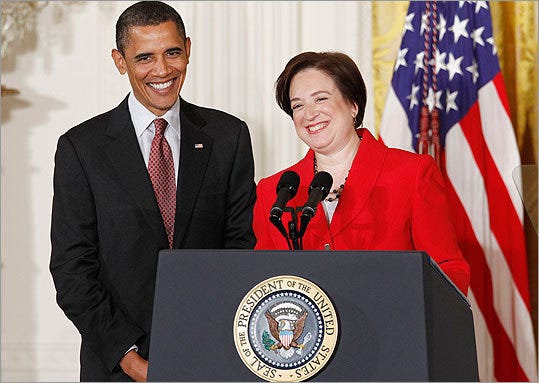
Elena Kagan
As the daughter of an elementary school teacher and an influential housing attorney, Elena Kagan developed an interest in both academics and law at an early age. Kagan attended Hunter College High School and served as the president of the student body.
In 1977, Kagan earned acceptance to the Ivy League, Princeton University. She majored in history for the purpose of later attending law school and was also an editor of The Princetonian. She received an A.B. and graduated summa cum laude in 1981, earning a fellowship from Princeton that enabled her to attend Worcester College in Oxford, England. There she earned her master’s degree in philosophy in 1983.
Kagan returned to the United States to attend Harvard Law School. At Harvard, she utilized her past editing experience to gain the position of supervising editor of the Harvard Law Review. Kagan excelled academically at Harvard Law School as well, graduating magna cum laude in 1986 which she earned a J.D.
Post-graduation, Kagan clerked for Judge Abner Mikva at the U.S. Court of Appeals level for the District of Columbia Circuit from 1986–1987. The following year, she clerked for United States Supreme Court Justice Thurgood Marshall of the Supreme Court of the United States during the 1987 Term.
She worked as an associate in the Washington, D.C. law firm of Williams & Connolly, LLP, from 1989–1991.
Kagan returned to academia, this time as a professor. She began teaching at the University of Chicago Law School in 1991. She became an assistant professor at the University of Chicago Law School and a tenured professor of law in 1995. She left only at the request of President Bill Clinton, who invited her to be his associate counsel. Kagan received two major promotions during her four years at the White House. First, she was appointed Deputy Assistant to the President for Domestic Policy. Soon after, she was appointed Deputy Director of the Domestic Policy Council. Clinton tried to promote her once more before he left office, but the Senate did not confirm Kagan’s nomination to become a judge on the U.S. Court of Appeals in Washington, D.C. As a result, Kagan left the White House and returned once more to the ivory tower of academia in 1999. She started as a visiting professor at Harvard Law.
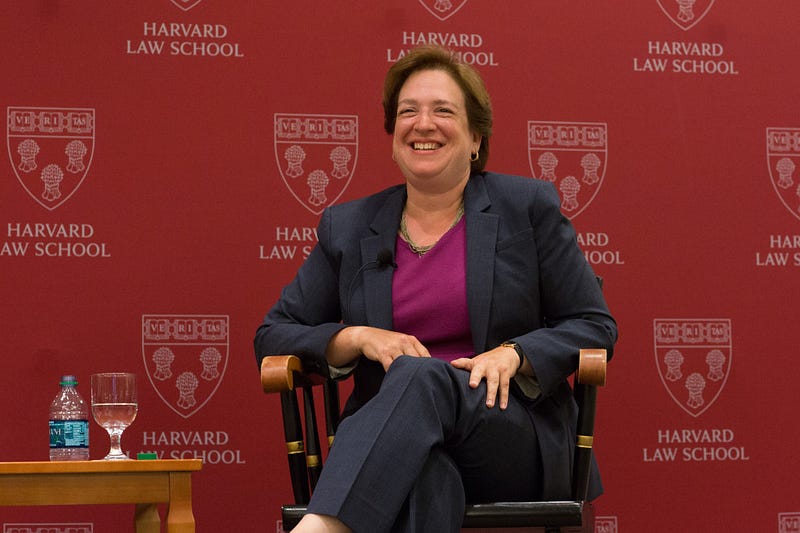
In 2001, given full professor status, she was the Charles Hamilton Houston Professor of Law. Ambitions of Kagan ran high and won her the position as dean and was appointed the 11th Dean of Harvard Law School. She served as the dean for five years before a second president tapped her. After Barack Obama won the presidency in 2008, he appointed Kagan to be the first female solicitor general, and in 2009, the Senate confirmed her nomination.
“I’ve led a school whose faculty and students examine and discuss and debate every aspect of our law and legal system. And what I’ve learned most is that no one has a monopoly on truth or wisdom. I’ve learned that we make progress by listening to each other, across every apparent political or ideological divide.” — Justice Elena Kagan
The following year President Obama nominated her as Supreme Court Justice John Paul Stevens’ replacement. The Senate confirmed her nomination, and Kagan began her career as a judge at the highest court in the land.
On May 10th, 2010, President Barack Obama made this statement:
“Good morning, everybody. Of the many responsibilities accorded to a President by our Constitution, few are more weighty or consequential than that of appointing a Supreme Court justice — particularly one to succeed a giant in the law like Justice John Paul Stevens.
For nearly 35 years, Justice Stevens has stood as an impartial guardian of the law, faithfully applying the core values of our founding to the cases and controversies of our time.
He has done so with restraint and respect for precedent — understanding that a judge’s job is to interpret, not make law — but also with fidelity to the constitutional ideal of equal justice for all. He’s brought to each case not just mastery of the letter of the law, but a keen understanding of its impact on people’s lives. And he has emerged as a consistent voice of reason, helping his colleagues find common ground on some of the most controversial and contentious issues the Court has ever faced.
While we can’t presume to replace Justice Stevens’ wisdom or experience, I have selected a nominee who I believe embodies that same excellence, independence, integrity, and passion for the law — and who can ultimately provide that same kind of leadership on the Court: our Solicitor General, and my friend, Elena Kagan.
Elena is widely regarded as one of the nation’s foremost legal minds. She’s an acclaimed legal scholar with a rich understanding of constitutional law. She is a former White House aide with a lifelong commitment to public service and a firm grasp of the nexus and boundaries between our three branches of government. She is a trailblazing leader — the first woman to serve as Dean of Harvard Law School — and one of the most successful and beloved deans in its history. And she is a superb Solicitor General, our nation’s chief lawyer representing the American people’s interests before the Supreme Court, the first woman in that position as well. And she has won accolades from observers across the ideological spectrum for her well-reasoned arguments and commanding presence.
But Elena is respected and admired not just for her intellect and record of achievement, but also for her temperament — her openness to a broad array of viewpoints; her habit, to borrow a phrase from Justice Stevens, “of understanding before disagreeing”; her fair-mindedness and skill as a consensus-builder.
These traits were particularly evident during her tenure as dean. At a time when many believed that the Harvard faculty had gotten a little one-sided in its viewpoint, she sought to recruit prominent conservative scholars and spur a healthy debate on campus. And she encouraged students from all backgrounds to respectfully exchange ideas and seek common ground — because she believes, as I do, that exposure to a broad array of perspectives is the foundation not just for a sound legal education, but of a successful life in the law.
This appreciation for diverse views may also come in handy as a die-hard Mets fan serving alongside her new colleague-to-be, Yankees fan Justice Sotomayor, who I believe has ordered a pinstriped robe for the occasion.
But while Elena had a brilliant career in academia, her passion for the law is anything but academic. She has often referred to Supreme Court Justice Thurgood Marshall, for whom she clerked, as her hero. I understand that he reciprocated by calling her “Shorty.” Nonetheless, she credits him with reminding her that, as she put it, “behind law there are stories — stories of people’s lives as shaped by the law, stories of people’s lives as might be changed by the law…”
That understanding of law, not as an intellectual exercise or words on a page, but as it affects the lives of ordinary people, has animated every step of Elena’s career — including her service as Solicitor General today.
During her time in this office, she’s repeatedly defended the rights of shareholders and ordinary citizens against unscrupulous corporations. Last year, in the Citizens United case, she defended bipartisan campaign finance reform against special interests seeking to spend unlimited money to influence our elections. Despite long odds of success, with most legal analysts believing the government was unlikely to prevail in this case, Elena still chose it as her very first case to argue before the Court.
I think that says a great deal not just about Elena’s tenacity, but about her commitment to serving the American people. I think it says a great deal about her commitment to protect our fundamental rights, because in a democracy, powerful interests must not be allowed to drown out the voices of ordinary citizens.
And I think it says a great deal about the path that Elena has chosen. Someone as gifted as Elena could easily have settled into a comfortable life in a corporate law practice. Instead, she chose a life of service — service to her students, service to her country, service to the law and to all those whose lives it shapes.
And given Elena’s upbringing, it’s a choice that probably came naturally. Elena is the granddaughter of immigrants whose mother was, for 20 years, a beloved public schoolteacher — as are her two brothers, who are here today. Her father was a housing lawyer, devoted to the rights of tenants. Both were the first in their families to attend college. And from an early age, they instilled in Elena not just the value of a good education, but the importance of using it to serve others.
As she recalled during her Solicitor General confirmation hearings, “Both my parents wanted me to succeed in my chosen profession. But more than that, both drilled into me the importance of service, character, and integrity.”
Elena has also spoken movingly about how her mother had grown up at a time when women had few opportunities to pursue their ambitions and took great joy in watching her daughter do so.
Neither she, nor Elena’s father, lived to see this day. But I think her mother would relish this moment. I think she would relish — as I do — the prospect of three women taking their seat on the nation’s highest Court for the first time in history. A Court that would be more inclusive, more representative, more reflective of us as a people than ever before.
And I think they would both be tremendously proud of their daughter — a great lawyer, a great teacher, and a devoted public servant who I am confident will make an outstanding Supreme Court justice.
So I hope that the Senate will act in a bipartisan fashion, as they did in confirming Elena to be our Solicitor General last year, and that they will do so as swiftly as possible, so she can get busy and take her seat in time to fully participate in the work of the Court this fall.”
The deans of over one-third of the country’s law schools, 69 people in total, endorsed the nomination in an open letter in June of 2010. It lauded what it called her coalition-building skills and “understanding of both doctrine and policy” as well as her written record of legal analysis.
Today Elena Kagan continues to serve the United States of America as a Supreme Court Justice.
There is a sense of mystery that surrounds these women who have devoted their lives to their love of the law and the constitution. They have the power to drastically change or in some cases end lives while writing history using their brilliance and influential legal minds. No matter your opinion of them, you cannot deny the fact that they have accomplished and achieved greatness in their work serving ‘we the people’ of the United States of America.


