
National Anthems
La Marseillaise
Composed on this day April 25th, 1792 — 230 years ago
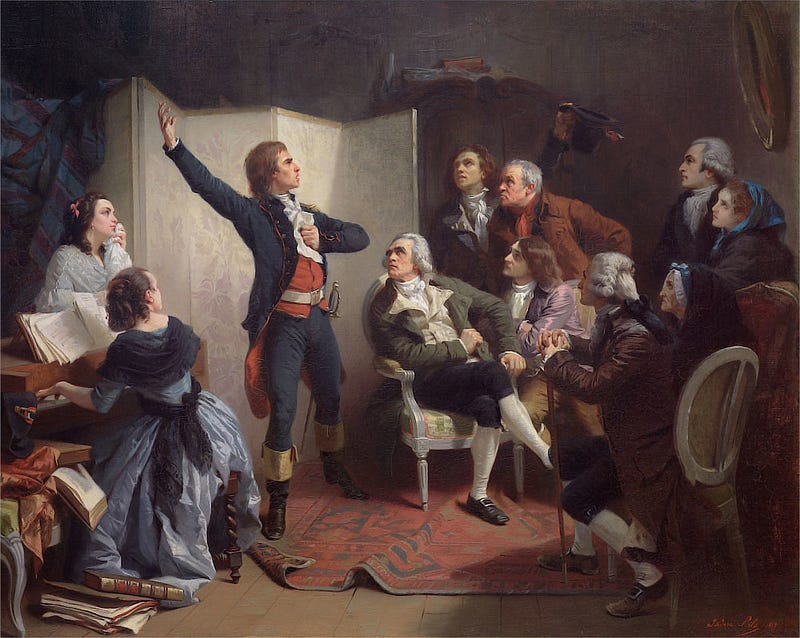
A brief history of one of the most rousing national anthems ever
On April 25th, 1792 the most iconic of national anthems was composed by Claude Joseph Rouget de Lisle. La Marseillaise.
Legend has it that the mayor of Strasbourg (and worshipful master of the local Masonic lodge), Baron Philippe-Frédéric de Dietrich, held a dinner for the officers of the garrison, at which he lamented that France had no national anthem. Rouget de Lisle, a military officer and attendant of the soirée, returned to his quarters and wrote the words in a fit of patriotic excitement.
The purpose generally speaking of a National Anthem is to instill patriotic fervor, and nationalistic pride in its citizens, making them excited and enthusiastic about what essentially comes down to cannon fodder. Good national anthems possessed that ability — the patriotic excitement. To dive into wars without asking too many questions.
To a certain degree, I can even understand the feelings of pride for one’s cause & country swelling up, making one a willing pawn to fight for freedom. While it sounds lofty, swashbuckling, and adventurous, and the willingness to die for the cause, any cause, is an existential part of any revolution— a blood-soaked battlefield, men with gaping wounds, legs and arms blown off, may have led the one or the other citizen to doubt the ask to die.
Of course, the deadly purpose has to be taken into account when speaking about anthems. In times of peace, for me, La Marseillaise is one of the most rousing and inspiring national anthems. So, job well done Rouget de Lisle. Even I’d consider joining the battle, although I’m sure I’d change my mind with a musket in my hands.
La Marseillaise has brought many souls to sing. For good and for bad. And except for football matches, I’m guessing mostly bad. Anyway, it wasn’t my intention to examine the dark side but I guess you can’t talk about an anthem without it.
As far as the history of this anthem goes — the melody and lyrics— inspiring, if ever there was an inspiring call to action — became the rallying call to join the French Revolution and was named La Marseillaise because a group of citizens eager to join the revolution in Paris was marching toward the French capital singing the catchy melody. They came from Marseilles. Birth of a song with a great name. Lyrics came and went but were established as La Marseillaise as we know it today around the 1870s.
National Anthems are meant to inspire the masses to rally in unquestioning unison for their nations. I’m happy to rally around the French football team. Every time I hear it at a football game, I’m singing along. Allez Les Bleus ;)
Let’s be honest, the French have one up on most other languages because things just sound better en français. At least in my opinion.
Aux armes, citoyens Formez vos bataillons Marchons, marchons! Qu’un sang impur Abreuve nos sillons!
If you’d like to listen and watch, here’s a moving rendition from a recent Bastille Day celebration
Vive La France and croissants for everyone! And as an American living in Europe, with a heart for Europe, I am so glad Macron won yesterday. Whew.


