
La Haine (Almost) 25 Years On
The seminal, cutting-edge French film and its lessons for today’s world
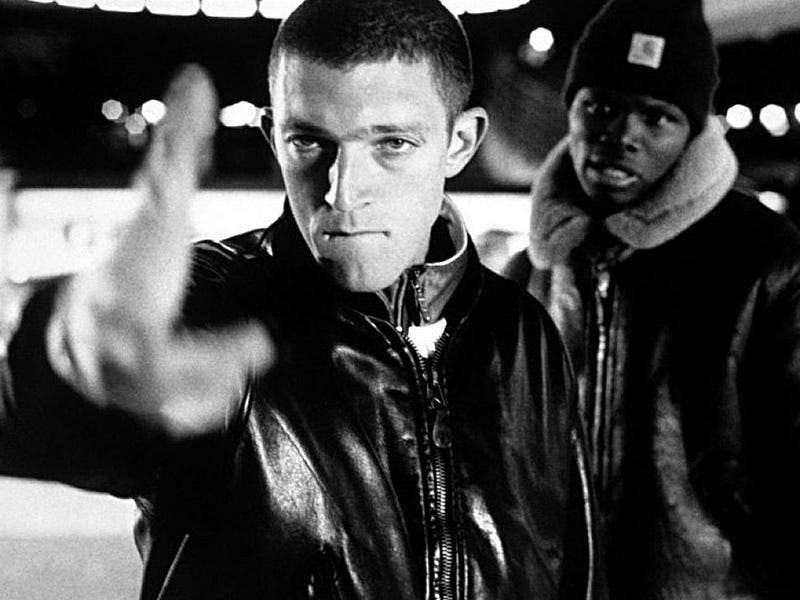
The revolution will not be televised, Gill. It will be Twitter-ised. It will also be hate-driven, because nowadays hate is more profitable than love.
I’m an optimist. I once read that optimists were those who believed we lived in the best possible of worlds. Pessimists were those who feared this might be true.
And yet…
Trump, Bolsonaro, Johnson/Cummings, Orbán… the list goes on. You can bet your bottom dollar (and that’ll probably be considered as initial investment) that hating is in fashion. Whether hatred comes packaged up as pure and unadulterated ready-to-use bile, or punching-down risqué comedy, is moot. Hatred is here and it’s here to stay.
It is almost 25 years to the day when the era-making French film La Haine was first released. Whilst much has changed since then, many things stay the same, not least the title.
Let us travel swiftly back in time to Paris 1995. Neo-Nazis hate immigrants; immigrants distrust (and hate) the police; the police hate immigrants. Hate is partout. And the state? The state hasn’t got a clue about what to do, other than carrying on with its austerity-driven measures.
These are perfect conditions for deep-seated anger and resentment to surface. You have banlieu youths who are often looked down upon and therefore short of options. These young people (ironically, some of them representative of the future, much-celebrated, multi-ethnic, ’98-World-Cup-winning French football team) don’t need to attract hate. They are hated for being what France has gone out of its way not to become. A slang-heavy, black-and-brown subculture which sits at odds with the idea of France as a place of refined culture and excellent cuisine.
The bomb that went off at the Saint-Michel métro station on 25th July 1995 was more than just the explosion of a device. It was, metaphorically speaking, the bursting of a big bubble and the revelation, in the process, of a hitherto-hidden world. The big bubble was the self-told lie on which French society had depended for much of the existence of the Fifth Republic. That just by invoking the principles of egalité, fraternité, humanité everything and everyone would be OK. The hidden world was that of Vinz, Hubert and Saïd and in it things were not OK. Cheaply-built, brutalism-influenced estates and its inhabitants were not particularly looked at with candour. In fact, they were very much ignored until the riots in Paris in ’95 made people sit up and notice.
And notice some of them did. Jean Marie Le Pen, then leader of the Front National, called for the rioters “to be sent to jail”. Twenty-two years later in 2017, his daughter, Marine Le Pen, by now in charge of the FN, went into a runoff against La République en Marche candidate Emmanuel Macron in France’s general election. That the latter eventually won should not detract from the fact that Le Pen polled at around 34% in the final round or that an emergency plan had to be devised in case the far-right bigot got into the Elysée palace.
This was six months after Donald Trump had got into the White House. No emergency plan there, but really, if there had been one, it’d have been pointless. Trump steamrollered his way into the highest office in the world in a hate-driven frenzy. The screams of “Lock her up” (directed at Democrat presidential hopeful, Hillary Clinton and later replaced with “Send her back” in reference to Congresswoman Ilhan Omar) reminded many of the same hate-filled atmosphere of Nazi Germany in the early to mid 1930s.
La haine engendre haine. Hate begets hate, because the feeling is already inside us. All it needs is a trigger for it to come out. Before Trump’s ascension to power, the UK was beset by Brexit malaise. The 2016 polarising referendum left a deep anti-immigrant feeling. This was seized upon by cash-hungry bigots looking to make hay of a sun that had long set in the now-extinct British Empire. By reviving old ideas of grandeur and colonial brilliance, Nigel Farage, Arron Banks, Boris Johnson, Dominic Cummings and Michael Gove, sought to shine this past-its-use-by-date sun on their own version of Britishness. One that excluded people who looked like Vinz, Hubert and Saïd.
With the stagnation of wages in first-world nations since the 2008 financial crash and the economic crisis that followed, the global middle-class has taken a hit. This has led to feelings of anxiety, resentment and anger. In response to this situation, the political right has played one of its more effective cards — it’s the immigrants’ fault — and as a consequence it has achieved a series of triumphs at the polls. Orbán in Hungary, Salvini in Italy, the AfD in Germany, Bolsonaro in Brazil and Boris Johnson in the UK. They are all united in their hatred of political correctness, identity politics and wealth redistribution. Lagging not too far behind and keeping a close eye on events are corporations such as Facebook, Google and Twitter. Their stock in trade is data, which has become a much-in-demand commodity nowadays, even, according to some reports, helping swing democratic elections. The other people who have gained from this new version of hate are writers such as Jordan Peterson and Rod Liddle. The lies they peddle in their books are avidly gulped down by (mainly) men with an axe to grind against what they see as an erosion of “true masculinity” (whatever that is) and the threat of multiculturalism.
Twenty-five years after the then Prime Minister Alain Juppé organised a special screening of La Haine for his cabinet, Vinz, Hubert and Saïd still stand as symbols of what can happen to societies when hatred is not confronted. However, a different future is possible. Let’s televise or Twitter-ise our own revolution, Gill Scott-Heron style. And let’s make sure this time it’s love-driven.


