
La Brea Tar Pits
Where Scary Monsters Ended Their Lives in a Surprising Way
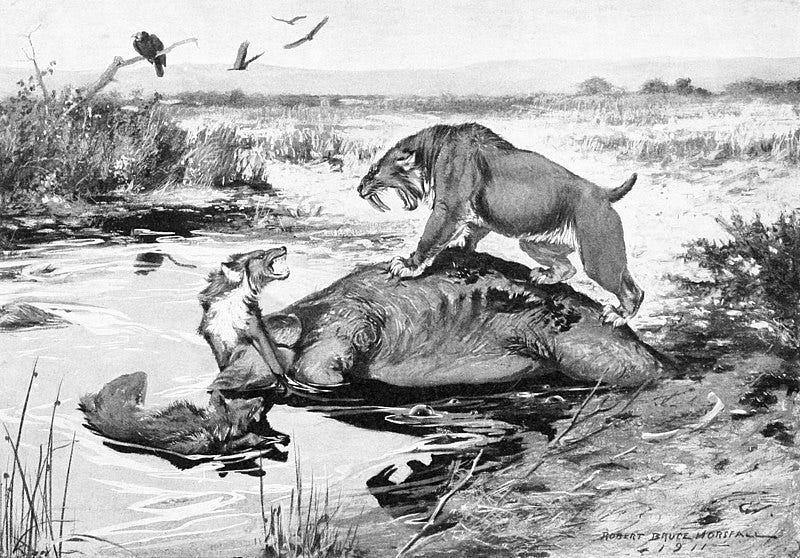
Hancock Park in the Fairfax District of Los Angeles was part of the Mexican Land Grant of Rancho La Brea. Bones had been found on the site for many years, but farmers and others thought they were just from wild animals such as pronghorn antelopes, or from farm animals which had strayed.
Early Interest in the Tar Pits
The “tar” at La Brea is actually asphalt, and has many uses, including waterproofing of boats and sealing roofs of houses.
At La Brea (Spanish for tar) it has been oozing up for tens of thousands of years. The oldest materials found at La Brea so far are wood and bone, dated around 38,000–50,000 years ago.
Native American Chumash and Tongva peoples made boats from fallen California Redwood trunks and used this natural asphalt to seal cracks and gaps.
The tar pits were discovered by European explorers when the Spanish Gaspar de Portolá travelled there, according to the first written record by Father Juan Crespi in 1769.
In 1886 Turnbull, Stewart and Co started excavating the area. In 1901, Union Oil geologist W W Orcutt was allegedly the first to notice that the bones were prehistoric Ice Age fossils, preserved in the sticky ashphalt. The La Brea coyote was named in his honour: Canis latrans orcutti.
More Recent Research
In 1913, the owner of the Ranch, George Allan Hancock, granted excavation rights exclusively to the Natural History Museum of Los Angeles County. In 1924, Hancock donated 23 acres (9.3ha) to the City of Los Angeles on condition the park was protected.
The George C Page Museum, built next to the tar pits, opened to the public in 1977. They found some 750,000 specimens in various pits, dating from 50,000 to 11,000 years ago, the end of the Ice Age.
Despite its shallow depth, the asphalt is so viscous that animals falling into it could not escape; as they struggled, they attracted scavengers and predators looking for an easy meal. These got stuck too. For every herbivore, nine carnivores have been found.
This also coincided with the arrival and growth of the human population, at which time many North American megafauna became extinct. Opinions differ as to the roles played by natural climate change and by people.
*The first were the Clovis people, who probably arrived from Asia/Siberia via the land bridge. They hunted mammoths with their spears and atlatls, but even for them America must have been terrifying — they were both hunters and hunted.
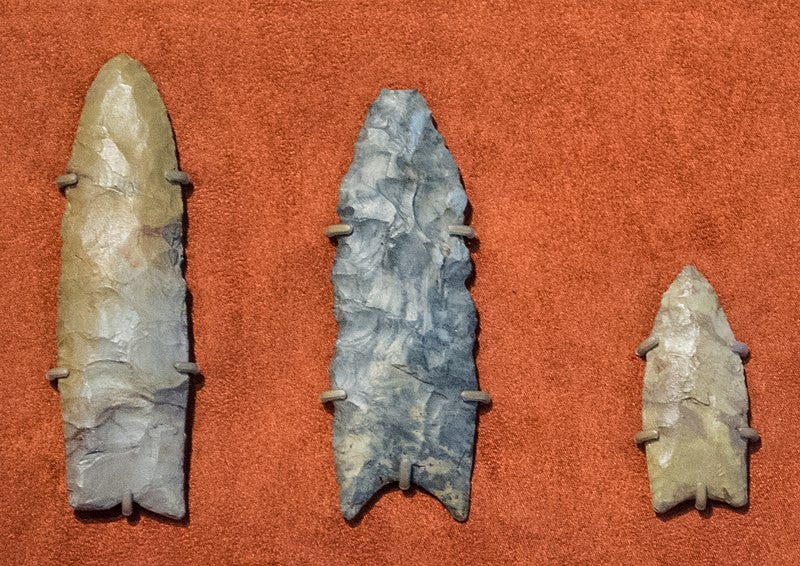
Some of the species found in the tar pits:
Dire Wolf (Canis dirus)
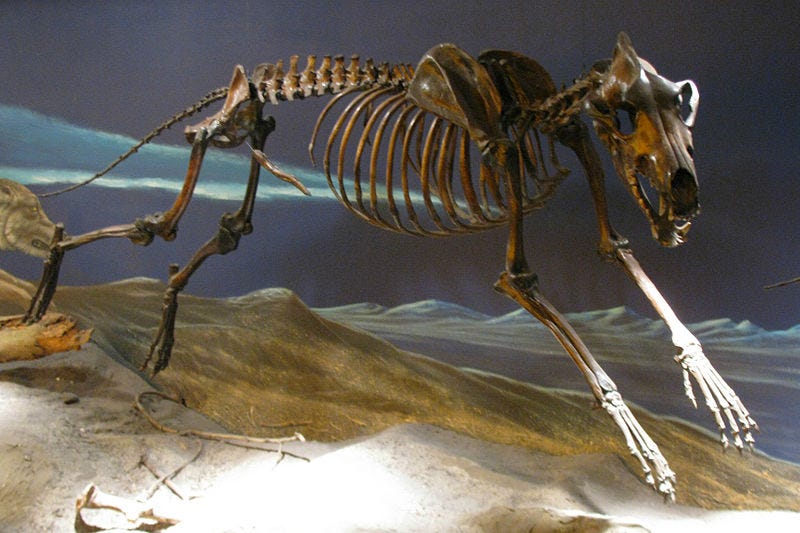
This is the most numerous species found at the tar pits, with bones from over 4,000 individuals found.
Dire wolves lived from 250,000 to 13,000 years ago. They were around 20% larger than Grey wolves. Averaging 1.75m (69”) long and 1 metre (36”) high, with weight 68.04 kg (150lbs), they were big enough to hunt the largest herbivores.
Their teeth indicate that they also scavenged; pitted and/or broken teeth are common in animals which break bones to eat marrow, so we know dire wolves lived by both hunting and scavenging. The higher ratio of Carbon 13 to Carbon 12 shows most of its prey lived in the open.
They most likely also hunted in packs, as do grey wolves. There are remains of a dire wolf with serious, but healed, injuries. As this animal could not have hunted for some time, this suggests that others at least brought it food.
Some recent research (details here) suggests this may have been a separate species from the grey wolf.
Mammoth (Mammuthus primigenius)
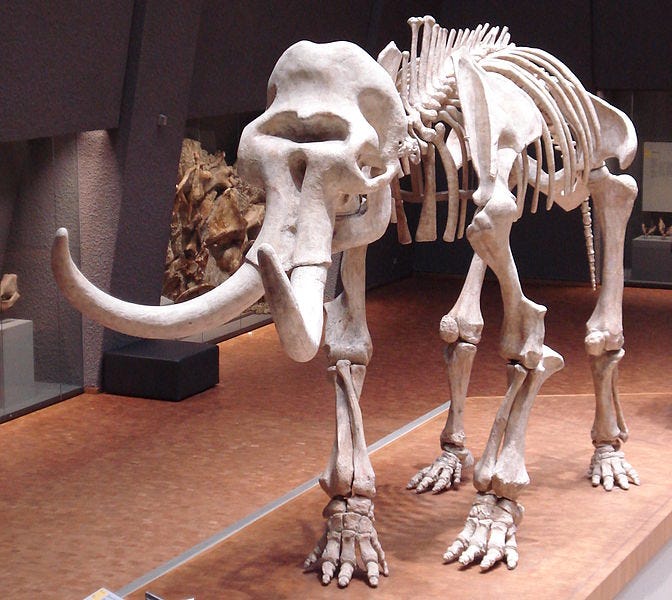
The sheer size of these animals is impressive. Adult male Mammoths could reach 3.4metres (over 11 feet) high and 4.6 metres (15 feet) long. It could weigh up to six metric tonnes. One specimen of Columbian mammoth found in Texas had tusks 4.9 metres (16 feet) long.
There were different species of Mammoth; they first appeared some 2.5 million years ago), and Woolly Mammoths, best suited to cold climates, dominated the Ice Age. The last Mammoths died out during the Holocene, some 4,000 years ago.
Smaller numbers were found of this herbivore than of other pleistocene mammals, but one almost complete skeleton found in 2009, for some reason called “Zed” and can now be seen at the Tarpits Museum
La Brea also has Mastodon fossils; these and Mammoths are not always found together. Mammoths thrived in the cold of the early to mid-Pleistocene, whils mastodons were more successful in the warmer inter-glacial periods.
Sabre-toothed Cat or Tiger (Smilodon fatalis)
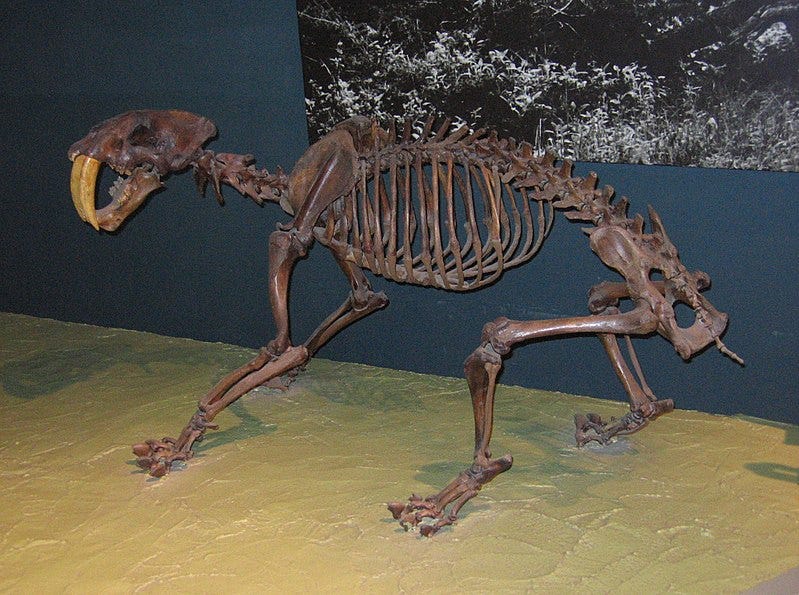
Ave 1.75m (6 feet) long, height 1 metre (3 feet 4 inches), weight 220–300 kg (485–661 lbs). Average length of canine teeth: 17–20 cm (7–8 inches)
Lived from Pleistocene (2.5million years ago, to around 10,000 years ago.
This sturdily-built ambush predator would have been seriously inhibited by increasing open grassland during post-glacial warming. Shady areas are easiest to hide in if you need to pounce. It also found the tarpits a suitable (though dangerous) hunting place. Bones of over 2,000 individuals have been found there.
Other animals:
Remains of other animals now extinct include Short-faced Bear, Giant Ground Sloth, and the rare American Lion, whose smaller cousin, the Mountain Lion, still exists.
There are remains of many different Ice Age birds, including the spectacular Merram’s Teratom (Teratomis merrami), a bird of prey up to 76,2 cm (30 inches) tall, with a 3,048–3,657 metres (10–12 foot) wingspan.
There is also an immense variety of “microfossils”; tiny plants and animals which all have their own story.
Most of the species found in the asphalt are still around, though the extinct ones fascinate us most.
Grey Wolves (Canis lupus) date from around 1 million-750,000 years ago) and Coyotes (Canis latrans) from between 1 million and 300,000 years ago. Both successfully adapted to the changing climate and the presence of humans, as did other species still with us today.
Others have a complicated history; the Bison (the most common herbivore at the Tarpits, with 300 individuals found) was hunted almost to extinction but has now been returned to the American plains. The Pleistocene horse became extinct, but horses were re-introduced by Europeans in the 15–16th centuries.
And a few more mysteries:
In 1914, the partial skeleton of a woman, dated 10,000–10,250 years ago, was found at the Tarpits. She was between 17–25 years old, and hers are the only human remains found there so far. The remains of a domestic dog (Canis familiaris) were found near her, but carbon dating in 2016 showed this animal to be from a much later period.
Because the asphalt preserves so well, even tiny markings can still be seen on bones and wood. Some older fossils show what appear to be cut marks, which date to around 15,200 years ago (+/-800 years). There may be another explanation, such as a natural cause, but if they are cut marks it would indicate human activity earlier than we expect.
And never forget bacteria: hardy forms have developed to live in the environment of La Brea.

The Museum is still researching the history of the Tarpits, which are now registered as a National Natural Landmark. 3.5 million fossils have been found so far, and excavations continue. La Brea Tarpits Museum now has a 3D exhibit which I might save up to visit.
Sources:
https://www.laalmanac.com/history/hi736.php
https://www.latimes.com/science/story/2019-08-26/la-brea-tar-pits-coyote-diet