ibe <a href="https://www.dimpo.me/newsletter?utm_source=medium&utm_medium=article&utm_campaign=kubeflow_13">here</a>!</p></blockquote><h1 id="371a">What’s new in Kubeflow 1.3</h1><p id="e9ad">As we said, Kubeflow 1.3 is a big feature release, and it aims at bringing Kubeflow closer to the Data Scientist, making it a top choice for doing ML on Kubernetes.</p><p id="3629">First, there are new and updated user interfaces (UIs). Someone would argue that <i>“if there is no UI change, then there is no update.” </i>This, of course, is a joke; however, Kubeflow 1.3 introduces an updated skin for Katib, filled with details about your hyperparameter tuning experiments.</p><figure id="94e5"><img src="https://cdn-images-1.readmedium.com/v2/resize:fit:800/1*K5GIbUeL10e-Zous2N7o4Q.png"><figcaption>Katib updated UI</figcaption></figure><p id="81fe">Another new addition, the Volume Manager, lets you manage your storage from a graphical user interface. Finally, the Tensorboard Web App enables you to visualize the logs produced by your training process and make informed decisions.</p><p id="c229">Other major features include updated images and support for new IDEs. New example images for Tensorflow 2.0 and PyTorch get you started quickly while bootstrapping a safe and stable working environment, and new IDEs such as Visual Studio Code and R Studio make you feel right at home.</p><p id="35e7">Lastly, many enhancements were made to KFServing; it’s now easier than ever to create canary deployments with traffic splitting. Now, you will be able to roll out updates to your models in a controlled way, making a smooth transition from staging to production.</p><p id="1639">Other improvements include:</p><ul><li><b>Multi-model serving:</b> more models on the same infrastructure</li><li><b>Pod affinity: </b>Avoid unnecessary usage of GPU accelerators or large CPU nodes</li><li><b>gRPC support: </b>fewer messages, less bandwidth for KFServing workloads</li><li><b>Katib trial templates: </b>simplifies hyperparameter tuning setup for custom models</li><li><b>Katib early stopping: </b>stops hyperparameter tuning trials that are unproductive</li><li><b>Pipelines step caching: </b>re-use results from previously run steps</li><li><b>Multi-user pipelines: </b>User and resource isolation for non-GCP environments</li><li><b>Manifest refactoring:</b> simplifies Kubeflow installation and upgrade</li><li><b>Istio upgrade: </b>improved security, day 2 operations, compatibility, and support</li></ul><p id="c4e4">If you want to get started with Kubeflow easily, in under 10 minutes of installation time, check out the following stories:</p><div id="bd18" class="link-block">
<a href="https://towardsdatascience.com/kubeflow-is-more-accessible-than-ever-with-minikf-33484d9cb26b">
<div>
<div>
<h2>Kubeflow is More Accessible than Ever, with MiniKF</h2>
<div><h3>Get started with the best Machine Learning platform for Kubernetes in 10 minutes.</h3></div>
<div><p>towardsdatascience.com</p></div>
</div>
<div>
<div style="background-image: url(https://miro.readmedium.com/v2/resize:fit:320/1*e5Vf07_3j_IfELV2mhiDRg.jpeg)"></div>
</div>
</div>
</a>
</div><div id="9e47" class="link-block">
<a href="https://towardsdatascience.com/kubeflow-is-your-perfect-machine-learning-workstation-91c5d26d4790">
<div>
<div>
<h2>Kubeflow is your perfect Machine Learning workstation</h2>
<div><h3>Turn your laptop into a Netflix st
Options
reaming device and work on the cloud!</h3></div>
<div><p>towardsdatascience.com</p></div>
</div>
<div>
<div style="background-image: url(https://miro.readmedium.com/v2/resize:fit:320/1*NAQCS9LiOq9-qP_V36NoxQ.jpeg)"></div>
</div>
</div>
</a>
</div><div id="1ae3" class="link-block">
<a href="https://towardsdatascience.com/mini-kubeflow-on-aws-is-your-new-ml-workstation-eb4036339585">
<div>
<div>
<h2>Mini Kubeflow on AWS is your new ML workstation</h2>
<div><h3>Accelerate your Machine Learning model development with MiniKF on AWS</h3></div>
<div><p>towardsdatascience.com</p></div>
</div>
<div>
<div style="background-image: url(https://miro.readmedium.com/v2/resize:fit:320/1*pof5bjAhW7ta9SEZZhAdng.jpeg)"></div>
</div>
</div>
</a>
</div><p id="4288">After having a working Kubeflow installation, you might want to try out several examples. A great way to do that is to follow one of the tutorials below:</p><ul><li><a href="https://towardsdatascience.com/jupyter-is-ready-for-production-as-is-b36f1d1ca8f8">From Notebooks to Kubeflow Pipelines</a></li><li><a href="https://towardsdatascience.com/the-way-you-version-control-your-ml-projects-is-wrong-42910cba9bd9">Dataset versioning and management</a></li><li><a href="https://towardsdatascience.com/how-to-use-time-travel-to-debug-your-ml-pipelines-efb5263372c0">Debugging in Kubeflow</a></li><li><a href="https://towardsdatascience.com/hyperparameter-tuning-should-not-be-part-of-your-ml-code-44c49e80adb6">Hyperparameter tuning made easy with Katib and Kale</a></li><li><a href="https://towardsdatascience.com/the-simplest-way-to-serve-your-ml-models-on-kubernetes-5323a380bf9f">The simplest way to serve your models on Kubernetes</a></li></ul><h1 id="625b">Conclusion</h1><p id="7b7b">Kubeflow is an open-source project dedicated to making deployments of ML projects simpler, portable, and scalable.</p><p id="24e1">A few days ago, Kubeflow 1.3 release candidate went live, and this story walked you through what’s new in this major and feature-packed release.</p><p id="3772">New UIs, tools, library integrations, and security upgrades, make Kubeflow 1.3 the best release to date. A new MiniKF release will be out in a few weeks, bringing the new features of Kubeflow to your local workstation. I can’t wait to see what you’ll build with it!</p><h2 id="26ff">About the Author</h2><p id="19c1">My name is <a href="https://www.dimpo.me/?utm_source=medium&utm_medium=article&utm_campaign=kubeflow_13">Dimitris Poulopoulos</a>, and I’m a machine learning engineer working for <a href="https://www.arrikto.com/">Arrikto</a>. I have designed and implemented AI and software solutions for major clients such as the European Commission, Eurostat, IMF, the European Central Bank, OECD, and IKEA.</p><p id="dcde">If you are interested in reading more posts about Machine Learning, Deep Learning, Data Science, and DataOps, follow me on <a href="https://towardsdatascience.com/medium.com/@dpoulopoulos/follow">Medium</a>, <a href="https://www.linkedin.com/in/dpoulopoulos/">LinkedIn</a>, or <a href="https://twitter.com/james2pl">@james2pl</a> on Twitter. Visit the <a href="https://www.dimpo.me/resources/?utm_source=medium&utm_medium=article&utm_campaign=kubeflow_13">resources</a> page on my website, a place for great books and top-rated courses, to start building your own Data Science curriculum!</p></article></body>
Kubeflow 1.3 Will Make You Fall in Love with MLOps
Take advantage of the new Kubeflow features to accelerate your machine learning model workflow.

Kubeflow is an open-source project dedicated to making deployments of ML projects simpler, portable, and scalable. From the documentation:
The Kubeflow project is dedicated to making deployments of machine learning (ML) workflows on Kubernetes simple, portable and scalable. Our goal is not to recreate other services, but to provide a straightforward way to deploy best-of-breed open-source systems for ML to diverse infrastructures. Anywhere you are running Kubernetes, you should be able to run Kubeflow.
Kubeflow consists of many components that you can use in conjunction or as stand-alone tools:
Notebook Serversputs you in a familiar and scalable working environment.
Kubeflow Pipelinesenables you to build and deploy portable and scalable machine learning (ML) workflows based on Docker containers.
MLMDfacilitates the process of tracking and managing the metadata produced by your experiments.
Katiboptimizes your models through hyperparameter tuning and neural architecture search.
KFServingallows you to serve your models as scalable APIs effortlessly and even do canary releases.
These components are the main pillars of Kubeflow, and the power you get when you bring everything together is unparalleled.
This week Kubeflow 1.3 release candidate (1.3-rc) went live, and this story walks you through what’s new in this major and feature-packed release.
Learning Rate is a newsletter for those who are curious about the world of AI and MLOps. You’ll hear from me every Friday with updates and thoughts on the latest AI news and articles. Subscribe here!
What’s new in Kubeflow 1.3
As we said, Kubeflow 1.3 is a big feature release, and it aims at bringing Kubeflow closer to the Data Scientist, making it a top choice for doing ML on Kubernetes.
First, there are new and updated user interfaces (UIs). Someone would argue that “if there is no UI change, then there is no update.” This, of course, is a joke; however, Kubeflow 1.3 introduces an updated skin for Katib, filled with details about your hyperparameter tuning experiments.
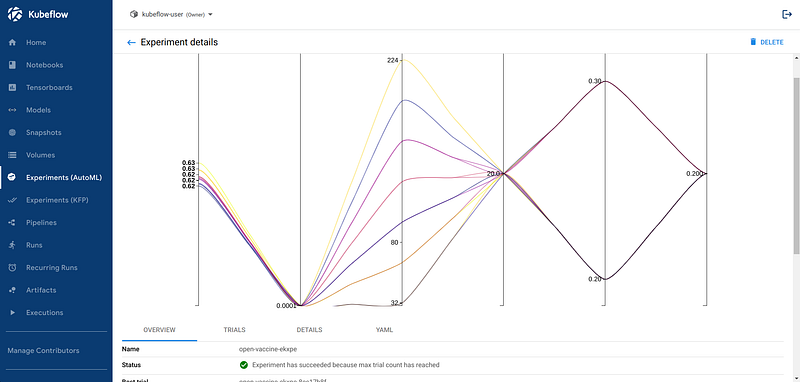
Katib updated UI
Another new addition, the Volume Manager, lets you manage your storage from a graphical user interface. Finally, the Tensorboard Web App enables you to visualize the logs produced by your training process and make informed decisions.
Other major features include updated images and support for new IDEs. New example images for Tensorflow 2.0 and PyTorch get you started quickly while bootstrapping a safe and stable working environment, and new IDEs such as Visual Studio Code and R Studio make you feel right at home.
Lastly, many enhancements were made to KFServing; it’s now easier than ever to create canary deployments with traffic splitting. Now, you will be able to roll out updates to your models in a controlled way, making a smooth transition from staging to production.
Other improvements include:
Multi-model serving: more models on the same infrastructure
Pod affinity: Avoid unnecessary usage of GPU accelerators or large CPU nodes
gRPC support: fewer messages, less bandwidth for KFServing workloads
Katib trial templates: simplifies hyperparameter tuning setup for custom models
Katib early stopping: stops hyperparameter tuning trials that are unproductive
Pipelines step caching: re-use results from previously run steps
Multi-user pipelines: User and resource isolation for non-GCP environments
Manifest refactoring: simplifies Kubeflow installation and upgrade
Istio upgrade: improved security, day 2 operations, compatibility, and support
If you want to get started with Kubeflow easily, in under 10 minutes of installation time, check out the following stories:
After having a working Kubeflow installation, you might want to try out several examples. A great way to do that is to follow one of the tutorials below:
Kubeflow is an open-source project dedicated to making deployments of ML projects simpler, portable, and scalable.
A few days ago, Kubeflow 1.3 release candidate went live, and this story walked you through what’s new in this major and feature-packed release.
New UIs, tools, library integrations, and security upgrades, make Kubeflow 1.3 the best release to date. A new MiniKF release will be out in a few weeks, bringing the new features of Kubeflow to your local workstation. I can’t wait to see what you’ll build with it!
About the Author
My name is Dimitris Poulopoulos, and I’m a machine learning engineer working for Arrikto. I have designed and implemented AI and software solutions for major clients such as the European Commission, Eurostat, IMF, the European Central Bank, OECD, and IKEA.
If you are interested in reading more posts about Machine Learning, Deep Learning, Data Science, and DataOps, follow me on Medium, LinkedIn, or @james2pl on Twitter. Visit the resources page on my website, a place for great books and top-rated courses, to start building your own Data Science curriculum!