
Knowledge is Power — The Concept of Knowledge in Islam:
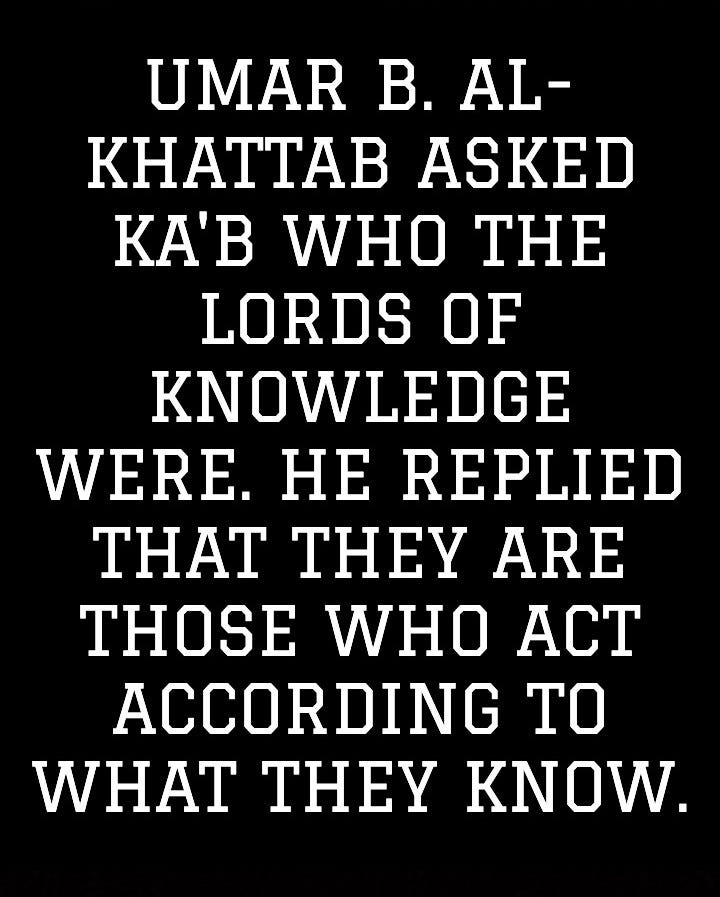
"Knowledge is Power" is a Popular Proverb.
It means that knowledge is more powerful than physical strength and no great work can be done without knowledge.
Knowledge is a powerful factor that empowers people to achieve great results. The more knowledge a person gains, the more powerful he becomes.
The Meaning Of True Knowledge In Islam:
In Islam, Allah is the ultimate Truth (al-Haqq). He is the Creator and His creation stands for the manifestation of His holy attributes. The creation is also a compendium of signs (ayat) which advances, as well as facilitates, the reading of the world which, in turn, leads to an understanding and appreciation of the Creator.
Knowledge, it follows, is closely related to the truth. It is about knowing the true and actual states of things at any level of the existential reality, be they most magnificent or most inconsequential. What matters is the truth, not the quantifiable dimensions of things. Indeed, knowledge and truth are two faces of the same coin.
Knowledge furthermore is a familiarity with or an awareness of things, inasmuch as they are related to the truth and their Creator. Processes related to knowledge signify the paths that, via progressive degrees of affirmation, eventually lead to a union with the truth. Knowledge itself is the best provision for the journey.
Knowledge, therefore, is a means, not an end in itself. In its totality, it should be placed in the service of the truth, operating but for a higher order of meaning and experience. There is no such thing as knowledge for knowledge’s sake, or knowledge for vain purposes.
It is for a reason then that the Prophet’s message is associated with knowledge, following him with obtaining and holding on to that knowledge, and travelling on a road to Paradise is associated with travelling on a road in search of knowledge. No one else but the learned ones are qualified to be successors of the seal of the Prophets and to lead societies, in that upon them the destinies of people and human civilization depend.
Positively, no qualification, skill, or talent can replace the forte of the “heirs of the Prophets”, whose reputation and contributions are celebrated across the tiers of worldly and otherworldly presence.
Knowledge Is Sacred:
Knowledge in Islam, it goes without saying, is sacred. All knowledge belongs to Allah. Opportunities and capacities to learn, and knowledge itself, are divine favours conferred on mankind.
Knowledge is a means of perennial connection with heaven. It is akin to a rope extended down from above, so that man, if he wants, can unchain himself from the fetters of matter and this fleeting world in general, and rise. He is thus set to draw ever closer to his heavenly origins, his primordial self, and of course to his Creator and Master.
According to Ibn Khaldun, there are three intimately interconnected levels of knowledge acquisition and application that enables man to:
1. Obtain his livelihood (self-development and personal fulfillment);
2. Cooperate with fellow men towards the goal of obtaining his livelihood and the goals of building social cohesion and civilization (social actualization and development);
3. Study and know his Master (Almighty Allah) whom he worships (ontological and spiritual actualization).
For all three levels, man needs to capitalize on his intrinsic ability to think and explore, and on the heavenly gift of the revealed knowledge which was delivered to man through the holy prophets, striking a delicate balance between the two types of knowledge and their respective jurisdictions.
Islam does not recognize the division of knowledge along ideological lines. In fact, it regards the world of knowledge as so holistic and universal that any dissection, even for mere educational ends, raises a series of conundrums.
There are no, for example, religious and non-religious sciences (knowledge), just as there are no religious and non-religious institutions of learning, nor religious and non-religious scholars.
Knowledge Is Closely Related To The Truth:
It is about knowing the true and actual states of things at any level of the existential reality, be they most magnificent or most inconsequential. What matters is the truth, not the quantifiable dimensions of things. Indeed, knowledge and truth are two faces of the same coin.
Knowledge furthermore is a familiarity with or an awareness of things, inasmuch as they are related to the truth and their Creator. Processes related to knowledge signify the paths that, via progressive degrees of affirmation, eventually lead to a union with the truth. Knowledge itself is the best provision for the journey.
Knowledge, therefore, is a means, not an end in itself. In its totality, it should be placed in the service of the truth, operating but for a higher order of meaning and experience. There is no such thing as knowledge for knowledge’s sake or knowledge for vain purposes.
It is for a reason then that the Prophet’s message is associated with knowledge, following him with obtaining and holding on to that knowledge, and traveling on a road to Paradise is associated with traveling on a road in search of knowledge.
No one else but the learned ones are qualified to be successors of the seal of the Prophets and to lead societies, in that upon them the destinies of people and human civilization depend. Positively, no qualification, skill, or talent can replace the forte of the “heirs of the Prophets”, whose reputation and contributions are celebrated across the tiers of worldly and otherworldly presence.
Difference Between Knowledge & Information In Islam:
Knowledge is the understanding and application of information.
Information is simply data or facts.
Knowledge in the Western world means information about something, divine or corporeal, while In Islamic point of view 'ilm is an all-embracing term covering theory, action, and education, it is not confined to the acquisition of knowledge only, but also embraces socio-political and moral aspects.it requires insight.
The Unity Of Knowledge:
There is only one knowledge, and that’s it, just as there is only one existential reality and only one certainty.Regardless of how Muslim scholars divide and categorize Islamic sciences (knowledge).
This is mainly for the sake of pedagogy and epistemological theorizing in the light of the prevalent public interests or benefits (al-masalih al-mursalah) and the impression of the objectives (maqasid) of Shari’ah - the most that could be said is that knowledge can be divided and classified solely in accordance with its proximity, together with intensity, as far as the spiritual objectives of life are concerned.
It is true that all knowledge is important, but, admittedly, some forms are more important, and hence more sought after, than others, because the former is more indispensable for one’s self-realization and for the fulfillment of mankind’s earthly mission in general than the latter. Hence, an ordering of knowledge (sciences) based on significance and impact is commonly resorted to.
By way of example, there is theoretical and practical knowledge, fard ‘ayn (individual duty) and fard kifayah (collective duty) knowledge, (pure) religious and (supplementary) intellectual knowledge, (pure) religious and (supplementary) worldly knowledge.
Ibn Khaldun even spoke about the sciences (knowledge) of human beings, the sciences (knowledge) of the angels, and the sciences (knowledge) of the holy prophets, all adding to each other and constituting a sanctified whole.
That is why the Prophet (pbuh) said that seeking knowledge is obligatory upon every Muslim (Sunan Ibn Majah, Vol. 1, Book 1, Hadith No. 224).
It is held that knowledge in this instance means the knowledge of Shari’ah.
The Concept Of Knowledge In Islam:
Knowledge is too great for it to be publicized, and clearer than for it to appear, for it is dearer to be desired and nobler to be desired.
Islam is one religion which gives a special concept to knowledge.The scholars are living a life in their books after they have passed away from this world. History witnessed those scholars who passed away more than the businessman lived in history. Growing our children under the blanket of knowledge is better than sending them to work. So if you water the seeds by helping the children to read they will shed the upcoming Ummath.
Allah Almighty says: “God will raise those who have believed among you and those who have been given knowledge by degrees”.
Ibn Abbas said: “Scholars are one hundred degrees above the believers, and between them is one hundred years.”
Knowledge is the path to winning Paradise, and the way to escape from Hell.
Abu Hurairah reported that “Whoever follows a path in pursuit of knowledge, Allah will make his path to Heaven easy for him.”
The words of the scholars among the Companions and those after them multiplied about knowledge and its virtues because they knew its value and saw its importance in the lives of Muslims.
Imam Shafi’i said: “Seeking knowledge is better than supererogatory prayers, and after the obligatory prayers is not better than seeking knowledge, and whoever does not like knowledge, there is no good in it, so there is no knowledge or friendship between you and him.”
The Scholars are loved in the heavens and the earth, Allah loves them and they love him. Knowledge remains its trace for man, alive and dead, so his memory will be immortalized with the next, even if he is buried under the soil.
Scholars are a safety for the people of Islam and a fence for the people of faith.
There is something better in this world than prophethood, and what comes after prophethood is something better than knowledge and jurisprudence.
Islam provided great impetus for the human pursuit of knowledge. The first verse that descended on the Prophet Muhammad (PBUH) was Iqra, which means “read”, an opening door to read, write, and ponder. The prophet Muhammad (SAW) commanded that seeking knowledge is a duty upon every Muslim,, and urged them to seek knowledge as far as they could reach and also to seek it at all times.
Muslims who distinguished themselves as patrons of learning, established some of the biggest libraries of medieval times.
The great intellectuals of their age including Ibn Rushid the encyclopedist, Ibn Miskawayah, the historian-philosopher, Al-Fadl Ibn Naubakht and Humayun Ibn Ishaq, the renowned translators, who were entrusted with the responsibility for the organization and maintenance of libraries.
Under the Abbasids, Muslims formed the vanguard of civilization. They were influenced by the knowledge that the ink of a scholar is equal to the blood of a martyr.
During this period the Muslim world became the unrivaled intellectual center for science, philosophy, medicine, and education as the Abbasids championed the cause of knowledge and established Darul Hikama (House of Wisdom) in Baghdad, founded by great Abbasid Caliph Harun-ar-Rashid.
Sufyan al-Thawri said that the compulsory knowledge is that knowledge for which a person will not have any excuse for not knowing (i.e. knowledge of the essential parts of Islam and also life).
Similarly, Abu al-Darda’ is reported to have said that nobody can be pious unless he is knowledgeable, and nobody can enjoy (and appreciate) knowledge unless he applies it practically (for the determined honorable goals).
The Messenger of Allah, may Allah bless him and grant him peace, said, "If Allah desires good for someone, He gives him understanding in the deen. Knowledge is gained through learning."
Abu Dharr pointed to his neck and said, "If you were to put the sword here and I thought that I could finish one sentence which I heard from the Prophet before you finished me, I would say it."
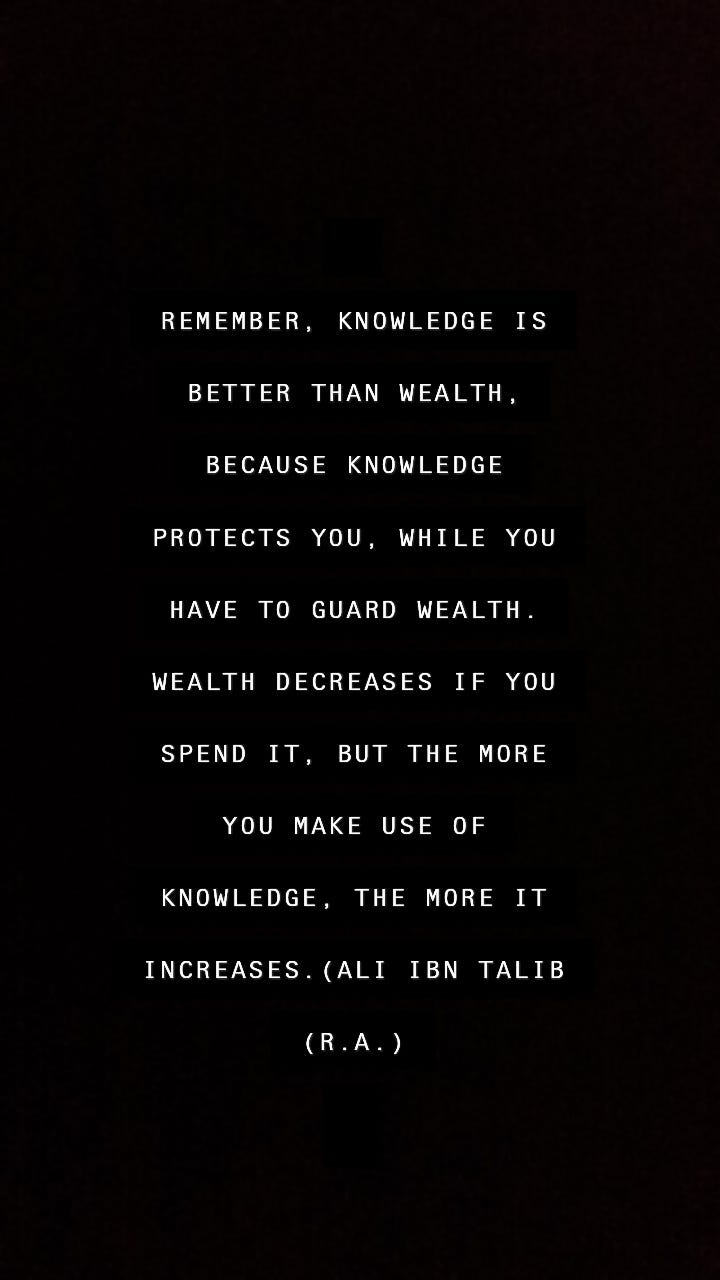
'Ali ibn Talib (R.A.) stated, "Knowledge is better than riches, for knowledge guards you while you guard riches. Knowledge governs while riches are governed. Riches diminish with spending but knowledge increases with it."
The people of knowledge are 'the heirs of the Prophets', as the Messenger of Allah said. He also said, "Wisdom adds honor to the noble and exalts the slave until he attains the level of king." He also said, "A single faqih is more formidable to Shaytan than a thousand worshippers."
This is because the one with knowledge can distinguish between the halal and the haram, and see the perils and machinations of Shaytan and thus avoid the traps he sets.
Al-Hasan al-Basri said, "Two innovations have appeared in Islam: a man of bad judgment who holds that the Garden will be the reward only for those who see eye to eye with him, and a man of luxury and extravagance who worships this world. .. Reject these two for they are doomed to the Fire."
So we have three types of people in respect of knowledge:
- one who follows true knowledge and applies it;
- one who seeks to satisfy his appetites,
- and one who seeks to have people follow his opinions.
Shafi’i on Knowledge: It is only knowledge if it benefits you
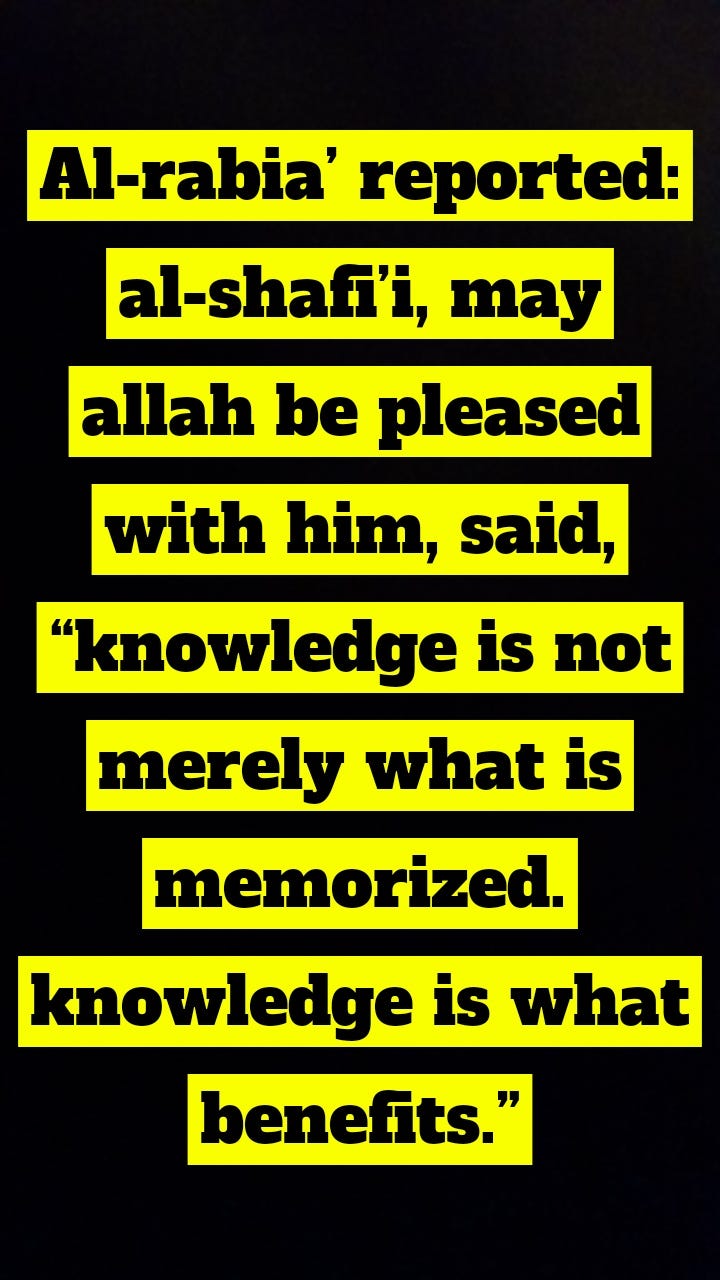
Al-Rabia’ reported: Al-Shafi’i, may Allah be pleased with him, said, “Knowledge is not merely what is memorized. Knowledge is what benefits.”
Source: al-Madkhal ilá al-Sunan al-Kubrá 400
All humans are dead except those who have knowledge; and all those who have knowledge are asleep, except those who do good deeds; and those who do good deeds are deceived, except those who are sincere; and those who are sincere are always in a state of worry.”(Al-Shafi'i)
Ali ibn Talib (R.A.) on knowledge :
For surely knowledge belongs to whoever knows and then acts accordingly so that his action corresponds to his knowledge. There will be people who will carry knowledge around with them, but it will not pass beyond their shoulders.
Seeking Knowledge Is An Obligation:
Anas ibn Malik reported: The Messenger of Allah, peace and blessings be upon him, said, “Seeking knowledge is an obligation upon every Muslim.”
(Sunan Ibn Mājah 224)
O Allah, "I seek refuge with You from the knowledge that does not bring benefit, from a supplication that is not heard, from a heart that does not fear (You), and from a soul that never satisfies. (Ameen)
JazakAllah (May Allah reward you with goodness) for reading.
Kindly follow & subscribe to receive the latest insightful stories by email.