
Knight of America
An inside look at the voyage of the Templar Knight who more than likely discovered America.
Christopher Columbus never claimed to have discovered America. Chances are you may have been taught the contrary belief in school along with millions of other American students. However, the Italian explorer was not the first European to have discovered the new western continent. Long before he was even born, it seems that there was perhaps another regal explorer who discovered America more than 90 years before Columbus sailed the ocean blue.
It’s been recorded that the Norwegian and Scottish nobleman, and Templar Knight, Prince Henry I Sinclair, sailed from Scotland to North America around the 1390s.
Sinclair was born in Scotland in 1345 A.D. He was granted the illustrious title, Earl of Orkney (islands north of Scotland). The Templar knight held these islands as a fief from the king of Norway. His mother descended from two kings of Norway. Sinclair was also Lord of Rosslyn, six miles south of Edinburgh, Scotland.
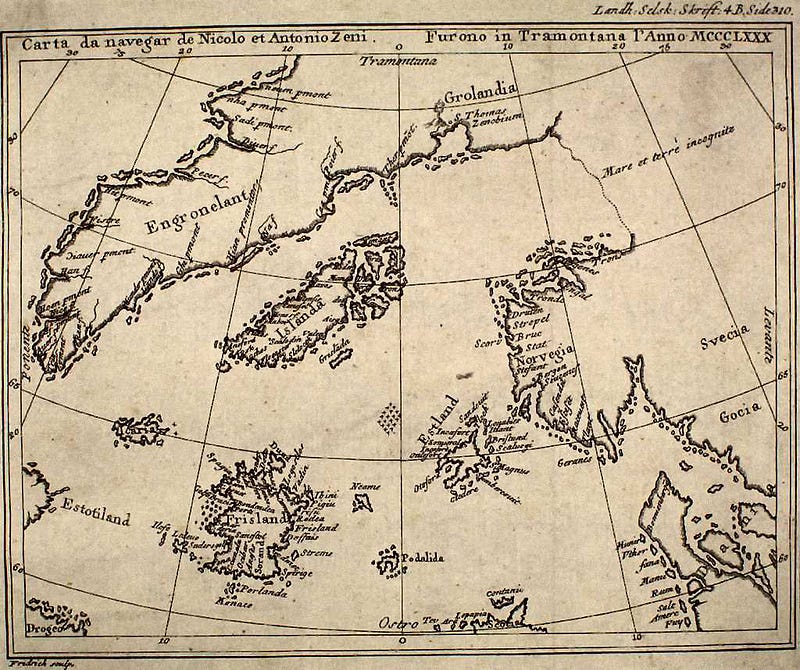
More than 300 colonists joined Prince Henry Sinclair on his journey west to Nova Scotia (New Scotland). He sailed in ten massive sailing vessels along with the colonists, his Italian navigator, Sir Antonio Zeno, and Antonio’s brother, Nicolo Zeno, from the Orkney Islands to Iceland, then to Greenland and several days from Greenland to Newfoundland, Canada.
When the travelers landed in North America, they discovered that the native Indians in Newfoundland were unfriendly. They took aim and shot at the foreign men, wounding and killing some of them while Prince Henry stopped to help themselves to freshwater. The knight quickly took action and left Newfoundland and continued on to Nova Scotia Province, Canada.
Sir Antonio Zeno recorded their journey in what is known today as the “Zeno Narrative”. The journal had been forgotten until a great-great-great-grandson discovered them in the family archives and had it published in Latin in 1558. An expert from the narrative:
“We brought our barks and our boats to land, and on entering an excellent harbor, we saw in the distance a great hill that poured forth smoke, which gave us hope that we should find some inhabitants. Neither would Sinclair rest, though it was a great way off, without sending 100 soldiers to explore the country, and bring us an account of what sort of people the inhabitants were.”
The land referred to herein was in fact, Nova Scotia Province, Canada. It is the only place on the North American coast having the open pitch deposits described within the Zeno Narrative. The deposits are located at Pictou and Stellarton, where the cave-dwelling native Micmac Indians lived. The year in which Sinclair explored America was determined by the tradition of naming discoveries from the religious calendar. Sinclair called their anchorage “Trin Harbor.” Trin stands for Trinity. In Zeno’s narrative, he states that the fleet arrived when “the month of June came in.” The only year between 1395 A.D. and 1402 A.D., the time frame of the voyage, when Trinity Sunday fell in early June was 1398 A.D.
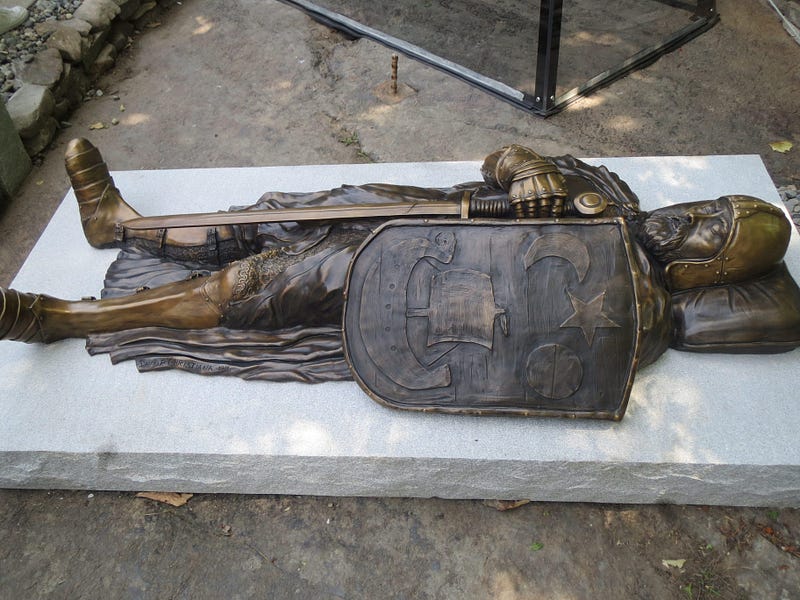
Additional evidence exists which suggests that Prince Henry Sinclair sailed south of Nova Scotia around 1399 A.D. to Massachusetts. Marked atop a hillside in Westford, Massachusetts, just west of Boston, lies a ledge bearing the carved outline of a medieval knight. He holds a broken sword, a symbol that a brave knight died in the field. This figure illustrates a shield displaying the arms of the Gunn family, who were kinsmen of the Sinclairs. The helmet is of the bascinet type, in common use among North Britons distinctly between 1375 and 1400 A.D. The Gunn family has its roots in Caithness, Scotland (northeast Scotland), near the Sinclair lands. It is highly likely that the Westford Knight represents Prince Henry’s friend and kinsman, Sir James Gunn. In the J.V. Fletcher Public Library in Westford, there is a stone that has a carving on it of one of Prince Henry Sinclair’s ships, and an arrow and the numeral 184, presumably giving the distance and direction to Prince Henry’s campsite in Westford.
It is unknown exactly when Prince Henry Sinclair returned to England. However, in 1400 A.D. the English launched a surprise attack on the city of Kirkwall on the Orkney Islands and it is believed that the English soldiers killed Prince Henry Sinclair.
It is suggested that the Templar Knight longed to make a return back to the Americas before meeting his fate at the hands of the English military.
Elusively written lore and legends have long intrigued curious modern generations. However, enough evidence exists to support this particular account that the regal Prince Henry Sinclair of Scotland did, in fact, discover America.
© Gena Vazquez 2020