avatarDiane Neill Tincher

Free AI web copilot to create summaries, insights and extended knowledge, download it at here

2406

Abstract

orses are strong and hardy, able to tolerate a sparse diet and the cold Nagano winters. Their hooves are so tough that there is no need for horseshoes, although in years past they wore straw sandals to help them gain purchase on slippery cobblestones and steep mountain trails.</p><figure id="76f4"><img src="https://cdn-images-1.readmedium.com/v2/resize:fit:800/1*Zr2rVGbP2Eg5aCqMM5w7JQ.jpeg"><figcaption>Straw horse sandals hanging in a barn with a recessed stall. Quote found on <a href="https://hoofcare.blogspot.com/2013/02/hoofcare-history-japanese-hoof-sandals.html">The Hoof Blog</a>.</figcaption></figure><p id="2466">In time, these horses came to be used on the battlefield, first during the Genpei War of 1180–1185, where they gained a reputation as a sturdy, reliable breed. During the feudal age that followed, many Kiso horses were used by samurai, yet they never lost their place as valuable workhorses on rural farms.</p><p id="11b0">In the late 19th century, the Imperial Army of the Meiji government decided they needed to improve and enlarge the breed. They decreed that all males be castrated and that the females only breed with Western imported stallions. This did not bode well for the Kiso horses.</p><p id="dca2">From the late 19th century through the 1920s, there were roughly 7,000 Kiso horses. Then, with the advent of mechanized farming, their numbers fell drastically.</p><figure id="284c"><img src="https://cdn-images-1.readmedium.com/v2/resize:fit:800/0*WVAIj7qCQmKrfeJq.jpeg"><figcaption>Kiso horse at Kiso Uma no Sato, Nagano Prefecture.</figcaption></figure><p id="9489">After WWII, there was only one intact male Kiso horse in existence. He had escaped castration by being donated to a shrine. His one male offspring, with 98.4% pure blood, was born in 1951. This stallion, Daisan Haruyama, became the father of all future Kiso horses, siring over 700 in his long and productive life.</p><p id="d7f4">The Kiso horse population went up and down through the years, and in 1976, the year after Daisan Haruyama’s death, there were only 32. Thanks to the careful work of conservationists, today, there are about 140 of this gentle breed. Forty of these reside at the Kiso Uma no Sato.</p><p id="3bde">The colors of these remaining horses have been dramatically affected by the genetic bottleneck. In the 19th century, there were gray, black, and palomino horses. Today, all Ki

Options

so horses are shades of bay, with a very few chestnut, sandy brown, or dun.</p><h1 id="0142">Bidding farewell</h1><figure id="d1d8"><img src="https://cdn-images-1.readmedium.com/v2/resize:fit:800/0*WetVdR4ZwQxSGtrJ.jpg"><figcaption>Horses peeking out of stalls at Kiso Uma no Sato. The stallions are in the front.</figcaption></figure><p id="2439">Having been charmed by these lovely little horses, it’s time for us to head to the bus stop. Buses only come once every couple of hours in such rural areas, so we want to be early.</p><p id="305c">We say our goodbyes to the horses, walk down the road past birch trees and a blueberry orchard, and reach the bus stop. The bus will take us to our inn where we will relax in an <a href="https://readmedium.com/10-tips-for-a-delightful-japanese-onsen-experience-c81081e9ef74">onsen bath</a> before being treated to a beautiful <a href="https://readmedium.com/washoku-wonderful-and-beautiful-japanese-cuisine-630d7383ef7f">kaiseki dinner</a>.</p><p id="80ee">It was another perfect day.</p><p id="4f4a">To visit these docile horses, seek out the <a href="http://kisoumanosato.or.jp/">Kiso Uma no Sato</a> on the Kaida Plateau of Nagano Prefecture.</p><h2 id="f8c5">References:</h2><p id="d2d2">Kiso Uma no Sato, <a href="https://takamori-tokinoeki.com/wp-content/uploads/2015/10/%E5%B9%B3%E6%88%90%EF%BC%92%EF%BC%96%E5%B9%B4%E5%BA%A6%E7%AC%AC%E4%B8%89%E5%9B%9E%E6%99%82%E3%81%AE%E9%A7%85%E8%AC%9B%E5%BA%A7.pdf">The Tragedy of the Kiso Horse</a> (Japanese).</p><p id="abb4"><i>If you want to join Medium to get access to all content, I’d be glad if you used my referral link below. Doing so gives me a small commission at no extra cost to you. My sincere thanks to those who have!</i></p><div id="d966" class="link-block"> <a href="https://diane-japan.medium.com/membership"> <div> <div> <h2>Join Medium with my referral link - Diane Neill Tincher</h2> <div><h3>Read every story from Diane Neill Tincher (and thousands of other writers on Medium). Your membership fee directly…</h3></div> <div><p>diane-japan.medium.com</p></div> </div> <div> <div style="background-image: url(https://miro.readmedium.com/v2/resize:fit:320/0*aTS9t0gD3bJwhWQU)"></div> </div> </div> </a> </div></article></body>

TRAVEL IN JAPAN

Kiso Horses — Overcoming the Disastrous Consequences of Meiji Era “Improvements”

Critically endangered adorable little horses
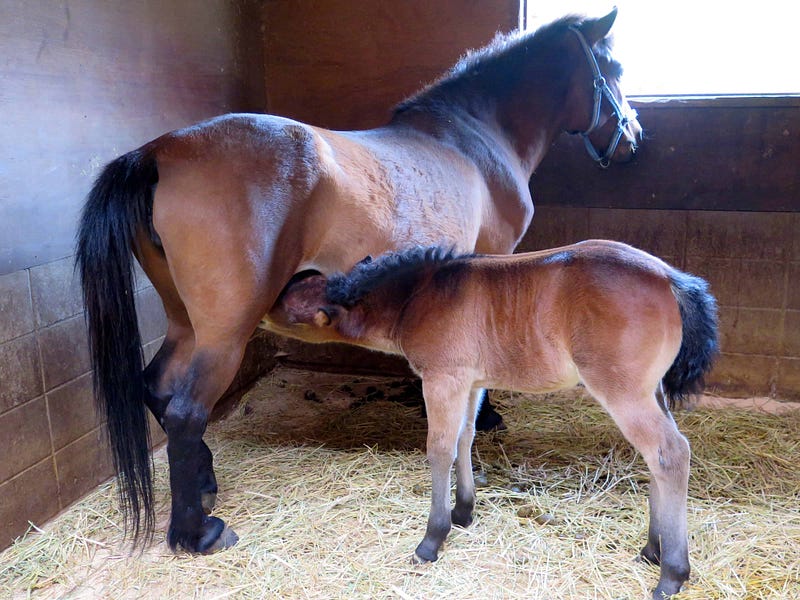
Kiso horse and foal. (All photos ©Diane Tincher)

After climbing over the Jizo Pass, my guests and I hike uphill, through swaying pampas grass and sasa bamboo, to the Kiso Uma no Sato, Kiso Horse Conservation Center, on the refreshingly cool Kaida Plateau of Nagano Prefecture.

The pleasant aroma of hay and horses reaches us as we near the stables. It is spring — the time of foaling.

Kiso horses are more like ponies, small, sturdy, and round-bellied. One of my guests asks, “Are all these horses pregnant?” Looking at them, I could understand the mistake. In truth, only three of the horses were pregnant.

Passing by the stables, we walk to the paddock behind the barns to pet the horses.

History of Kiso Horses
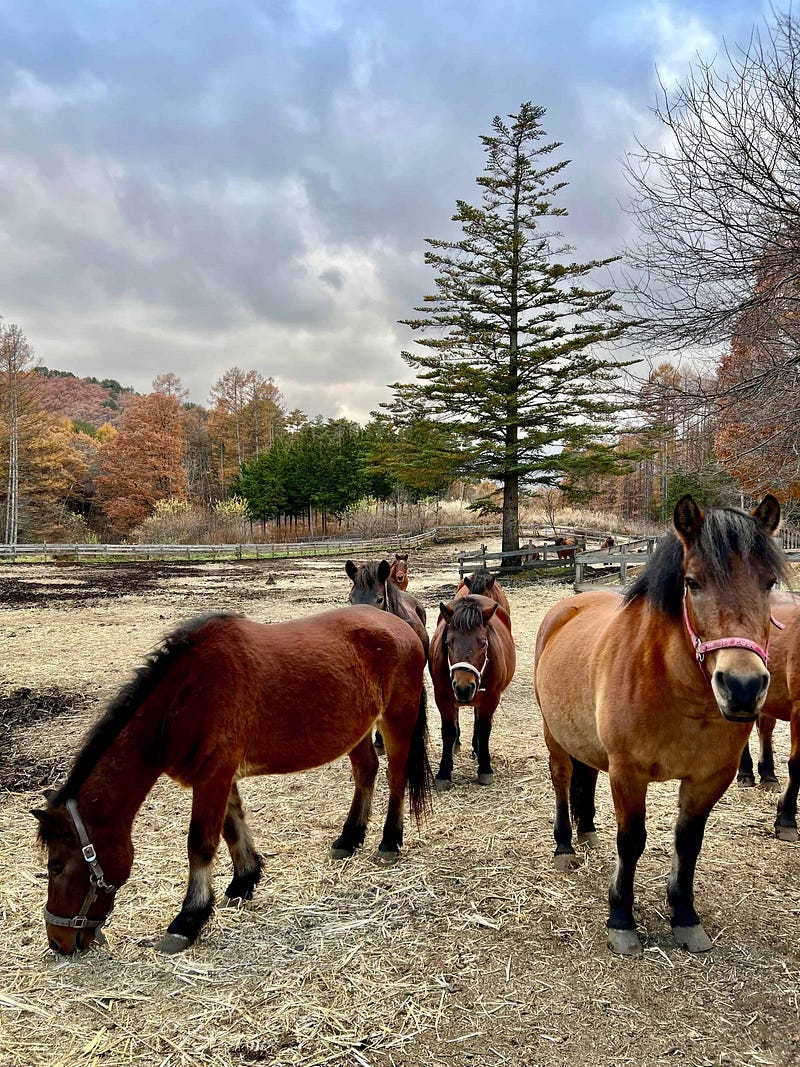
Kiso horses in a paddock at the Kiso Uma no Sato Conservation Center.

In the 4th century, several horse breeds were brought to Japan from the Asian continent. It is thought that what we now call Kiso horses originally came from Mongolia to Japan through China and Korea. They are the only “indigenous” horse breed on the main island of Honshu.

These sweet, pony-like horses have been raised in the Kiso Valley for centuries, where they were used for farming and transportation. They are small horses, weighing 350–400 kilos (770–880 pounds), a mere 110 to 140 cm tall at the withers (3′ 7″- 4′ 7″).

These horses traditionally lived under the same roof as their owners on the sunny, southeast side of the farmhouse in one large recessed stall. The women who cared for them treated them like beloved children.

Although small, Kiso horses are strong and hardy, able to tolerate a sparse diet and the cold Nagano winters. Their hooves are so tough that there is no need for horseshoes, although in years past they wore straw sandals to help them gain purchase on slippery cobblestones and steep mountain trails.
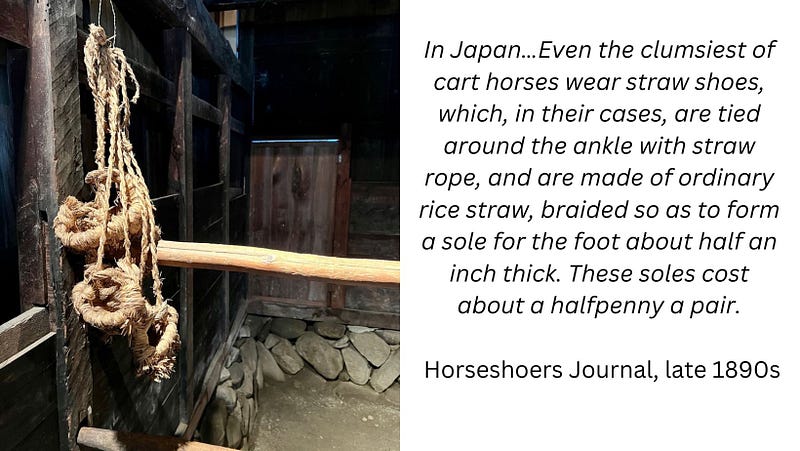
Straw horse sandals hanging in a barn with a recessed stall. Quote found on The Hoof Blog.

In time, these horses came to be used on the battlefield, first during the Genpei War of 1180–1185, where they gained a reputation as a sturdy, reliable breed. During the feudal age that followed, many Kiso horses were used by samurai, yet they never lost their place as valuable workhorses on rural farms.

In the late 19th century, the Imperial Army of the Meiji government decided they needed to improve and enlarge the breed. They decreed that all males be castrated and that the females only breed with Western imported stallions. This did not bode well for the Kiso horses.

From the late 19th century through the 1920s, there were roughly 7,000 Kiso horses. Then, with the advent of mechanized farming, their numbers fell drastically.
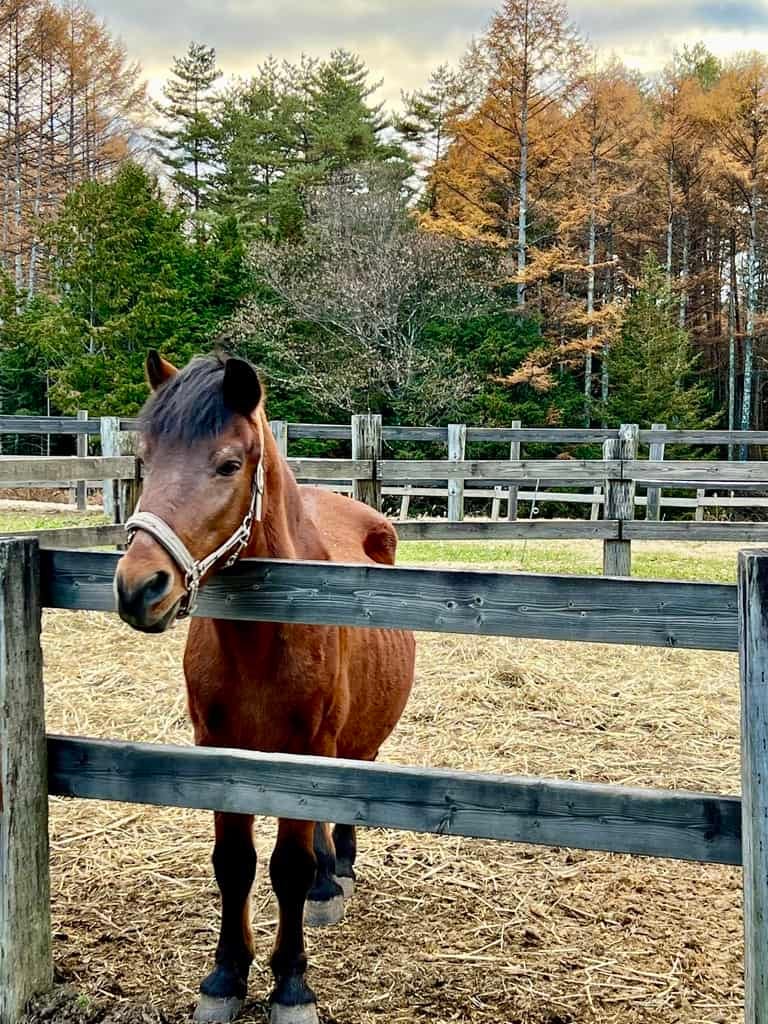
Kiso horse at Kiso Uma no Sato, Nagano Prefecture.

After WWII, there was only one intact male Kiso horse in existence. He had escaped castration by being donated to a shrine. His one male offspring, with 98.4% pure blood, was born in 1951. This stallion, Daisan Haruyama, became the father of all future Kiso horses, siring over 700 in his long and productive life.

The Kiso horse population went up and down through the years, and in 1976, the year after Daisan Haruyama’s death, there were only 32. Thanks to the careful work of conservationists, today, there are about 140 of this gentle breed. Forty of these reside at the Kiso Uma no Sato.

The colors of these remaining horses have been dramatically affected by the genetic bottleneck. In the 19th century, there were gray, black, and palomino horses. Today, all Kiso horses are shades of bay, with a very few chestnut, sandy brown, or dun.

Bidding farewell
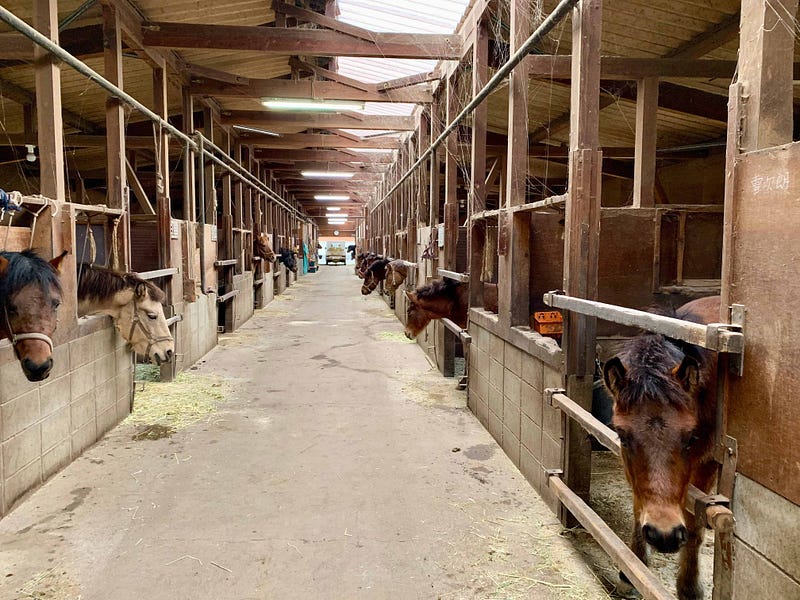
Horses peeking out of stalls at Kiso Uma no Sato. The stallions are in the front.

Having been charmed by these lovely little horses, it’s time for us to head to the bus stop. Buses only come once every couple of hours in such rural areas, so we want to be early.

We say our goodbyes to the horses, walk down the road past birch trees and a blueberry orchard, and reach the bus stop. The bus will take us to our inn where we will relax in an onsen bath before being treated to a beautiful kaiseki dinner.

It was another perfect day.

To visit these docile horses, seek out the Kiso Uma no Sato on the Kaida Plateau of Nagano Prefecture.

References:

Kiso Uma no Sato, The Tragedy of the Kiso Horse (Japanese).

If you want to join Medium to get access to all content, I’d be glad if you used my referral link below. Doing so gives me a small commission at no extra cost to you. My sincere thanks to those who have!

Travel
Japan
Horses
Nonfiction
Nature
Recommended from ReadMedium