King Of The Hill Was Iconic In Every Way, For The Best Of Reasons
Because, let’s face it, it was an accurate depiction of the 90s.
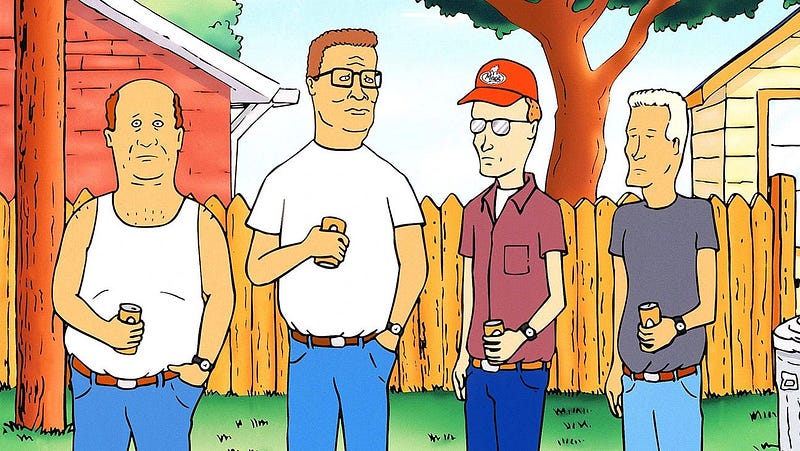
There are very few shows that are from the 90s that I find worthy of a revisit. Lately, I’ve been on a King of the Hill kick. Back in the day, King of the Hill was a treat for me and my family.
As a young child, this was one of the only two adult cartoons I was allowed to watch in my parents’ presence. The other was The Simpsons. But, King of the Hill was a uniquely important part of my life. It was unusually real.
I recently started to revisit the series as an adult — partly due to nostalgia, and partly due to curiosity. I wanted to see if it was as timeless as I felt it was. You know what? Mike Judge did good. It’s fairly timeless and makes for a great example of what good writing is like.
King of the Hill is an excellent example of what life was like in the 90s and early 2000s.
It’s hard to explain how uncannily accurate King of the Hill was with certain tropes. The Texas-based show had a way of showing slices of life that were wholesome, catty, and unwholesome at the same time.
It featured accurate tropes of people and personalities that no longer exist.
Most people I meet today have never met a guy like Hank Hill, Dale, or Cotton, but they were real. I may have grown up in New Jersey, but I saw a lot of people who acted similar to them back in the day. I always imagined this was how Texas was.
My dad was a Texan to the core, and he let me know it almost every day. Barbecue and steak weren’t just foods. They were a way of life. I was regularly reminded that I should have learned to drive on a farm, on a dune buggy named “Doombuggy.”
The Dallas Cowboys were the only football team I knew about, though I didn’t really understand what they were supposed to do. A brisket was not a brisket unless it had smoke rings. And if you didn’t “get it,” you “weren’t right.”
My dad befriended two of my friends’ parents.
One was a Moonie who later became affiliated with Rod of Iron Ministries. His daughter, my friend, was a budding blacksmith-artist-swordsman who liked to duel with real steel swords, talk taxidermy, and also hack lumber apart in the backyard at the age of 10.
My dad would hang out with him, smoke a cigarette, and listen to my friend’s dad play the banjo. Dad loved those bluegrass tunes. If things got really lit, we’d watch my friend’s dad on a unicycle or a penny farthing. They often just talked by exchanging a knowing nod and maybe drinking a beer or seltzer.
The other was a former military man from Kansas. His daughter was the ultimate forager. We would go on walks and identify trees by their bark, eat wild berries, swim, and talk about the importance of cooking wild mushrooms before you eat them as soup. Maybe we’d eat her golden retriever’s treats, if we got the right brand.
My dad and her dad would talk about the farming projects my friend would have. They’d talk about how the corn was growing in, whether or not to get a hunting dog, and things about the military. They, too, would exchange a knowing nod.
In both of these friendships, I saw a lot of Hank Hill. My first friend’s dad was a lot like Dale, but a lot more stoic and a better cook, kind of. (Her mom made rice explode. Like, on fire. The bar is not high here.) My other friend’s dad was like a more coherent Hank or Boomhauer.
It’s hard to explain to people how formal and oddly social-climby society was in the 90s. I usually just refer to King of the Hill to show the dynamics between adults back then.
As a child, I related to Bobby and Connie.
Bobby is one of the best (albeit weirdest) depictions of a preteen exploring his world that I’ve ever seen. He’s always doing something, even if it’s stuff his dad thinks is strange, crazy, or worrying.
He went through a Christian phase, which was actually commonplace in my area. He went through a phase with dog dancing. He tried gardening. He tried magic and comedy.
Connie was a girl who was very straightlaced and appreciated Bobby’s curiosity. At the same time, she often felt the pressure to please her demanding parents and be a top student.
Bobby’s dynamic around girls was particularly noticeable. He was naive enough to fall for Connie’s meth-making cousin just because she looked super cool and edgy. Actually, he was always trying to impress girls in his area. So was his awkward friend Joseph.
They had insecurities but they also had confidence. They also solved problems, even if it was in an awkward “that’s my purse” way.
The dynamics between adults, particular women, was bang-on.
Maybe it’s just the way I remember the 90s, but I remember women being a lot more professional-yet-catty back in the day. If you take a look at how the women on King of the Hill behaved, they never quite cut loose the way adults today did.
It was just not what you did.
The writers got an excellent idea of the strange competition women often felt with one another in the 90s. It was a time when moms wanted to do well by their families, but they also wanted that status and elite. They wanted to be in the “in crowd” of moms.
Though they often would try to casually one-up one another, the truth is they still had their backs when it came to secrets that would devastate a family. A good example of this? Nancy Gribble’s affair with John Redcorn. All the women knew but said nothing because they didn’t want Dale to be hurt or Nancy to be single.
The show was also an accurate depiction of the light smacks of purity culture the 90s should have been famous for.
If you took a close look at things, there were no kids in Bobby’s class who were gay. It wasn’t a thing in the 90s. If you were gay, you kept that under wraps. Girls who got a bad reputation, deserved or otherwise, suffered greatly.
That’s why Connie burst into tears when she was called “cheap” by Bobby. It was a grave, serious insult back in the day. Today, we’d probably call Bobby a prick and Connie a cheater.
Peggy and Hank were both terrified of talking about genitalia. In the sex ed episode, Peggy actually had to train herself to say the word “vagina.”
The cast was never fully Flanderized.
Among people who critique movies, Flanderization is known as the simplification of a person’s character. This happened to Ned Flanders of the Simpsons. At first, he was a well-meaning Christian who felt taken advantage of by Homer.
Over time, Flanders became a Christian zealot who took abuse with a smile. Even when his wife died, it didn’t develop his character that much. He still “Hi-diddly-ho neighborino’d” his way through life because his religion became his personality.
Writers eventually fixed that, but the name for the term stuck.
The characters of King of the Hill never had that problem. Hank was a conservative guy who meant well, but was open to learning new things about life. Dale was a conspiracy theorist, yes, but he was also a devoted father and had an odd naivete about him.
Boomhauer was the neighborhood playboy, but he also liked bluegrass and could say really witty things if you understood him. And Bill? That’s a perfect example of a guy who struggled with mental illness and still couldn’t figure out where he belonged in life.
Peggy was a narcissist, but she really was a benevolent one for the most part. She had substitute teaching, Boggle championships, and insecurities. They all did. They acted like people, not like characters.
Writers from the show shone because they didn’t try to steal the show.
Did you notice how many cartoons are all about showing off the show’s wit or “funny” writing? Family Guy literally shoehorns in one liners and surreal cutscenes as a way of getting laughs. That’s fine, but it gets old.
Eventually, it starts feeling like you’re expected to suck the writer’s dick. King of the Hill was the opposite. The dialogue was organic and natural. It let us find the humor in chats that we could see friends, neighbors, or community buddies do.
The jokes were subtle enough to feel like something you’d retell among friends at a bar.
It was still a realistic yet surreal show — and that added to its appeal.
One thing that I liked about King of the Hill was that it kept a certain level of plausible surrealism. It was surreal that Luanne saw Buckley’s angel, though I honestly think that was more of an allegory of grief or mental disorder than anything actually concrete.
Dale with his “assistant” Octavio buying alien urine was a good example of this. So was all the crazy construction projects that Bill and Hank did were another good example. Hell, that episode where Bill stole a tank is a perfect example of the surrealism.
We’ve all wanted to have those moment of zany hijinks with our friends. King made it just seem within inches of reach at times. That’s a mark of good writing, period.