
King of the Desert!
The exotic sand cat — Felis Margarita!
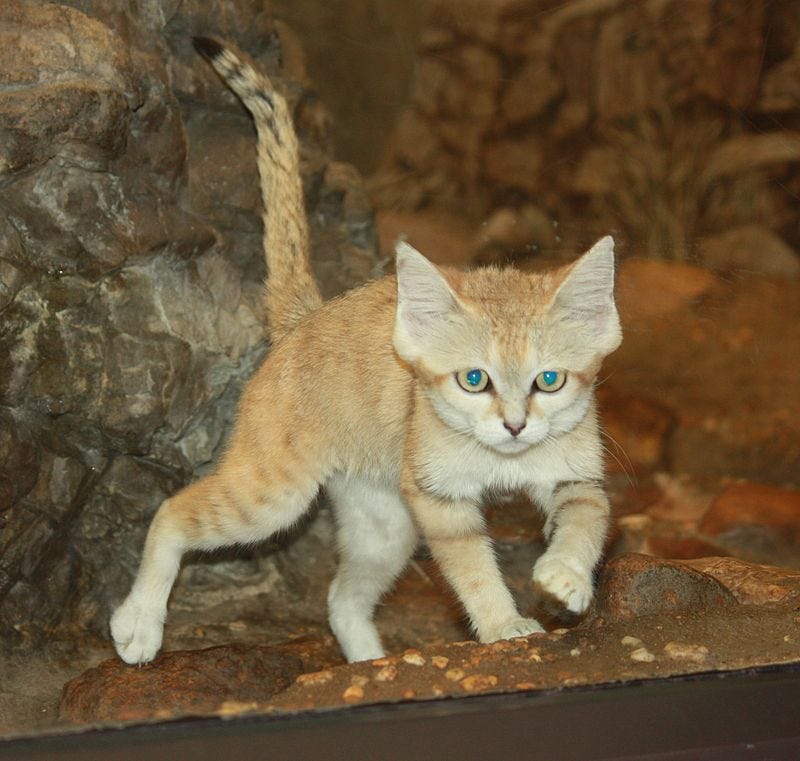
Wildlife scientists have known the sand cat since its discovery in the Algerian Sahara in 1858. They named the kitty after the French Expedition leader, General Margueritte. The other common name is the sand-dune cat.
Today the kitty is seen in Morocco, Algeria, Niger, Chad, & Egypt. It is a small wild cat in the Felinae subfamily.
The kitty weighs about 2.7 kg. The length of the cat’s body is about 50 cm & its ringed tail is around 30 cm long.
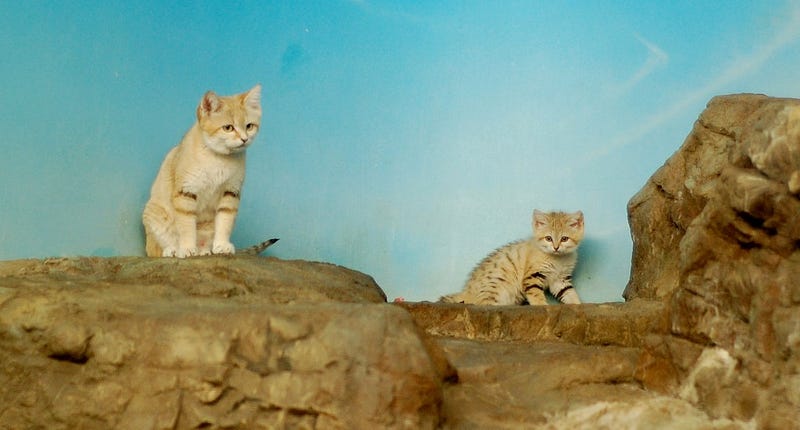
The cat has sand-colored fur and a broad head with ears that point up & out. Fur covers its paws to protect its pads from the hot sand.
Habitat:
Sand cats live in the Sahara & Arabian deserts, but they are also present in Iran & Pakistan. They live in sandy & rocky desert areas, primarily flat terrain with small bushes & little grass.
The sand cat hides in underground burrows, out of the hot sun during the day.
Humans, wolves, snakes, and large birds are the predators of the sand cat.
Wildlife studies find that this kitty is not a territorial fighter. Instead, it takes turns sharing its burrow with its mates & sand cat mothers raising their young.
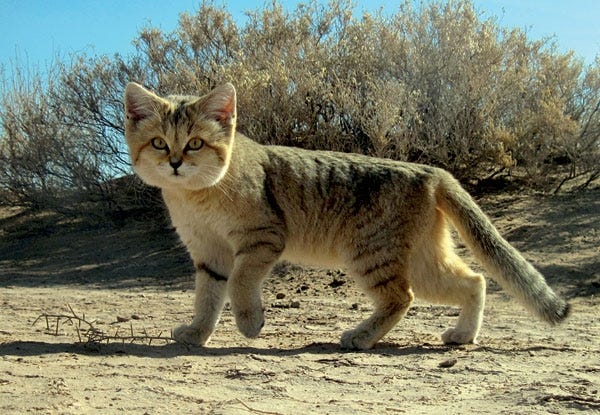
So what does the cat eat?
The night hunter, kitty kills & eats rodents, lizards, insects & some snakes.
Wildlife experts reveal that the cat does not drink water. Instead, it gets fluids by eating raw fresh, killed prey.
The researchers observed sand cats hunting young cape hare, hoopoe lark, desert monitor, sandfish, & venomous vipers.
On the IUCN Red List of endangered animals, they classify the sand cat as the least concerned species.
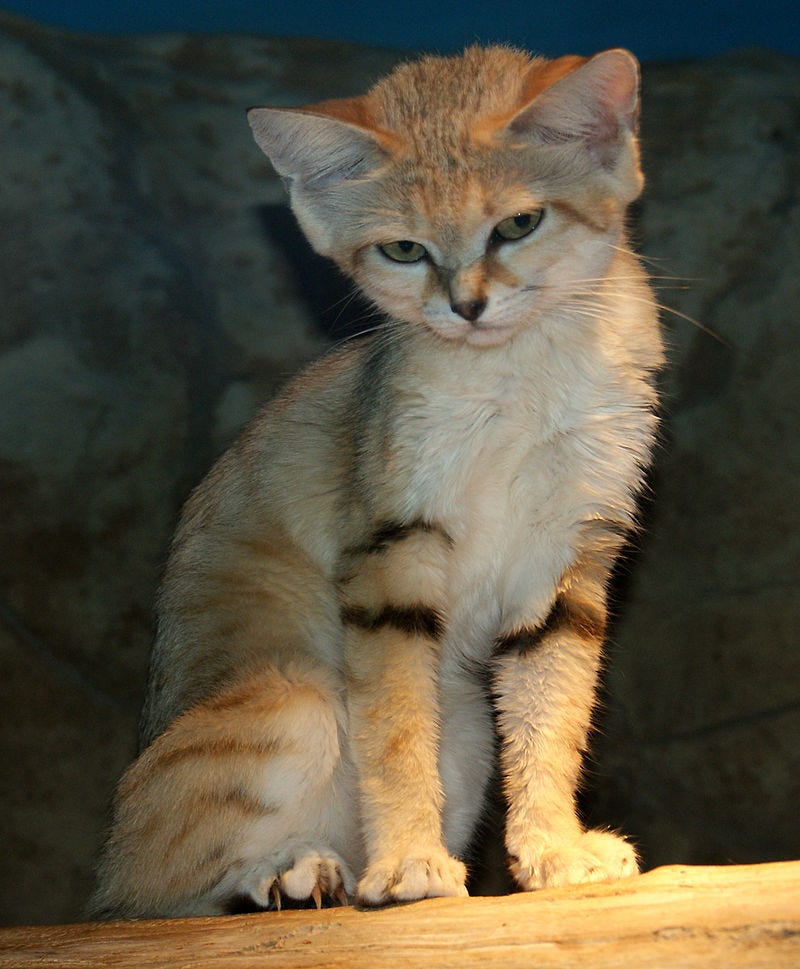
What about keeping a sand cat as a pet?
Sand cat Legality.
Exotic cats are illegal in most states except Nevada, North Carolina, Florida, & Texas. The conditions require class 3-pet permits. However, we see sand cats in some zoos.
Melissa Smith, the author of exotic animals for sale, explains that the pet trade intentionally produces hybrids between sand cats and domestic cats. But, sand cat hybrids are rare in the exotic cat trade & have little presence in captivity.
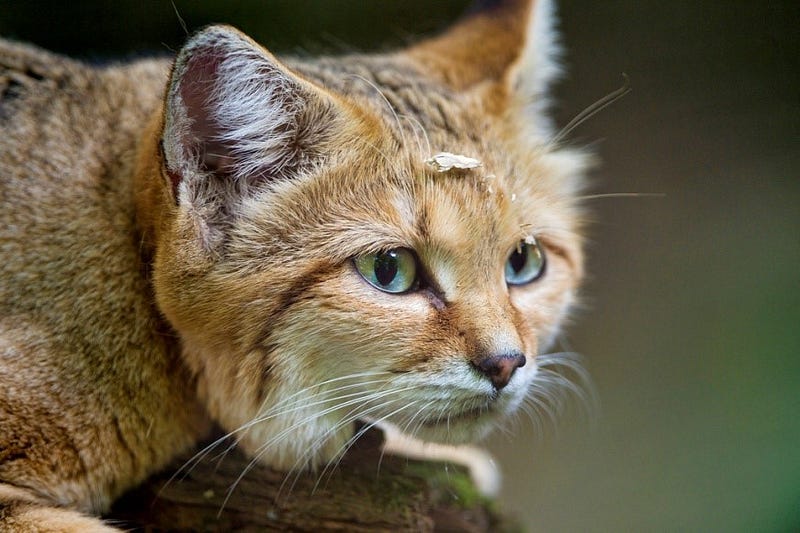
Few people have owned a hybrid. But then, there was an advertisement in 2018 that a hybrid kitty was on sale for $7000. The cat came from a breeding farm. The owner described the cat as ‘charming’ with a skittish and shy personality.
Challenges in Captivity.
Unlike domestic cats, sand cats are sensitive to humidity levels since they hail from deserts, where the air is dry.
Their moisture is from eating raw meats & insects.
Enclosure enrichment.
The cats require large spacious enclosures that offer an environment of sand & rocks to perform their species-specific behaviors. In addition, their habitat needs several places to hide to feel secure.
In human care, the sand cat lives for 13 years. There is no data on the kitty’s survival in the wild.
Conclusion:
Sand cats are expensive & not easy to find.
Research reveals that these animals need educated husbandry lest they die prematurely.
Zoo personnel & private owners with lots of experience are the best experts to care for captive sand cats by providing a stress-free environment.
I believe they are best living in the wild in their accustomed habitat.
(If you have time-the video is fascinating!)
Sand Cat: The King of the Desert
Source: https://simple.wikipedia.org/wiki/Sand_cat
Source: https://www.exoticanimalsforsale.net/articles/keeping-sand-cats-as-pets.asp
Thank you, readers, for your views.


