
Kindness and the Opposite in the Same Country
Sometimes, traveling can really suck
I love traveling. You probably do as well.
It’s a great way to dispel preconceptions and misconceptions about foreign places. Unfortunately, it is also sometimes inadvertently used to affirm stereotypes.
Some stereotypes are true. Stereotypes are sometimes true. They can be true in a certain place and at a certain time with a certain person or group of people. Or they are not.
That was a confusing paragraph. Purposely so. Just the way travel is a lot of the time. If you’re really extending yourself. Purposely or otherwise.
Whenever I’m inclined to say that a given location “is” something, some way or another, I have to remind myself that I’m wrong. I’m not talking about statistical information that generally stays consistent. Like GDP rankings or the number of hours of sunlight a place enjoys (or suffers) annually.
(Well, given economic upheaval and climate change, those two might not be the best examples.)
I’m talking about the way a place makes you feel about it. And this feeling should be complicated. No destination can or should be only overwhelmingly positive or negative. If you think so about any place you’ve been, then I’m afraid you probably weren’t paying enough attention.
Human beings respond well to kindness. And less well to the opposite, whatever that is, really.
Thus, the following is a list of unrelated incidents that occurred in the same country (to me).
Three rules:
- The incidents must involve people (I am of the mind that it is the people of a place that define how you, a visitor, ultimately feel about it).
- These people must not be travelers themselves (I am also of the mind that fellow travelers usually share an unspoken camaraderie and cannot take responsibility for the way you feel about the canvas of a destination — although they are very much responsible for the way you feel about the time you spent in a place, which is a different topic altogether despite all tempting connections).
- These people cannot be service professionals. They’re paid to be nice to you.
India
My tuk-tuk driver dropped me off at the train station in Mumbai, and a stranger came up to me, shouting that my train had already left. The manager at the hotel where I stayed in Jaipur had warned me about this scam.
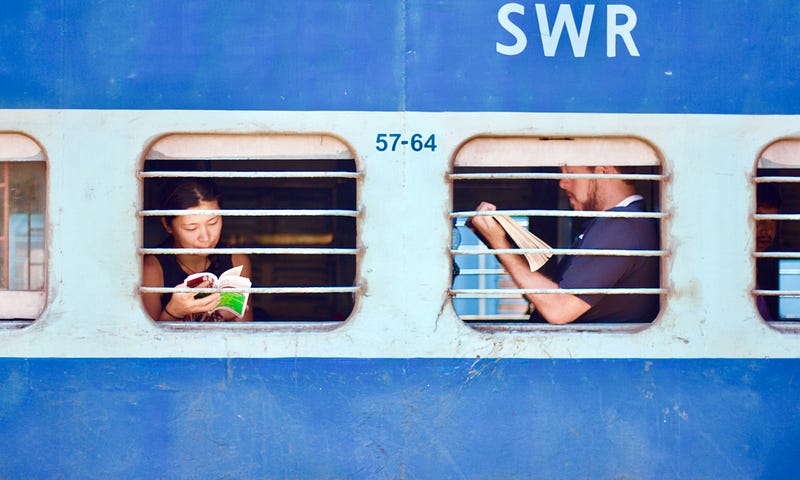
On my long, long train ride from Hospet to Varanasi, I got confused about my stop. The announcements were all in Hindi (presumably, or maybe one of the other 200+ languages that the subcontinent boasts). The girl sitting across helped me translate.
(Okay, I might’ve already broken the second rule, since she was technically also a traveler, though not a foreign one.)

Colombia
A guy at a soccer match in Medellin nearly punched me. Things had gotten a bit rowdy. There had been some pushing and some pushing back as goals were being scored (or not scored).
I’ll keep this one brief. I was at a bar in Bogota that mostly served craft beer based on American and European recipes. The locals were talkative.
Latvia
On New Year’s Eve, a local guy in Riga actually punched me (I hope you’re not seeing a theme here). The punch did land, but he was drunk, so it barely scraped me. I was more confused than angry. I did readily walk away, since he was part of a group, the rest of whom thankfully seemed as perplexed as I felt.
(To be accurate, looking back, I’m only assuming he was a local, if not from Riga then at least from Latvia.)
On New Year’s Day, someone (who I once again assumed was local) helped me find my way back to the hostel after I had taken a long and much needed walk following the festivities of the previous night.
So What?
Does this mean all Indians are scammers? Does this mean all Colombian guys and all Latvian guys like to punch strangers? Or maybe I have a punchable face? Does this mean I should expect help and friendliness wherever I travel? Are any of my personal stereotypes about the aforementioned places reinforced or dispelled due to these experiences?
Of course not.
This just means I don’t even know how to identify a local. And, more importantly, a place is defined by more than one incident.
Now, would you help me define the opposite of kindness?
Dash Ip initially thought there would be more examples included, but this article was getting long enough.


