
Kim’s Convenience: I Finally Watched the Last Episode
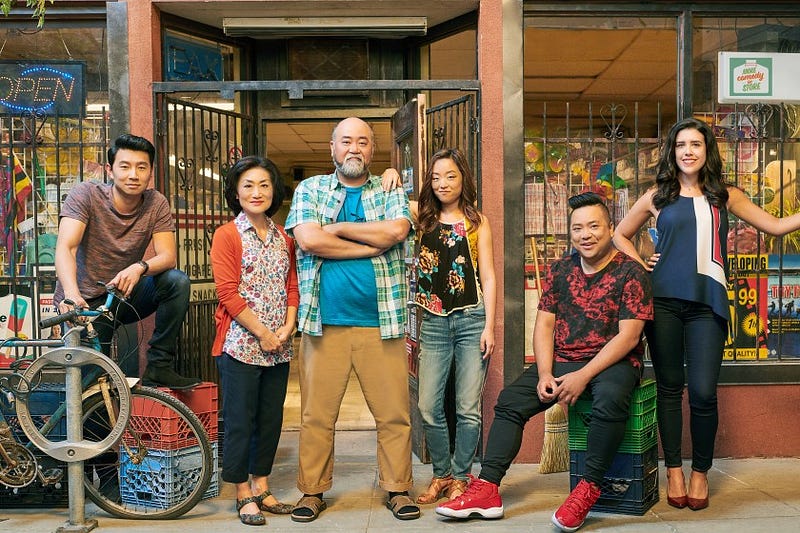
The old love story starts again and ends again.
Though my age was still in the single digits, I remember the anticipation building in my chest as the last episode of Family Ties grew near. The final episode of The Cosby Show and of Who’s the Boss? a few years after are also bookmarked in my memory.
The story goes the same each time in my case. I get a crush on the daughter in the show (Mallory, Denise, and Samantha), then I fall for the family as well. Not long after I start imagining Christmas dinners together, I have to say goodbye.
This time the crush was on Janet, played by Andrea Bang. Janet was the daughter of two convenience store owners and sister to a man who was no longer speaking to their father.
I watched all but the very last episode of Kim’s Convenience months ago. Then I stopped, leaving it in my queue.
Remembering a college lecture on emotional intelligence I once heard, and remembering my lifelong pursuit of maturity, I decided it was time. Janet and I must embrace the end of our relationship so that it can afterwards be cherished by both of us. I sat down with a soda and bag of chocolate-covered peanuts and turned on Netflix.
Have no fear of spoilers in this article. Anyway, the show is not one of those that relies upon such gimmicks and swindles as plot twists and surprise endings. The strength of Kim’s Convenience is in the characters and the family that loves each other, no matter how irritating or irritable they might be at times.
A worry I have is that this quiet, lovely show about a Canadian family will be swallowed up by the now public frustrations that were brewing behind the scenes, culminating in the shows cancellation just as it was finding a far broader audience outside of Canada on Netflix.
Jean Yoon, who played Mrs. Kim both in the original play and in the TV show, has been speaking out publicly about those frustrations. She is pictured in a new NBC article written by Claire Wang. Yoon is quoted here as saying, “You cannot do a show about a minority experience, have it run by a white person, and expect it to be OK”.
The article opens on an episode in which the family gets food poisoning and how the writers were not aware that kimchi could not give a person food poisoning because of its probiotic nature. They eventually changed the source of the food poisoning to galbijjim.
Wang writes that this story indicates “systematic issues” behind the scenes on the show. Based on what is presented about this story, it seems more indicative of writers who forgot what they learned about fermentation in sixth grade science rather than their being guilty of having a cultural blind spot.
Yoon also tweeted accusations of the show being “overtly racist” and “extremely culturally inaccurate”. As support for these claims, she references her character getting a diagnosis of multiple sclerosis in spite of Koreans rarely getting this disease.
Here again, I am wondering how many people living in South Korea, or any other country, could recite the comparative statistics on multiple sclerosis from one nationality to the next — an apparent pre-requisite for writing on a family sitcom without racial bias.
A claim of racist writers on a show is a big one, and one that needs to be addressed if true, but the support for such claims needs to be more robust than this.
Simu Liu, the actor whose character begins the show not speaking to his father before slowly returning to the family, will soon be on the big screen, starring in Marvel’s Shang-Chi and the Legend of the Ten Rings.
Liu was perhaps the first to be publicly vocal about how upset he was with the show’s cancellation. Liu posted his complaints on Facebook just as the final season was released on Netflix. He later told Vanity Fair that he was not “trying to call anyone out specifically”.
One issue Liu has mentioned repeatedly is a sense that his creative ideas on the development of his character were not considered by the writers. He has also referenced his deep connection with, and feelings for, the show. The abrupt and unexpected ending of something he cared so much about understandably triggered strong emotions.
Something Yoon and Liu seem to be in agreement about, is that this show about an Asian-Canadian family had too few writers and producers of Asian descent.
The hit TV show began as a play written by Ins Choi. The play starred Paul Sun-Hyung Lee, who went on to play Mr. Kim on the TV show. The extraordinarily skilled actor was most of the reason the show was a hit. If you want to think of the show in terms of a wall chart, put Paul Sun-Hyung Lee’s character in the middle and circle it. Then draw lines out to all the other characters.
Choi, the creator, apparently decided to end the show in spite of its building popularity. The other producers are continuing on with a spinoff starring Nicole Powers’ character. They are able to do this because Choi does not own the character, as she was added as a love interest for Liu’s character after the play became a TV show.
It is difficult for fans to square the complaints from behind the scenes with what is visible from the outside.
The show ended because co-creators Ins Choi and Kevin White departed and the producers decided they could not carry on in their absence. Perhaps the story will become less garbled for outsiders once Choi tells his side.
What seems to be apparent is that actors had disputes with writers, though this is often the case on shows as they become popular and the actors recognize that they have increased leverage. I wonder if the silent writers might argue that letting actors write the show is as absurd as letting writers step in to play the characters for a scene or two.
It can surely be justly argued that more communities need to be represented in writing rooms. The success of Kim’s Convenience may lead to improvements on this score. However, it would be a shame if the decision makers hesitate the next time a great idea for a minority-led sitcom reached their desk due to the social media storm following the end of Kim’s Convenience.
“When communities and people see themselves reflected up on the screen,” Paul Sun-Hyung Lee said in a tearful award acceptance speech, “it means they have been moved from the margins, into the forefront and it gives them a voice.”
My hope as a lowly fan of the show is that all of this vitriolic reaction fades from public memory, leaving everyone with the impressions that watching this wonderful show gave them.
So long to Janet and all my imaginary in-laws. I wish you all the best.